Growth
Marketplace metrics: the 12 KPIs to track every week
The 12 marketplace metrics that matter: net sales, order value, take rate, disputes, active sellers. Definitions, thresholds and a simple weekly dashboard.
Contents
Running a marketplace takes neither an analyst nor a forty-tab spreadsheet. Twelve numbers are enough to know whether it is growing, whether it pays you, whether it stays healthy and whether supply meets demand. This guide from the Marketplace Factory team, which creates complete marketplaces from a single sentence and delivers them with Pilote, their back office and its statistics, defines those twelve metrics, gives the thresholds that matter, suggests a weekly dashboard and shows where to read them. The definitions are the ones Pilote gives for each number: you can reuse them as they are.
Three rules before you count
- Net before gross. Revenue that rises thanks to orders that are later refunded earns you nothing. Think in net sales, and in what you actually keep.
- The same definitions, every week. A metric whose calculation changes along the way no longer tells you anything. Choose a definition, write it down, keep it.
- Beware of small numbers. On forty orders, a single dispute is 2.5%. At the start, look at the count as much as the rate, and at the trend over several weeks rather than a single point.
Volume: what goes through your marketplace
1. Gross sales and net sales
Gross sales, often called GMV (gross merchandise value), are the price of listings paid online multiplied by the quantity, excluding shipping and service fees, before discounts and refunds, counted on the day of the successful payment. Net sales take away discounts and refunds: they are the base of your commission. GMV tells you about activity; net sales tell you what is really earned.
2. Orders
The number of successful buyer payments. On a marketplace, one detail matters: a cart spanning three sellers counts as one order for the site, and as one sale for each of the three. Orders tell you how many times your marketplace kept its promise, whatever the amount.
3. Average order value
Gross sales minus discounts, divided by the number of orders. It decides how much your fixed fees weigh: at Stripe, each payment with a standard card from the European Economic Area costs 1.5% + €0.25 according to its price list, and a US domestic card 2.9% + 30¢ (Stripe US); that fixed part weighs far more on a €15 basket than on a €300 rental. If yours is small, our guide to the marketplace business model shows how to take it into account in your prices.
Your revenue: what comes back to you
4. Commissions and effective commission rate
Your commissions are those taken on successful payments, minus those returned on refunds. The effective rate, also called the take rate, divides them by net sales. It almost always differs from your displayed rate: free months for the first sellers, different rates by category, refunds. To place yours, Sharetribe, in its guide to marketplace pricing updated in June 2024, suggests 10% as a starting point and reports an average of 12.4% among its ten largest customers, between 5% and 30%.
5. Marketplace Factory fees
If your marketplace runs on Marketplace Factory, Pilote also calculates what you owe us: sales paid online, minus refunds and lost disputes, multiplied by your plan’s rate on the day of the sale, which is 2% on Launch, 1.5% on Pro and 1% on Dedicated. Nothing is due on requests or on what you collect offline. This number also helps you choose your plan: above €24,000 of online sales a month, Pro costs less than Launch. Full prices are on the pricing page.
6. Net revenue
Your commissions and your other revenue (seller subscriptions, boosts, listing fees, paid contacts), minus Marketplace Factory fees. Stripe’s fees are still to be deducted. Here is a sample month, for a rental marketplace that is starting out, on Launch, with a 12% commission, except for its founding sellers, who get it for free. Stripe fees are those of its price list for cards and of its Connect pricing when the platform sets its own prices, cautiously counting one payout per order. Amounts exclude VAT, and the volumes are assumptions, not results.
| Line | Amount |
|---|---|
| Gross sales, 120 orders | €10,200 |
| Refunds | −€200 |
| Net sales | €10,000 |
| Your commissions: 12%, except on €1,000 of sales by founding sellers | €1,080 |
| Effective commission rate | 10.8% |
| Marketplace Factory fees (2% on Launch) | −€200 |
| Your net revenue | €880 |
| Stripe card fees (standard EEA cards: 1.5% + €0.25 per payment) | −€183 |
| Stripe Connect: €2 for each of the 15 sellers paid in the month, then 0.25% + €0.10 per payout | −€64.30 |
| Launch subscription | −€79 |
| Left before your other costs | €553.70 |
This table shows why the displayed rate is not enough: 12% commission on €10,000 does not leave €1,200. It also shows where to act. The commission given to founding sellers cost €120 that month: a good investment, as long as it has an end date.
Health: the warning signs
7. Dispute rate
Disputes are payments contested by a buyer with their bank; the rate divides them by orders. It is the metric that can threaten your access to online payments. Stripe writes in its documentation on measuring disputes that “the credit card processing industry standard recognizes dispute activity above 0.75% as excessive”, and that a sudden spike or a steep upward trend can trigger placement in a monitoring programme before that threshold. All disputes count, won or lost, and cardholders can dispute a charge up to 120 days after the payment, sometimes even later. Each dispute also costs a €20 fee from a euro-area account, plus €20 more if you respond to it manually, refunded if you win; in the US, the two fees are $15 each.
Pilote shows an alert from 0.5%, to give you time to act. The remedies are well known: accurate listings, faithful photos, a quick answer before the buyer calls their bank, a refund when it is due. At Marketplace Factory, for a rental, a stay or a service, a customer who reports a problem before the seller is paid sees the money held until your team decides: they have a simpler route than a bank dispute.
8. Failed payment rate
Attempted payments that failed, divided by attempted payments, with the reason given by Stripe: card declined, insufficient funds, authentication abandoned. A sudden rise, or the same reason coming back, signals a problem to fix before it costs sales.
9. Payout delay
The median time between the buyer’s payment and the payout to the seller. Your sellers care about it more than about any other number. On a marketplace created with Marketplace Factory, a purchase is paid out to the seller at payment, a rental or a stay after it starts, an appointment or a session after it ends, and you set when sellers get paid in your back office. Our guide to marketplace payments with Stripe Connect details how the money travels.
The market: does supply meet demand?
10. Active sellers
Pilote distinguishes two kinds: active sellers, with at least one listing online, and selling sellers, with at least one transaction or accepted request over the period. The gap between the two tells you how many sellers are still waiting for their first customer. Also watch concentration, the share of net sales made by the top 10% of sellers: above 60%, the marketplace depends on very few people. To recruit new ones, read our guide to the marketplace chicken and egg problem.
11. Requests received and acceptance rate
Requests received, those your customers confirmed and sent to sellers, tell you whether supply finds takers; set against the number of listings online, they can be compared from month to month and from category to category. The acceptance rate divides requests accepted by those accepted, declined or expired. Two additions: the response rate within 24 hours and the time to first response. A buyer who waits two days has had plenty of time to book elsewhere.
12. Occupancy rate
For a rental, stays or appointments marketplace: the days, nights or slots booked, divided by those open in the calendar. It is only valid if calendars are kept up to date: a seller who forgets to close their dates distorts everything. For classes or sessions with a set number of places, its equivalent is the fill rate, seats taken divided by seats open.
The weekly dashboard
Keep a fixed appointment, twenty minutes every Monday, with these twelve lines. For each, one question and one signal to watch: benchmarks to adapt to your marketplace, except for the dispute threshold, which is set by the card industry.
| Metric | The question | The signal to watch |
|---|---|---|
| Net sales | Is my marketplace growing? | three weeks of decline in a row |
| Orders | How many sales went through? | orders falling while your listings online rise |
| Average order value | Do my fixed fees weigh too much? | a shrinking basket, fees weighing more |
| Effective rate | Is my commission holding? | a growing gap with your displayed rate |
| Marketplace Factory fees | Am I on the right plan? | above €24,000 of online sales a month: Pro costs less |
| Net revenue | What is left for me? | net revenue that no longer covers your fixed costs |
| Dispute rate | Are my buyers disputing? | 0.5%: Pilote’s alert; 0.75%: the level Stripe says the industry treats as excessive |
| Failed payments | Do payments go through? | a sudden rise, the same reason coming back |
| Payout delay | Are my sellers paid quickly? | a delay that gets longer |
| Active sellers | Is supply growing? | more than 60% of sales made by 10% of sellers |
| Requests received | Does supply find takers? | listings with no request for 30 days, answers beyond 24 hours |
| Occupancy rate | Are calendars filling up? | calendars that are no longer kept up to date |
One week, one move: the most worrying number decides your main action. A rising dispute rate comes before everything else; listings with no requests call for buyers, not sellers, and our guide to marketplace SEO shows how to bring them through Google; customers who cannot find what they look for call for the opposite.
What Pilote, Marketplace Factory’s back office, shows
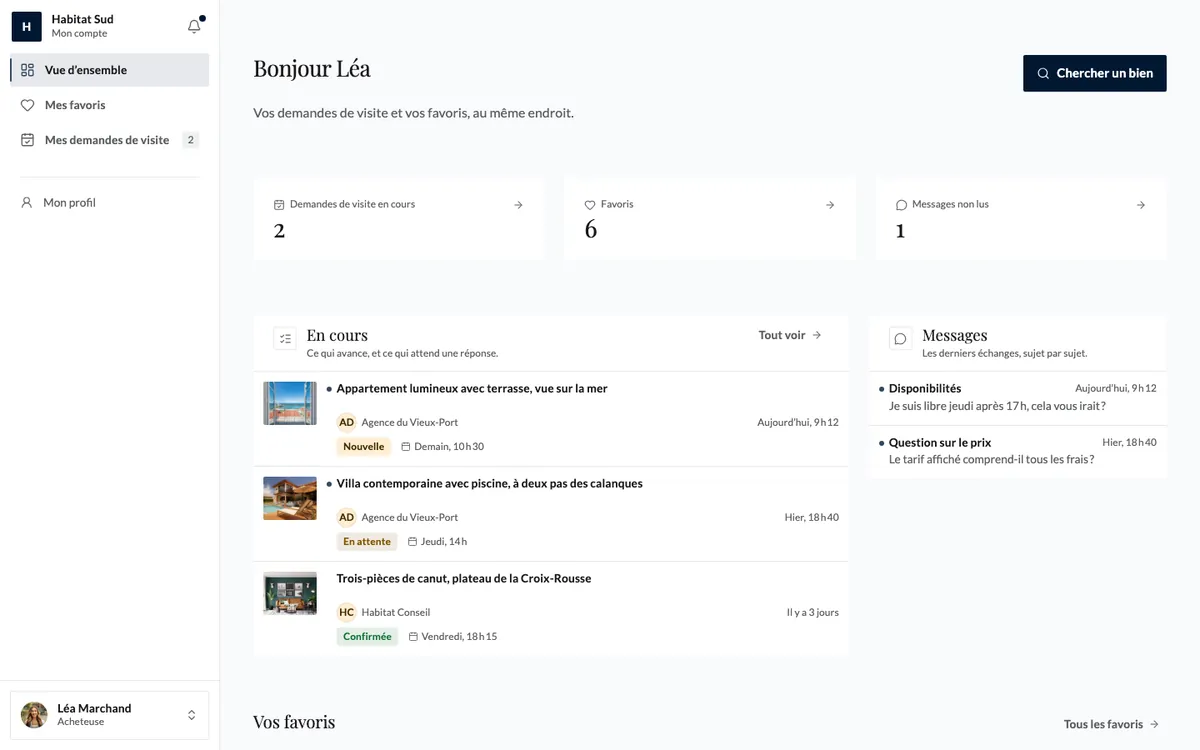
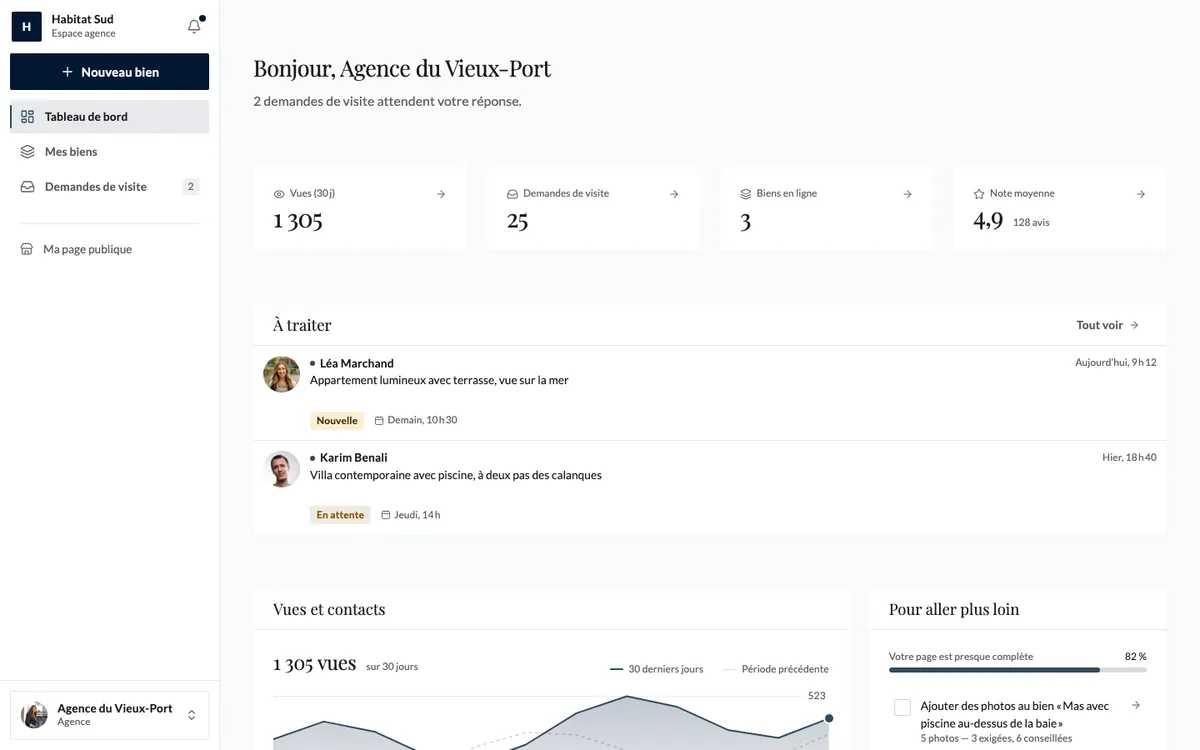
Pilote is switched on for every marketplace created with Marketplace Factory, and its statistics fit into seven tabs: Overview, Live, Sales, Audience, Marketplace, Customers and Reports. Every number has its “How it’s counted” help, giving its written definition: the one used in this guide.
- Overview starts with a few plain-language findings, such as “3 requests have been waiting for a reply for more than 48 hours”, then shows where the money goes: your commissions, minus Marketplace Factory fees, equal your net revenue.
- Sales lines up gross and net sales, refunds, orders, average order value, your commissions, the effective rate, our fees and your net revenue, with disputes and their alert at 0.5%.
- Marketplace measures how supply meets demand: three indices out of 100, supply, demand and match, then the response within 24 hours, acceptance and the concentration of sales.
- Customers follows your buyers: new ones, returning ones, and what they spend.
Before your first sales, Pilote can show sample data from the same trade, clearly marked as such, so you learn to read every screen; one click, and you are back to your own numbers. To see what the rest of a ready-to-open marketplace includes, our turnkey marketplace checklist goes through it point by point.
In short
You do not need a data team to run a marketplace: twelve numbers, twenty minutes a week, and one action at a time. With Marketplace Factory, those numbers are calculated for you, defined in black and white and placed where you need them, from day one. You can launch: the numbers will tell you where to go.
Frequently asked questions
What is a marketplace’s GMV?
GMV, for gross merchandise value, is the total amount of sales made through your marketplace, before discounts, refunds and commissions. It measures activity, not your revenue: that depends on your effective commission rate and your fees. In Pilote, Marketplace Factory’s back office, it is called gross sales, next to net sales, the base of your commission.
What dispute rate becomes dangerous?
Stripe says the card processing industry treats dispute activity above 0.75% as excessive, and that a sudden spike can trigger a monitoring programme before that threshold. All disputes count, won or lost, and each one costs a €20 fee at Stripe in the euro area ($15 in the US). Pilote, Marketplace Factory’s back office, alerts you from 0.5%, so you can act before the threshold.
How many active sellers do I need?
There is no universal number. The right benchmark is local: in your city and your trade, a visitor should find several credible offers for most of their searches. Also watch concentration: if the top 10% of sellers make more than 60% of net sales, your marketplace depends on very few people. Pilote, at Marketplace Factory, counts your active sellers and calculates that concentration.
Which numbers should I track every week?
Eight are enough to start: net sales, orders, average order value, net revenue, dispute rate, active sellers, requests received and response rate within 24 hours. Look at them on the same day, over the same period, compared with the previous week. In Pilote, Marketplace Factory’s back office, every number shows its definition and its change from the previous period.
Sources5
The pages cited in this article, checked on the date given in the text.
These articles are written by the Marketplace Factory team, who build the studio and the marketplaces it generates. How we write