Guides
How to build a marketplace in 2026: a step-by-step guide
How to build a marketplace in 2026, in the right order: niche, booking flow, business model, tools, payments, legal basics and first sellers, with real costs.

Contents
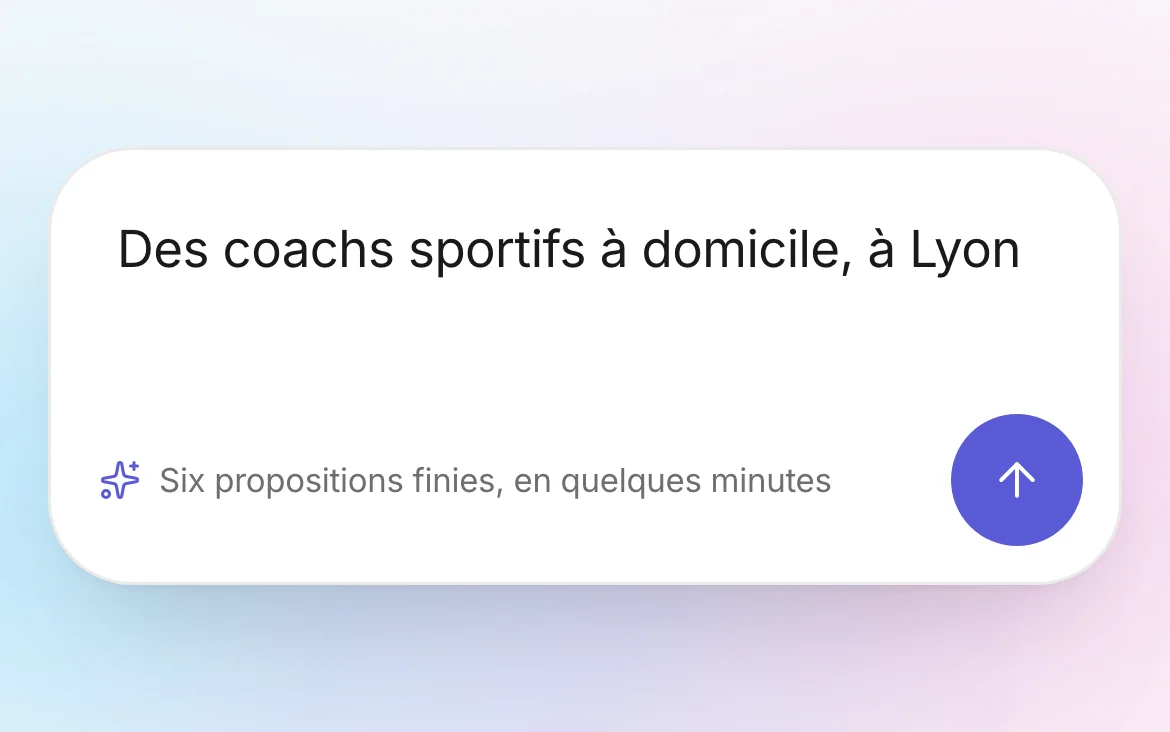
Knowing how to build a marketplace in 2026 no longer starts with a forty-page specification. With Marketplace Factory, one sentence is enough to see complete marketplaces for your trade within minutes. What takes time is the decisions: which market, which booking flow, which business model, how to take payments, which rules apply, where to find the first sellers. This guide takes them in the order you will face them, with the cost and timing of each, and a link to the article that goes deeper.
Who is writing? The team behind Marketplace Factory, which creates complete marketplaces from a single sentence. Prices, ours and everyone else’s, are read on official pages and dated.
What a marketplace is, and what it is not
Three models look alike from the outside and have nothing in common behind the scenes.
| Online store | Directory | Marketplace | |
|---|---|---|---|
| Who sells | you | the listed businesses, elsewhere | sellers, on your site |
| Who publishes the offer | you | you, or the members | the sellers themselves |
| Where the deal happens | on your site | off your site | on your site: request, booking or payment |
| How you earn | your margin | subscriptions, advertising | commission, subscriptions, featured listings |
A marketplace brings two audiences together, and each needs its own space. In practice, you need four:
- the public site: search, filters, map, listing pages, seller profiles;
- the buyer account: requests and their status, favourites, messages;
- the seller space: listings, requests to handle, a public page, statistics;
- the back office: where you review listings, follow activity and configure the platform.
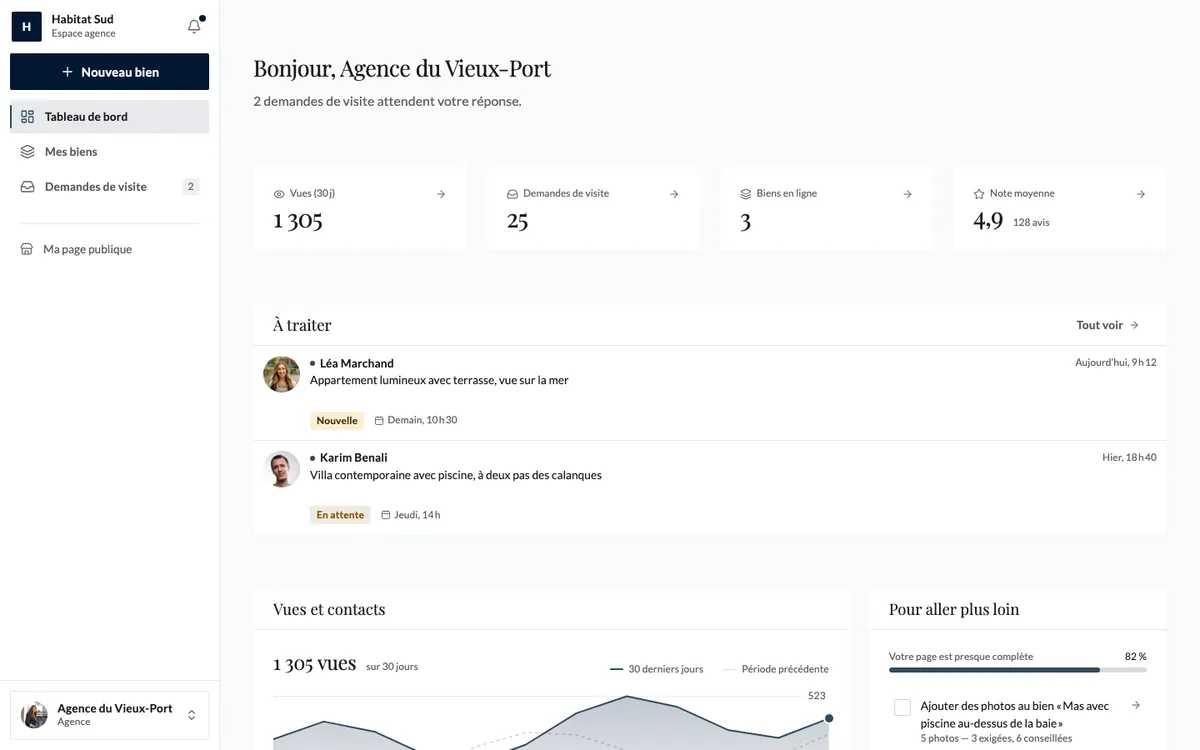
“Habitat Sud”, a French demo property marketplace created with Marketplace Factory, shows all four on the Marketplace Factory home page: a site to search for homes, a space for buyers, one for agencies, one for the administrator. If a tool only gives you the first, the other three are still to be built.
1. Pick a narrow market
Many marketplaces that succeeded started small: one trade, one city, one audience. Not out of modesty: a visitor who finds three offers 100 miles away leaves; the same visitor who finds twelve in their neighbourhood comes back.
Three sentences from our gallery show the right starting size (the demos are French, so are the cities):
- “Private cars to rent near you, in Bordeaux”;
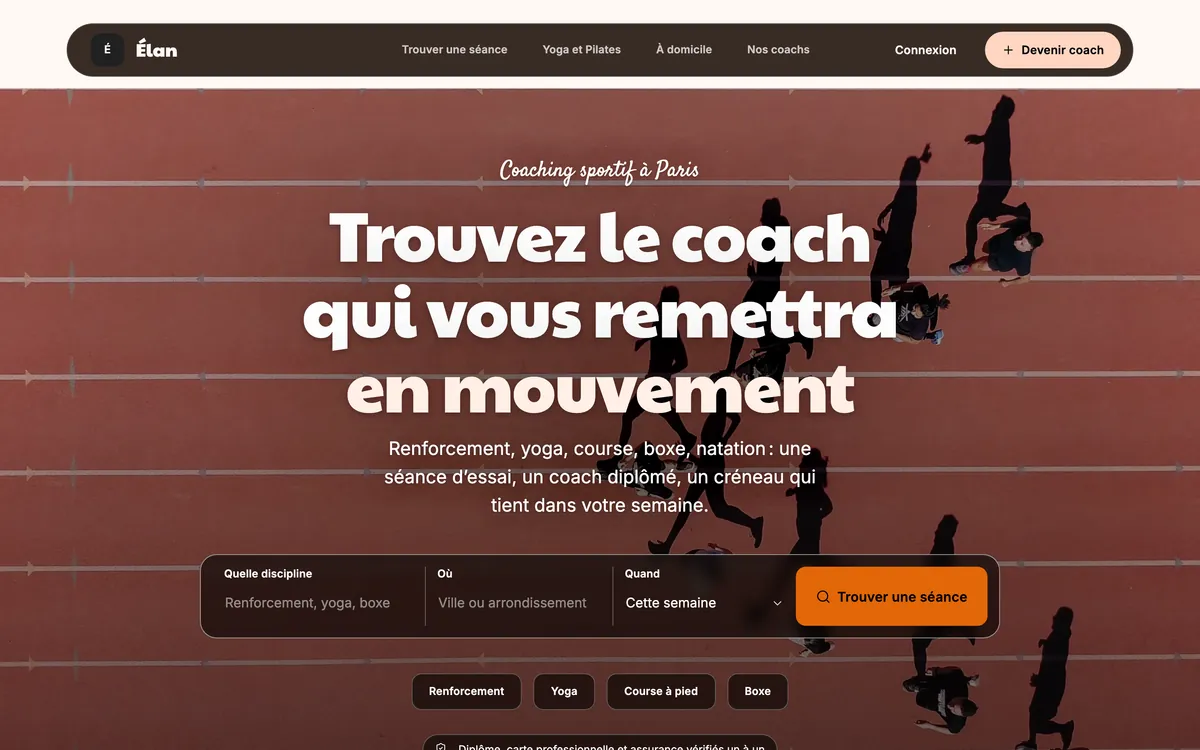
- “Home care and wellbeing practitioners who come to you, in Lyon”;
- “Classified ads between neighbours, in Nantes”.
Each one says who sells, what, and where. The same logic works anywhere: dog walkers in Manchester, surfboards in San Diego. A simple test before going further: can you write down, in one evening, fifty possible sellers with their names and a way to reach them? If so, your market is precise enough to win. If not, narrow it.
2. Choose the flow: request, booking, rental, application or order
The flow is what happens between “I found it” and “it’s done”. It decides the screens, the emails and the moment money moves. Five flows cover most trades:
| Flow | What the customer does | Typical trades | What you need on top |
|---|---|---|---|
| Request | writes a message; the seller replies or sends a quote | consultants, craftspeople, caterers | messaging, quotes |
| Booking | picks a time slot | lessons, treatments, personal trainers | calendar, availability |
| Rental | picks dates | cars, boats, equipment | calendar, deposit, check-in and check-out |
| Application | applies | odd jobs, gigs | application tracking |
| Order | fills a basket | makers, refurbished goods | stock, shipping, returns |
One piece of advice: even if your trade calls for online payment, nothing forces you to switch it on from day one. A request confirmed by the seller is enough to prove there is a market; step 5 explains how to start that way.
3. Choose the business model
Four ways of making money come up everywhere: a commission on each transaction, a subscription paid by sellers, paid featured listings, and service fees paid by the buyer. The right choice depends on three things: basket size, how often people buy, and the risk that buyer and seller deal directly after the first match.
- Large basket, one-off purchase, online payment (a day on a boat, a stay): commission is the natural fit.
- Recurring relationship that is easy to take offline (cleaning, tutoring): a seller subscription holds up better.
- Many similar listings (property, classifieds): featured listings.
For an order of magnitude, Sharetribe’s article on the cost of starting a marketplace (updated 18 September 2026) runs this sum: to make $1,500 a month with a 13.4% commission on a $70 average order, you need about 160 transactions a month. Our article on the marketplace business model goes into detail, with break-even calculations.
4. Choose how to build it
Five ways of building share the field. Prices below were read on official pages on 27 September 2026, excluding VAT unless stated; at the ECB reference rate of 25 September (€1 = $1.1403), $1 is worth about €0.88.
| Approach | To start | Each month | Time to first visitor | What is left to do |
|---|---|---|---|---|
| Custom development | above $50,000 according to Sharetribe | hosting, maintenance | several months | everything, then maintaining it |
| Subscription marketplace software | free trial | €99 (Kreezalid), $99 billed yearly (Sharetribe) | days to weeks | setup, content, recruiting |
| WordPress and a plugin | licence from $149 a year (Dokan) | hosting, extra | a few weeks | installing, assembling, updating |
| No-code and AI app builders | free to try | $59 billed yearly (Bubble Starter, web and mobile), a credit-based subscription (Lovable) | varies | seller accounts, split payments, moderation |
| Marketplace Factory | free studio, no account needed | €79 excl. VAT + 2% of sales paid online, online payments included | finished proposals within minutes, live within days | your content and your first sellers |
The real difference sits in the last column: what is left for you to build. An AI app builder quickly produces a beautiful home page; but Lovable’s documentation states that only one built-in payment provider can be active per project, selling as a single merchant. Splitting a payment between several sellers, verifying their identity and paying them out remains your job.
At Marketplace Factory, the marketplace is already there, whole. The subscription includes: finished proposals from one sentence, within minutes; the complete marketplace for your trade (public site, buyer space, seller space, back office) with its real booking flow; online payments split between your sellers from the Launch plan; no code at all; and a team that answers your questions.
Our share only applies to sales paid online, refunds deducted and shipping excluded: while you sell little, you pay little, and nothing on requests or on what is settled offline. Here is what Marketplace Factory costs for one month, excluding VAT and Stripe fees:
| Online sales per month | Launch (€79 + 2%) | Pro (€199 + 1.5%) | Dedicated (from €990 + 1%) |
|---|---|---|---|
| €1,000 | €99 | €214 | from €1,000 |
| €5,000 | €179 | €274 | from €1,040 |
| €10,000 | €279 | €349 | from €1,090 |
Above about €24,000 of online sales a month, Pro costs less than Launch; the pricing page runs the sum for your volume. During the beta, you try everything without paying a thing: payments run in test mode.
Three articles go further: what a marketplace really costs, no-code marketplace builders and AI and our comparison of Sharetribe alternatives.
5. Plan payments (or start without them)
On a marketplace you collect money that is not yours: the seller’s share passes through the platform. That is a regulated activity, and the sensible route for a young platform is a licensed payment provider that does the job for you. Stripe Connect is one of them: each seller opens an account linked to yours, Stripe verifies their identity, then the buyer’s payment is split between your commission and the seller’s share, which is paid out to them.
What it costs depends on where your platform’s Stripe account is based. On Stripe’s pages, read on 27 September 2026:
| Card payment | Connect, when the platform sets prices | |
|---|---|---|
| Euro area (cards, Connect) | 1.5% + €0.25 for a standard EEA card | €2 per active account per month, 0.25% + €0.10 per payout |
| United States (cards, Connect) | 2.9% + 30¢ for a domestic card | $2 per active account per month, 0.25% + 25¢ per payout |
An account counts as active in any month it receives a payout. An example: a €120 rental with a 15% commission. The owner receives €102. You keep €18, on which Stripe charges €2.05 for the card (1.5% of €120, plus €0.25) and €0.36 for the payout (0.25% of €102, plus €0.10): about €15.60 is left, before €2 a month per active owner. The same rental at $120 from a US account leaves about $13.70, because US card fees are higher. With us, the Launch plan adds 2% of the amount paid, €2.40 (or $2.40): about €13.20 (or $11.30) is left. Who bears which fee is something your terms must say.
Not ready to collect money? Open in request mode: the customer asks, the seller confirms, payment happens offline. No identity checks to organise, no payment fees. Our Launch plan allows both. Everything is explained in our article on marketplace payments with Stripe Connect.
6. The legal basics on day one
Opening a marketplace makes you a platform operator, with duties that start the day you go live. In the European Union, the first five are:
- Say who is selling and how offers are ranked. Since the 2019 consumer “Omnibus” directive (Directive (EU) 2019/2161), an online marketplace must tell consumers, before they are bound, the main parameters that determine ranking and whether the third party offering the product is a trader or not.
- Apply the DSA. The Digital Services Act (Regulation (EU) 2022/2065) has applied to all platforms since 17 February 2024. For everyone: a point of contact, clear terms, a way to report illegal content, and a statement of reasons when you remove a listing (Articles 11, 12, 14, 16 and 17). Micro and small enterprises, meaning fewer than 50 staff and no more than €10 million in turnover or balance sheet, are exempt from the extra platform duties, including internal complaint handling and trader traceability (Articles 19 and 29).
- Report sellers' income (DAC7). Every year, by 31 January, the operator reports to the tax authority what its sellers earned the year before: sales of goods, personal services, rental of any mode of transport and rental of property. Sellers of goods with fewer than 30 sales and no more than €2,000 are excluded (Directive (EU) 2021/514).
- Protect personal data. For your users' data you are the controller under the GDPR: privacy notice, cookie consent, contracts with your providers.
- Offer one-click withdrawal. When traders sell at a distance to consumers, Directive (EU) 2023/2673 has required since 19 June 2026 a withdrawal function labelled “withdraw from contract here” or an unambiguous equivalent, available throughout the withdrawal period. On a marketplace, sellers go through your interface, so that is where the function belongs.
Outside the EU, the logic is similar and the texts differ. In the UK, platforms report sellers' income to HMRC by 31 January, with the same exclusion for sellers of goods with fewer than 30 sales and €2,000 (about £1,700) (HMRC guidance). In the US, marketplaces selling new products must collect and verify details of high-volume sellers under the INFORM Consumers Act, and payment platforms issue Form 1099-K when a seller exceeds $20,000 in more than 200 transactions (IRS).
The split of roles with your tool matters too. Our terms of sale set it out: you are the publisher and operator of your marketplace; we provide the software, never hold funds on your behalf, and our service fee on online sales is billed to you separately, never taken from your buyers’ payments. The full list, with the texts, is in our guide to marketplace legal requirements in the EU.
7. First sellers, then first buyers
This is the famous chicken-and-egg problem: no buyers without supply, no supply without buyers. In most cases, start with supply, because sellers can be convinced one by one, while buyers only come when there is already something to choose from.
- Take the list of fifty sellers from step 1 and call them one by one.
- Create the first listings with them, on the phone or in person: ten complete listings with good photos beat a hundred empty ones.
- Offer a founding-member status: your commission waived while you prove the concept, a visible spot on the home page.
- Bring the first request yourself: your network, a local group, a neighbourhood association.
- Never invent listings to look busy: a visitor who finds a fake offer does not come back, and neither do your real sellers.
Methods, metrics and a 90-day plan are in our article on the marketplace chicken and egg problem.
8. Go live, measure, fix
Once live, track five numbers weekly; a spreadsheet will do.
| Number | The question it asks |
|---|---|
| Active listings, per seller | does the supply really exist? |
| Requests per listing per week | do buyers find what they are looking for? |
| Seller response rate and time | does the site keep its promise? |
| Share of requests confirmed | does the match turn into a deal? |
| Returning customers | does the market work without you? |
When a number stalls, fix what people see first: the home page headline, the categories, the photos, the listing copy.
A realistic timeline, from idea to first sales
The pace we recommend for a local marketplace:
| Weeks | What you do | What it costs |
|---|---|---|
| 1 | write your sentence, compare proposals, pick a name; list fifty sellers | €0 |
| 2 and 3 | meet sellers, create ten to twenty listings with them; write terms of use, legal notice and privacy notice | your time, a lawyer if needed |
| 4 | go live, in request mode or with online payments | Marketplace Factory Launch plan: €79 a month excluding VAT, plus 2% of sales paid online |
| 5 to 8 | bring the first requests, measure every week, fix | some local promotion |
| 9 to 12 | if confirmed requests are there: online payment and your commission; your own domain once the brand takes hold | Stripe fees; €199 a month excluding VAT plus 1.5% with us (Pro plan), for the domain |
By industry
Each family of trades has its traps. We give each one its own article:
- Peer-to-peer rentals (cars, boats, equipment): calendar, deposit and insurance, in how to build a rental marketplace.
- Services and lessons: profiles, time slots, quotes and disintermediation, in how to build a service marketplace.
- Makers and craftspeople: shops, baskets, shipping and returns, in how to start a handmade marketplace.
- Property and flatshares: map, alerts, agencies and private owners, in how to build a real estate listing website.
To see what each of these marketplaces looks like once created, the examples gallery shows eighteen of them, from boats to concierge services. Marketplace Factory understands your sentence in English, and more languages are coming soon.
With Marketplace Factory, the four spaces, your trade’s booking flow and online payments are there within minutes: your time goes to what makes a marketplace live, its sellers and its customers.
Frequently asked questions
How long does it take to build a marketplace?
With Marketplace Factory, the first complete versions of your marketplace arrive within minutes and the site can open within days; software you configure yourself takes days to weeks, custom development takes months. Technology is rarely the slow part: gathering an offer people want is. Allow four to twelve weeks between the idea and the first real requests, most of it spent meeting sellers.
Do I need a company to launch a marketplace?
Not to try an idea: at Marketplace Factory, your first idea is free, with no account and no card. To open to the public and earn money, you need a registered business, because you become a platform operator with information, tax-reporting and data-protection duties. Whether a sole trader or a company suits you best depends on partners, liability and ambitions: an accountant can help you decide.
Can I launch a marketplace without online payments?
Yes, and it is often the right start. In request mode, the customer sends a request, the seller confirms it, and payment happens in person or by bank transfer. You prove there is demand without payment fees or seller identity checks to organise. You then earn from seller subscriptions or featured listings, and add a commission once online payment is switched on.
What is the difference between a marketplace and an online store?
In an online store you sell your own products. On a marketplace, other sellers publish their offers and deal with customers; you organise the match and earn a commission, a subscription or fees for visibility. That means seller accounts, moderation, often split payments, and the duties of a platform operator, such as showing who is selling and handling reports of illegal content.
What is the minimum cost of a marketplace?
Prices as read in September 2026: a ready-made online marketplace starts at roughly €80 to €100 a month: €79 excluding VAT at Marketplace Factory, online payments included, plus 2% of sales paid online; €99 at Kreezalid (table on its pricing page); or $99 a month billed yearly at Sharetribe. Add payment fees if you take money online. Custom development usually starts above $50,000.
Sources18
The pages cited in this article, checked on the date given in the text.
- sharetribe.com/academy/how-much-does-it-cost-to-start-a-marketplace-business
- sharetribe.com/pricing
- kreezalid.com/pricing
- dokan.co/wordpress/pricing
- bubble.io/pricing
- lovable.dev/pricing
- docs.lovable.dev/features/payments
- stripe.com/ie/pricing
- stripe.com/ie/connect/pricing
- stripe.com/pricing
- stripe.com/connect/pricing
- eur-lex.europa.eu/legal-content/EN/TXT/?uri=CELEX:32022R2065
- eur-lex.europa.eu/legal-content/EN/TXT/?uri=CELEX:32021L0514
- eur-lex.europa.eu/legal-content/EN/TXT/?uri=CELEX:32019L2161
- eur-lex.europa.eu/legal-content/EN/TXT/?uri=CELEX:32023L2673
- gov.uk/guidance/reporting-rules-for-digital-platforms
- ftc.gov/business-guidance/resources/informing-businesses-about-inform-consumers-act
- irs.gov/businesses/understanding-your-form-1099-k
These articles are written by the Marketplace Factory team, who build the studio and the marketplaces it generates. How we write