Tools
Turnkey marketplace: what it must include on launch day
Turnkey marketplace: the ten points to check before you open, what turnkey offers really include and cost, and how to get yours, complete, in a few minutes.

Contents
A turnkey marketplace promises a launch without the construction work: you turn the key, sellers post their listings, customers book or buy. Yet very different things are sold under the same word, from an agency project that runs for months to software you still have to configure yourself. Marketplace Factory creates the complete marketplace for your trade from a single sentence: six finished proposals arrive in about a minute, each with its four spaces, its booking or buying flow and online payments.
This article gives the ten-point checklist a turnkey marketplace must tick on the day you open, compares what the word covers from one vendor to the next, and says what is still yours to do, whatever you choose. Prices, ours and everyone else’s, were read on official pages on 10 October 2026.
What “turnkey” should mean
A simple definition: a turnkey marketplace is one you open yourself, without a developer. On launch day, your sellers publish, your customers search, ask, book or pay, and you follow everything from a back office. If opening requires a specification, a developer or a project manager, it is no longer a key: it is a construction project, sometimes very well run, but a construction project all the same.
You will also meet the words “white-label” and “ready-made”. White-label says whose name is on the site; turnkey says how much work is left before it opens. The checklist below is what tells them apart.
What the word often covers elsewhere
Three kinds of offers share the expression.
- The turnkey project, run by an agency or an enterprise vendor: scoping, design, development, launch. It is the most flexible route and the slowest. Sharetribe puts the cost of building a marketplace from scratch at “typically north of $50,000” in its guide to marketplace costs (updated 18 September 2026), and Marketplacer, which sells an enterprise platform, recalls in an article of 24 May 2025 that “teams spent 12 to 18 months planning and coding to get to an MVP”.
- Marketplace software to configure: a generic marketplace that works, for you to set up. At Sharetribe, the Build plan, at $39 a month, is for building and testing; going live takes the Live plan, at $199 a month billed yearly or $259 billed monthly, with usage beyond the included allowance billed separately. At Kreezalid, Build, at €39 a month, is a private test environment; the marketplace opens to the public with Launch, at €129 a month, for up to 100 sellers, 2,000 listings and 250 transactions a month.
- The template: a theme or a plugin to install, connect and host. The design is there; the rest, from seller accounts to split payments, has to be assembled. On Bubble’s marketplace, a template with an individual licence is free or sold for up to $500; the WordPress plugin Dokan starts at $149 a year for one site, hosting not included.
| Offer | What you buy | Price read on 10 October 2026 | Before you open |
|---|---|---|---|
| Turnkey project | a project: scoping, design, development | on quote; typically north of $50,000 from scratch, according to Sharetribe | a specification and months of work |
| Software to configure | a generic marketplace | €129 a month (Kreezalid Launch); $199 a month billed yearly (Sharetribe Live) | configure, write, brand |
| Template or plugin | a design, features to assemble | free to $500 (Bubble template); $149 a year (Dokan), hosting extra | accounts, payments, moderation, emails |
| Marketplace Factory | the complete marketplace for your trade, created from one sentence | €79 excl. VAT a month + 2% of sales paid online (Launch) | your content, your sellers, your Stripe account |
For the full budget of each route, hidden costs included, see the cost to build a marketplace.
Turnkey marketplace: the ten-point checklist
Before you sign, ask for a complete demo and check these ten points, one by one. For each: what to ask, and what Marketplace Factory does.
1. The four spaces
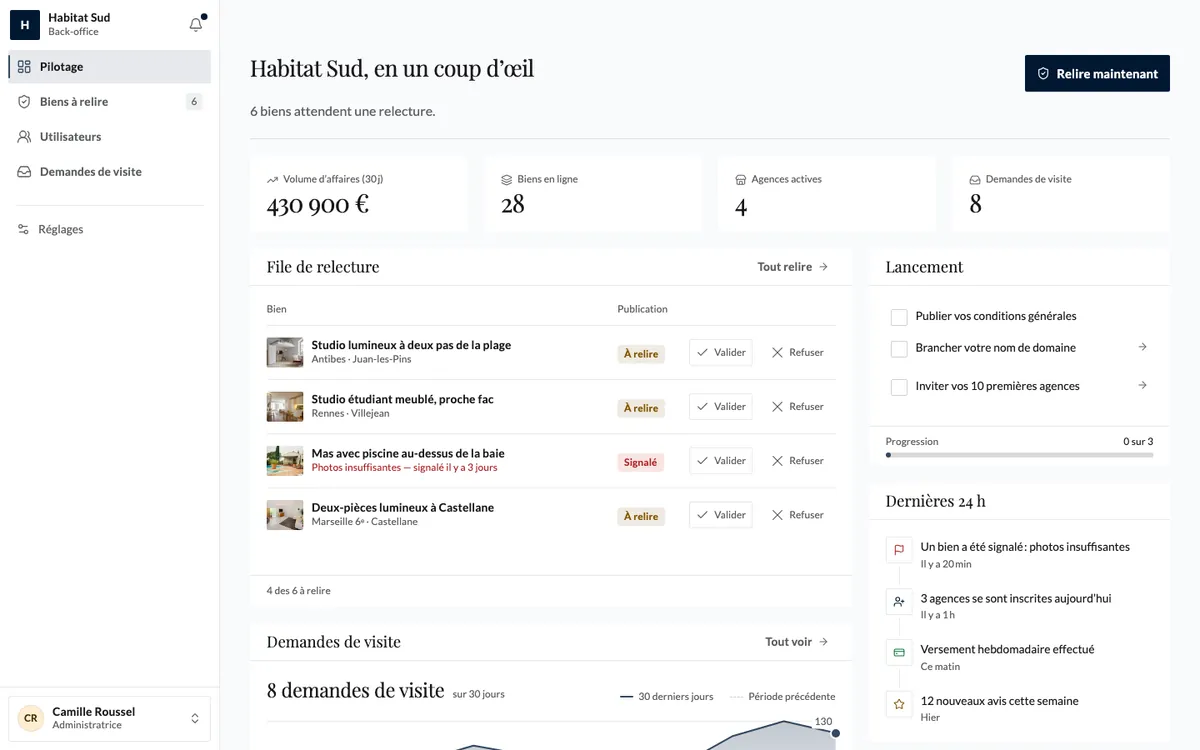
A marketplace is not a home page. It needs four spaces: the public site (search, filters, map, listing pages, a page for each seller), the customer area (requests and their status, favourites, messages), the seller area (listings, requests to handle, statistics) and the back office, where you review listings and run the platform.
Ask: can I open the seller area of the demo and post a listing?
At Marketplace Factory: every proposal arrives with its four spaces, connected, and you try them before paying anything.
2. Your trade’s flow
Between “I found it” and “it’s done”, every trade has its own flow: a quote for a craftsperson, a time slot for a coach, dates for a rental, a cart for a shop, an application for a job. Generic software offers a few of them; the others are configured, or developed.
Ask: do the screens, statuses and emails of my flow already exist?
At Marketplace Factory: nineteen trades are in the catalogue, from real estate to online courses. A trade of your own, read in your sentence, rests on one of ten families of flows: staying by the night, renting by the day or by the month, selling, booking an appointment, taking classes, buying through a cart, answering a request or a quote, recruiting, test-driving a vehicle.
3. Payments, on your own Stripe account
On a marketplace, the customer’s payment is split: your commission on one side, the seller’s share on the other, paid out once their identity has been checked.
Ask: which account does the money land in, who verifies sellers, what happens if a booking is cancelled or disputed?
At Marketplace Factory: online payment is included from the Launch plan. The money lands in your own Stripe account, with Stripe Connect and Express accounts for your sellers; you set your commission from 0% to 50%; a payout is held if a customer reports a problem before it goes out; four cancellation rules apply automatically. Without Stripe connected, the site switches to request mode: the customer asks, the seller confirms, payment happens offline. Stripe’s fees come on top, as everywhere: from a euro-area account, 1.5% + €0.25 per standard European card and, to pay sellers out, €2 per active account per month plus 0.25% + €0.10 per payout; from a US account, 2.9% + 30¢ per domestic card, $2 and 0.25% + 25¢.
4. Emails
A marketplace writes all the time: sign-up, new request, payment received, reminder, refund, payout, search alert. Every email has to leave at the right moment, to the right person, with the right amount.
Ask: how many emails are already written, and which address do they come from?
At Marketplace Factory: more than a hundred, already written and sent at the right moment; on Pro, they go out from your own domain name.
5. Legal pages and platform rules
Opening a marketplace makes you a platform operator: terms of use, information on how listings are ranked, a way to report content, a statement of reasons when you remove a listing.
Ask: are the legal pages provided, and who is named as the host?
At Marketplace Factory: every site has its legal notice, its privacy page, its terms of use, and its terms of sale as soon as it takes payments, written for the country where you are established, with Marketplace Factory named as the host. On top of that come a “How listings are ranked” page and a “Report” button on every page. These texts are binding on you: have them reviewed. What they must say is set out in our guide to marketplace terms and conditions.
6. Moderation
Sooner or later come a dubious listing, a fake account, an unhappy customer.
Ask: can I review a listing before it goes live, suspend an account, decide on a report?
At Marketplace Factory: from the back office, you review listings with reasons specific to your trade, verify and sanction users, decide each report with a written reason, and you can hide contact details exchanged in messages. Professionals declare their identity and their company registration is checked, and only a customer who bought or booked can leave a review.
7. Hosting, security and backups
A platform where other people earn a living must neither go down nor lose its data.
Ask: who hosts it, where is the data, how often is it backed up?
At Marketplace Factory: the marketplace is hosted and maintained for you, with nothing to install or update; your data is backed up every day and hosted in the European Union, on AWS in Stockholm; payments go through Stripe, emails through Brevo, and AI never receives your account or payment data. Two-factor authentication is available to every administrator. The guarantees to demand from any solution are listed one by one in our guide to marketplace hosting and security.
8. Statistics
Without numbers, you steer blind.
Ask: which numbers does the back office give, and how are they defined?
At Marketplace Factory: the Pilote back office shows statistics in seven tabs, from the overview to reports, each number with its written definition: gross and net sales, average order value, effective commission rate, dispute rate, with an alert from 0.5%. The twelve that matter are explained in our guide to marketplace metrics.
9. Exporting your data
The day you want to leave, or simply do your accounts elsewhere, your data must come out.
Ask: can I export everything, on which plan, and until when?
At Marketplace Factory: export is included on every plan: listings, orders, customers, payments and messages as spreadsheets that open in Excel, photos in an archive. It stays open for thirty days after you cancel. The source code of your marketplace can also be bought, at the price of thirty-six months of Dedicated paid upfront.
10. Support that answers
A question from a seller, a setting you cannot find: someone has to be on the other end.
Ask: through which channel, and how fast?
At Marketplace Factory: on Launch and Pro, by ticket from your account, with a reply within 48 business hours; on Dedicated, on WhatsApp and by ticket, seven days a week from 9 am to 8 pm, with a first reply within 4 hours.
What Marketplace Factory does
Marketplace Factory starts from your sentence, not from an empty template. You write, for example, “Exceptional craftspeople to renovate your home, on quote, natural and terracotta”: Marketplace Factory recognises the trade, its flow and the style you want, then composes six finished proposals, in about a minute, in contrasting styles. The ten points are included, in every proposal and on every plan: these are real sites, whose customer area or back office you can open and try. The solutions by industry show what each family of trades gets on top.
You then refine with one gesture, or by asking the AI: a text, a colour, a section; you can even change the design without losing anything. How the AI goes about it, and what it never touches, is explained in build a marketplace with AI. And for the time from sentence to opening, step by step, see how long it takes to build a marketplace.
The prices, in full
| Marketplace Factory | Launch | Pro | Dedicated |
|---|---|---|---|
| Subscription, excl. VAT | €79 a month, or €790 a year | €199 a month, or €1,990 a year | from €990 a month: €2,970 a quarter or €11,880 a year |
| Share of sales paid online | 2% | 1.5% | 1%, renegotiated above about €50,000 of sales a month |
| Address | name.marketplacefactory.app, with the “Powered by Marketplace Factory” badge | up to 3 domain names of your own, emails sent from your domain | your domain, on an installation of your own |
| Administrators | 2 | 10 | custom |
| AI credits per month | 200 | 1,000 | 5,000 |
| Support | ticket, within 48 business hours | ticket, within 48 business hours | WhatsApp and ticket, 7 days a week, within 4 hours |
| Commitment | none | none | one year, then three months’ notice |
The share applies to what your customers pay online, refunds deducted and delivery excluded; nothing on requests or on what is collected offline. It is invoiced monthly, separately from the subscription. At €1,000 of online sales a month, Launch comes to €99 excl. VAT; at €5,000, to €179; at €10,000, to €279. Above €24,000 of online sales a month, Pro costs less: the pricing page runs the sum for your volume. During the beta, you try everything without paying a thing: payments run in test mode.
Against the other meanings of “turnkey”, the difference fits in three lines: no specification and no development; the marketplace of your trade rather than a generic model; online payments included from the first plan.
What is still yours
Turnkey does not mean without you. Four jobs cannot be delegated, whatever the solution:
- Your sellers. An empty marketplace is visited once. The first sellers are won one by one, and ten complete listings with good photos beat a hundred empty ones. The method is in the marketplace chicken and egg problem.
- Your copy. The proposals arrive written and illustrated for your trade; making them yours is up to you: your tone, your guarantees, your rules.
- Your Stripe account, live. Open it in your company’s name: in test mode it is ready at once, and Stripe will ask for your documents before the first real payment.
- Your terms, reviewed. The legal pages are ready, but they bind your business: have them reviewed, and register your activity before you take money.
And if you want your own domain name, Pro accepts up to three, with emails sent from yours.
To compare other tools point by point, see our comparison of Sharetribe alternatives; and if you are weighing no-code against development, no-code marketplace builders puts the routes side by side. The whole project, in order, is in our guide on how to build a marketplace.
With Marketplace Factory, “turnkey” means what the word promises: the ten points are there from the first proposal, and your time goes to what makes a marketplace live, your sellers and your customers.
Frequently asked questions
Is a turnkey marketplace really no-code?
At Marketplace Factory, yes: you describe your marketplace in one sentence, pick from six finished proposals, then refine it with a click or by asking the AI. Nothing to install or maintain: the marketplace is hosted, backed up and updated for you. Elsewhere, ask who does the setup, who connects payments and who builds what is missing: that is often where code comes back.
How much does a turnkey marketplace cost?
Prices read on 10 October 2026: an agency project is quoted case by case, and Sharetribe puts building from scratch at typically north of $50,000; software to configure costs €129 a month at Kreezalid (Launch) or $199 a month billed yearly at Sharetribe (Live). Marketplace Factory is live from €79 excl. VAT a month plus 2% of sales paid online, online payments included; Pro, at €199 plus 1.5%, adds your own domain. Stripe fees come on top everywhere.
How quickly is a turnkey marketplace ready?
With Marketplace Factory, six finished proposals arrive in about a minute, and the complete marketplace, sample listings included, within a few minutes. Your copy, your first sellers, your Stripe account and your terms remain: a few weeks are enough to open in good conditions. A custom project is counted in months.
Can I take my data and leave?
At Marketplace Factory, yes, on every plan: the export gives you your listings, orders, customers, payments and messages as spreadsheets that open in Excel, and your photos in an archive. It stays open for thirty days after you cancel. Launch and Pro are monthly, with no commitment, and the Stripe account that collects your sales is in your name.
What is left to do yourself?
What no solution does for you: finding your first sellers, making the copy your own, switching your Stripe account to live, having your terms reviewed, registering your business and making your marketplace known. With Marketplace Factory, the technology is ready from the first proposal: your time goes to the work that decides success.
Sources10
The pages cited in this article, checked on the date given in the text.
- sharetribe.com/academy/how-much-does-it-cost-to-start-a-marketplace-business
- marketplacer.com/blog/marketplace-launch-timeline-myth-debunked
- sharetribe.com/pricing
- kreezalid.com/pricing
- manual.bubble.io/account-and-marketplace/building-templates
- dokan.co/wordpress/pricing
- stripe.com/ie/pricing
- stripe.com/ie/connect/pricing
- stripe.com/pricing
- stripe.com/connect/pricing
These articles are written by the Marketplace Factory team, who build the studio and the marketplaces it generates. How we write