Payments
Marketplace payments: Stripe Connect, KYC and seller payouts
Marketplace payments explained: Stripe Connect, seller verification (KYC), commissions, payouts, real fees in the EU, UK and US, and who may hold the money.
Contents
Marketplace payments are unlike any other. A shop collects money for itself; a marketplace collects for dozens of sellers, keeps its share, pays out the rest and refunds when needed. Marketplace Factory, which builds complete marketplaces from a single sentence, has built this flow on Stripe Connect and includes it from the Launch plan. This guide explains, without jargon, who is allowed to handle that money, what Stripe Connect does for you, how sellers are verified and paid, and what it all really costs, fees added up, in the euro area, the UK and the US. Fees were read on Stripe’s pages on 27 September 2026.
Why marketplace payments are different
On a marketplace, three parties share every euro or dollar: the buyer who pays, the seller who provides the goods or service, and you, the operator, who takes a commission. So on every transaction you must:
- collect the buyer’s payment;
- separate your commission from the seller’s share;
- send that share to the right seller’s bank account;
- know who refunds if the rental is cancelled, and who pays if the buyer disputes the charge with their bank;
- keep track of what each seller earned, for them and for the tax authority.
None of this works with a simple payment button connected to your bank account. And the first reason is not technical: it is legal.
Collecting for sellers: what the rules say
Taking a buyer’s money to pass it on to a seller means handling someone else’s funds. In the EU, that falls under the second Payment Services Directive (PSD2, Directive (EU) 2015/2366), and payment services are reserved for licensed payment, e-money or credit institutions and their registered agents.
There is an exclusion for commercial agents (Article 3(b)): it covers payments through an agent authorised to negotiate or conclude the sale on behalf of only the payer or only the payee. The directive’s recital 11 is blunt about marketplaces: some Member States had let e-commerce platforms “that act as an intermediary on behalf of both individual buyers and sellers” use the exclusion, and lawmakers found that this went beyond its intended scope. In other words: do not count on it.
The UK kept the same rule in its Payment Services Regulations 2017, which exclude agents acting “on behalf of either the payer or the payee but not both”. In the US, the equivalent question is money transmission, regulated at federal level by FinCEN, where no activity threshold applies to the definition of a money transmitter, and by each state.
That leaves two routes. Get licensed yourself, which takes capital, procedures and months of work. Or, like the vast majority of marketplaces, rely on a licensed provider that collects, safeguards and pays out under its own licence. Stripe, for example, states on its Connect page (French version) that it holds an e-money institution licence in the European Union.
Stripe Connect in five minutes
Stripe Connect is the part of Stripe built for platforms. Four ideas are enough to understand it.
The platform and connected accounts
Your marketplace has one Stripe account: the platform. Each seller opens a connected account, linked to yours. Stripe offers several kinds of connected accounts. Express accounts suit a marketplace well: the seller signs up through a form hosted by Stripe, then follows their payouts in a simplified dashboard. According to Stripe’s Express accounts documentation, Stripe handles onboarding, account management and identity verification, while the platform controls payout timing and branding. The same page notes that Stripe now steers brand-new platforms towards its newer accounts API: check the current recommendation when you set up.
Three ways to charge
Stripe’s guide to designing an integration distinguishes three charge types:
| Type | What happens | For whom |
|---|---|---|
| Direct charges | the buyer pays the seller; the platform takes a fee | software for merchants, shop-style |
| Destination charges | the buyer pays the platform; the seller’s share is transferred straight away | marketplaces where people buy “on the platform”, Airbnb-style |
| Separate charges and transfers | the platform collects, then splits between several sellers | multi-seller baskets, deliveries |
Destination charges are the simplest model for a rental, services or lessons marketplace: one payment, one seller, one commission.
The commission
With a destination charge, the platform sets its commission, called an application fee, when the payment is created. Stripe transfers the payment to the seller and immediately takes the fee back to the platform. Stripe’s destination charges documentation explains that the platform pays Stripe’s fees: card fees come out of what you keep.
The payout
The seller’s share lands in their Stripe balance, then goes to their bank account. For a new account, Stripe’s payouts page says the first payout is typically sent within 7 to 14 days of the first live payment. After that, standard settlement takes 2 business days in the US and 3 business days in the UK and the EU, after an initial 7 calendar days in the latter two. Warn your sellers: the first payment is the slowest.
Verifying sellers (KYC)
KYC, for know your customer, is the duty to know who you are paying. Stripe runs identity checks, KYC and anti-money-laundering checks on people and businesses, and sanctions screening. In practice, a seller who signs up provides their identity, address, bank details and, if they trade through a company, the company’s details; Stripe may ask for an ID document or proof.
Two limits to know:
- Losses remain yours. Stripe’s Express documentation is explicit: since your platform is liable for losses on Express connected accounts, you must carefully review every account that signs up. A fraudulent seller who collects and disappears leaves a debt on your balance: review early sign-ups, and be wary of sellers in a hurry.
- Stripe’s KYC does not replace your platform duties. If your sellers are traders selling to consumers, the EU Digital Services Act requires marketplaces above small-enterprise size to collect and check their details before they can sell; in the US, the INFORM Consumers Act does something similar for high-volume sellers of new products. It is good practice well before you are obliged. See marketplace legal requirements in the EU.
Commission and payouts
How much to charge is a business decision, covered in our article on the marketplace business model. On the payments side, three settings matter:
- What the commission applies to: usually the price paid. If you add a service fee for the buyer, show it before payment.
- When the seller is paid: at payment time (simplest), or after the service (more protective for the buyer, but you then need to hold funds, which separate charges and transfers allow).
- Who invoices what: the seller sells goods or services to the buyer; you invoice your commission to the seller. Have your accountant confirm how VAT or sales tax applies to that commission.
Fees, added up
Stripe’s public fees depend on where the platform account is based. Read on 27 September 2026:
| Fee | Euro area (cards, Connect) | United Kingdom (cards, Connect) | United States (cards, Connect) |
|---|---|---|---|
| Standard domestic card | 1.5% + €0.25 (EEA) | 1.5% + 20p (UK) | 2.9% + 30¢ |
| Premium card | 2.8% + €0.25 | 2.8% + 20p | same rate |
| Card from elsewhere | UK 2.5%, international 3.15%, + €0.25 | EEA 2.5%, international 3.15%, + 20p | + 1.5% |
| Currency conversion | + 2% | + 2% | + 1% |
| Active seller, “you handle pricing” | €2 a month | £2 a month | $2 a month |
| Payout to a seller | 0.25% + €0.10 | 0.25% + 10p | 0.25% + 25¢ |
| Dispute received | €20 | £20 | $15 |
Stripe offers two Connect pricing options: with “Stripe handles pricing”, Stripe bills your sellers directly and the platform pays no Connect fees; “You handle pricing”, recommended for marketplaces, usually applies when your platform takes payments, pays card fees and keeps a commission. An account counts as active in any month it receives a payout. Check which option your Stripe dashboard shows.
A worked example: a €120 rental
Take a €120 equipment rental, paid with a standard French card, with a 15% commission. The owner has four rentals in the month, each followed by a payout.
| Line | Calculation | Amount |
|---|---|---|
| Paid by the renter | €120.00 | |
| Platform commission | 15% × €120 | €18.00 |
| Share transferred to the owner | €120 − €18 | €102.00 |
| Card fee, paid by the platform | 1.5% × €120 + €0.25 | −€2.05 |
| Payout to the owner, paid by the platform | 0.25% × €102 + €0.10 | −€0.36 |
| Owner’s active account, spread over 4 rentals | €2 ÷ 4 | −€0.50 |
| Left for the operator | €15.09 |
Your displayed commission is 15%; your real margin is about 12.6%. With a premium card, card fees rise to €3.61 and €13.53 is left; with a card issued outside Europe, €4.03 in fees and €13.11 left. The owner still receives their €102.
The same rental at $120 from a US account: card fee $3.78, payout about $0.51, active account $0.50 per rental, so about $13.21 left, an 11% margin. At £120 from a UK account: £2.00, £0.36 and £0.50, so £15.14 left. Then take off what your software costs: its subscription, spread over the month’s transactions, and its share of sales if it takes one. That total tells you whether your commission is enough.
Deposits, refunds, disputes
The deposit
Rental marketplaces often ask for a deposit. The usual method is an authorisation: the amount is blocked on the card without being charged, then released, or partly captured if damage is found. Stripe’s page on placing a hold on a payment method says an online card authorisation is generally valid for seven days (Visa allows five for merchant-initiated charges), and that capturing less than the authorised amount releases the rest automatically. For a two-week rental, place the hold just before pick-up, or save the customer’s card, with their consent, to charge proven damage later. For valuable items, insurance is safer than a deposit.
The refund
When you refund a destination charge, by default Stripe leaves the seller’s share with the seller: your balance covers the refund. To take back the seller’s share, you reverse the transfer; to return your commission too, you refund the application fee. Write in your terms who pays what when a booking is cancelled, and apply it every time.
The dispute
If a buyer disputes a payment with their bank, Stripe debits the amount and the dispute fee from the platform account, even with a destination charge. You can then recover the amount from the seller by reversing the transfer. Keep evidence for every transaction: messages, confirmation, check-in and check-out reports, photos.
Other providers
Stripe is not alone: Mangopay, Lemonway, licensed by the French regulator, and Adyen also serve marketplaces, with e-wallets or a product that collects, splits and verifies sellers. To compare them, ask for their prices and apply them to a typical transaction like the one above, including payout and seller onboarding fees. Marketplaces built with Marketplace Factory run on Stripe Connect, integrated from the start.
How it works at Marketplace Factory
We provide the software; we never touch your marketplace’s money.
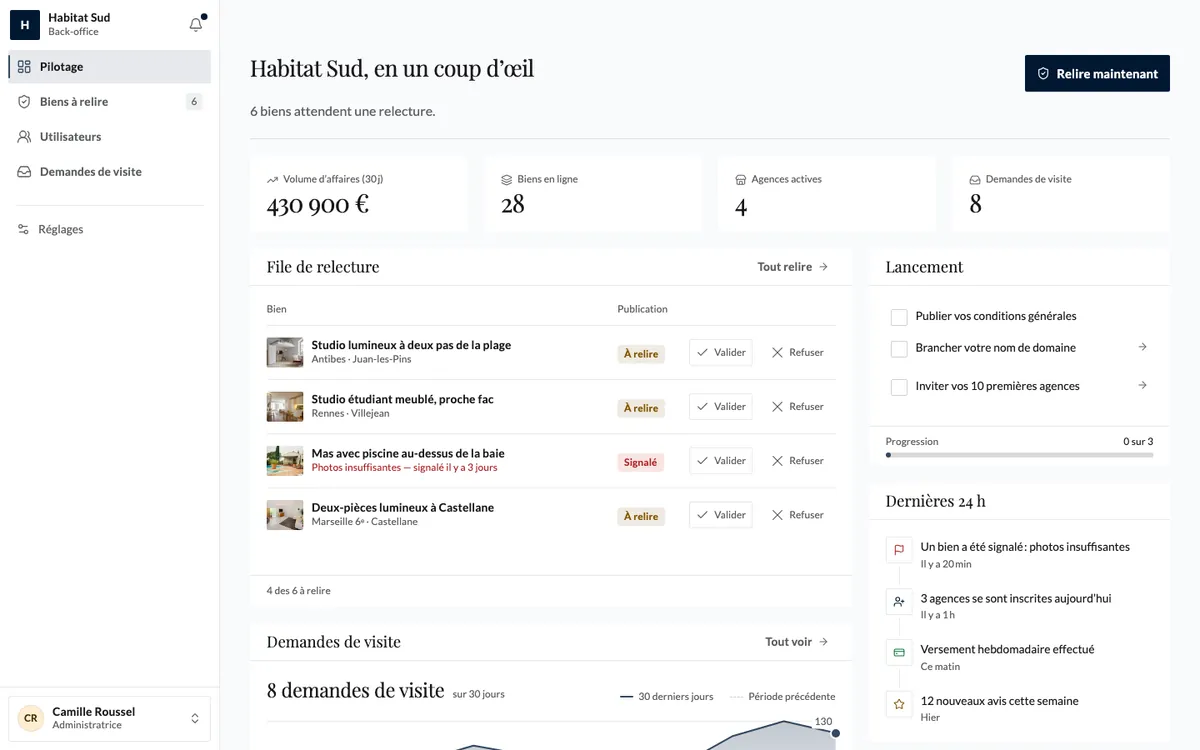
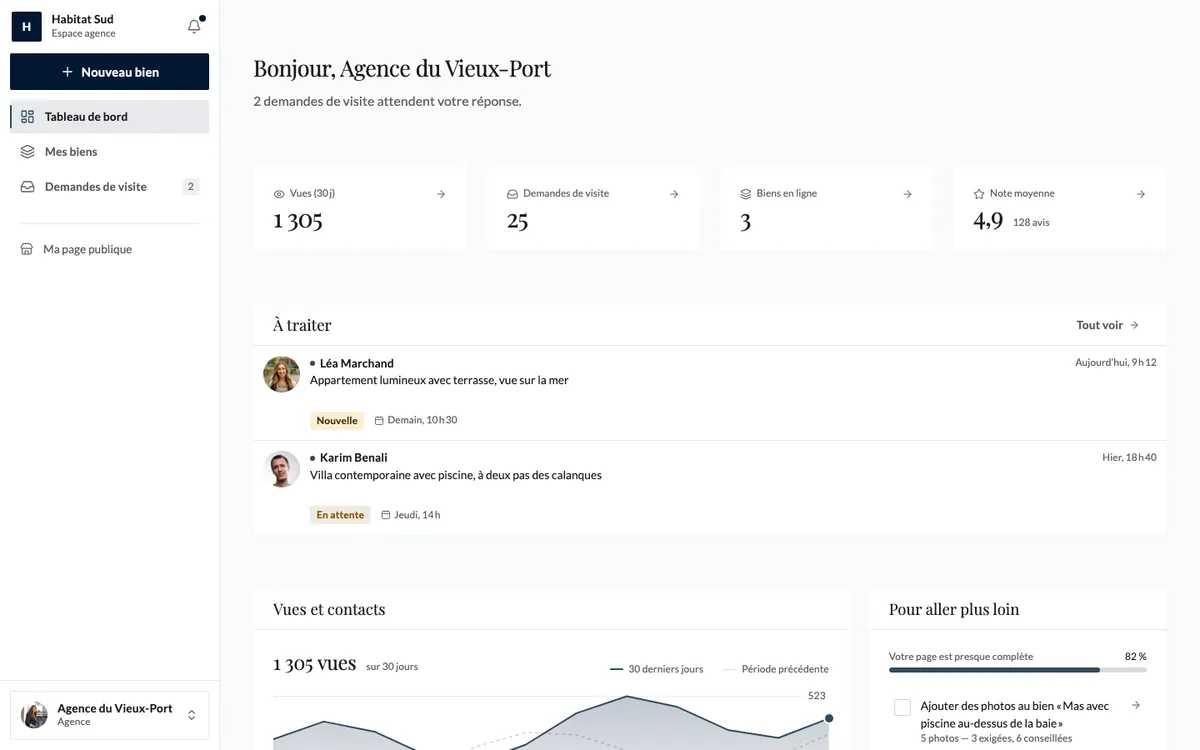
- Online payments are included from Launch. Payments go through your own Stripe account. You open it in your name, enable Connect as a platform or marketplace with Express accounts, then paste your key from your account. You set your commission, anywhere up to 50%; it stays in your Stripe balance. Your sellers open their Stripe account from their seller space, and Stripe verifies their identity. Buyers pay by card on Stripe’s checkout page, the seller’s share is transferred at payment time, and the “Refund” button in the back office takes back both the seller’s share and your commission.
- Without Stripe, request mode. Until Stripe is connected, customers send requests, bookings or orders that the seller confirms; payment happens outside the site. It is a good way to check there is demand before taking money online.
- Our share of sales. On top of the subscription, we charge a percentage of the sales paid online on your marketplace: 2% on Launch (€79 a month excluding VAT), 1.5% on Pro (€199 a month), 1% on Dedicated (from €990 a month). It applies to what buyers paid online, excluding delivery and net of refunds, with no cap; requests and offline payments are not counted. It is billed at the start of the following month, on an invoice separate from the subscription: it is never taken out of your buyers’ payments, and we never hold funds on your behalf, as our terms of sale state. Stripe bills its own fees on its own price list.
- During the beta, you try everything without paying a thing: payments run in test mode, with Stripe test keys.
Over a month at Marketplace Factory, subscription and share of sales added up, before Stripe fees:
| Online sales per month | Launch (€79 + 2%) | Pro (€199 + 1.5%) | Dedicated (from €990 + 1%) |
|---|---|---|---|
| €1,000 | €99 | €214 | from €1,000 |
| €5,000 | €179 | €274 | from €1,040 |
| €10,000 | €279 | €349 | from €1,090 |
Amounts exclude VAT. Pro costs less than Launch above €24,000 of sales a month; on Dedicated, the rate is renegotiated for large volumes. Paid yearly, two months are free on Launch (€790) and Pro (€1,990). That price covers a complete marketplace with your trade’s real workflow, from the site to the back office, picked from finished proposals that arrive in a few minutes, without writing a line of code.
If you disconnect Stripe, your marketplace falls back to request mode without losing anything. Plans are on the pricing page, and launch steps in our guide on how to build a marketplace. Building a rental platform? Our article on how to build a rental marketplace covers calendars, deposits and insurance.
With Marketplace Factory, none of this needs building: you open your Stripe account, paste your key, and payment splitting, seller verification, payouts and refunds are in place.
Frequently asked questions
Do I need a licence to collect money for my sellers?
Collecting funds for sellers and paying them out is a payment service, reserved for licensed institutions or their registered agents in the EU and the UK. The commercial agent exclusion only covers an agent acting for the buyer or the seller, not both, and EU lawmakers wrote that platforms acting for both sides go beyond it. The usual route is a licensed provider such as Stripe, Adyen or Mangopay. With Marketplace Factory, payments go through your own Stripe account: we never touch your marketplace’s money.
How much does Stripe Connect cost for a marketplace?
On the public price lists read on 27 September 2026, from a euro-area account: 1.5% + €0.25 per standard EEA card, and, when the platform sets its own pricing, €2 per active seller per month plus 0.25% + €0.10 per payout. From a US account: 2.9% + 30¢ per domestic card, $2 per active account and 0.25% + 25¢ per payout. On a €120 rental, allow about €2.90 in total fees.
Who verifies sellers' identities?
With Stripe Express accounts, Stripe does: each seller fills in a form hosted by Stripe (identity, bank details, company if any) and Stripe runs identity, anti-money-laundering and sanctions checks. The platform remains liable for losses on those accounts, and should review sign-ups carefully and watch for suspicious ones.
Can a rental marketplace take a security deposit?
Yes, with a card authorisation, often called a hold: the amount is blocked on the card without being charged, then released or partly captured. An online card authorisation generally lasts seven days, so for longer rentals, place the hold just before pick-up, or save the card with the customer’s consent to charge proven damage later.
When do sellers receive their money?
With destination charges, the seller’s share lands in their Stripe balance at payment time, then goes to their bank on the payout schedule. Stripe says a first payout typically arrives within 7 to 14 days of the first live payment; after that, standard settlement takes 2 business days in the US and 3 in the UK and the EU.
Sources18
The pages cited in this article, checked on the date given in the text.
- stripe.com/ie/pricing
- stripe.com/ie/connect/pricing
- stripe.com/gb/pricing
- stripe.com/gb/connect/pricing
- stripe.com/pricing
- stripe.com/connect/pricing
- stripe.com/fr/connect
- docs.stripe.com/connect/destination-charges
- docs.stripe.com/connect/express-accounts
- docs.stripe.com/connect/design-an-integration
- docs.stripe.com/payouts
- docs.stripe.com/payments/place-a-hold-on-a-payment-method
- eur-lex.europa.eu/legal-content/EN/TXT/?uri=CELEX:32015L2366
- legislation.gov.uk/uksi/2017/752/schedule/1/part/2
- fincen.gov/money-services-business-definition
- mangopay.com
- lemonway.com
- docs.adyen.com/marketplaces
These articles are written by the Marketplace Factory team, who build the studio and the marketplaces it generates. How we write