By industry
How to start a job board: your own niche job site
How to start a niche job board: applications with CVs, stage tracking, Google for Jobs, the rules to follow and the business model, without a line of code.
Contents
Starting a job board means opening a job site for a trade, a region or an audience that the big general sites serve poorly. Candidates find jobs made for them, with what they want to know before applying; recruiters find qualified candidates, and are willing to pay for them. This guide explains how to choose your niche, what a job board must do, the rules to follow, the business model and the real budget. Marketplace Factory creates your complete job board from one sentence: six finished proposals arrive in about a minute, then the site, sample listings included, within a few minutes.
The niche: a trade, a region, an audience
A general job site lines up thousands of jobs; a niche job board publishes fewer, but better. It wins on three fronts: complete job posts on what matters in the trade, candidates who recognise themselves in the site, and recruiters who know why they pay for it.
A few niches that work:
- A trade: kitchens and dining rooms, care, construction, wine-making, events.
- A region: the jobs of a valley, an island, a labour market where everyone knows everyone.
- An audience: students, with jobs that fit into the week; seasonal workers, with housing and meals written on the job post; apprentices.
What the job post must say changes with the niche, and that is where you make the difference:
| Niche | What the job post must say | What the candidate checks first |
|---|---|---|
| Restaurants and hotels | continuous or split shifts, days off, seasonal housing, meals, tips | the real pay and life outside service |
| Student jobs | hours per week, schedules compatible with classes, length of the assignment | that the job fits into the week |
| Seasonal work | start and end dates, housing, getting to the workplace | where to sleep and how to get there |
| Care and home help | qualifications required, night or weekend hours, area covered | the pace and the travel |
The niche test is simple: do you know twenty recruiters who struggle to find candidates, and do you know where those candidates spend their days? If so, you have your job board. Keep in mind, from now on, the rule that sets the business model: applying must stay free. Recruiters pay.
The features of a job board
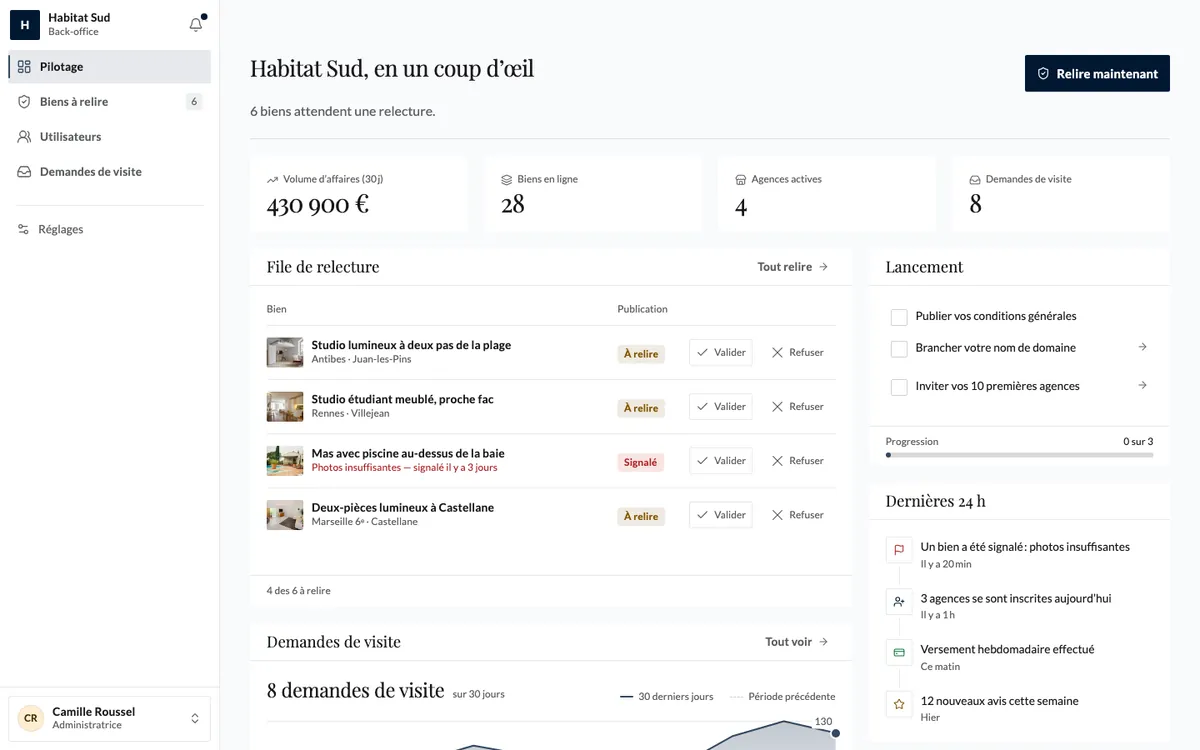
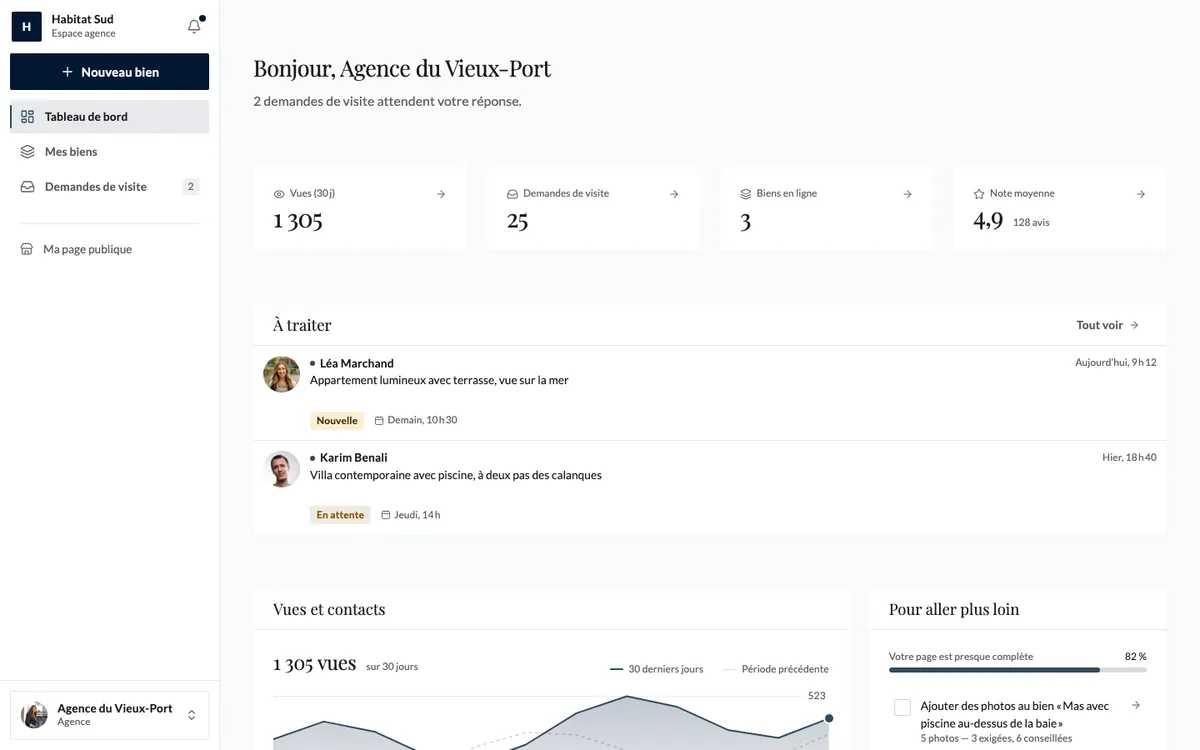
A job board is a marketplace whose sellers are recruiters and whose customers are candidates. Here is what it must do, and what a Marketplace Factory marketplace from the Jobs family does:
- Complete job pages: the role, the location, the contract, similar jobs; a salary range on every job, and a closing date if the recruiter sets one.
- Applying with a CV: as a PDF, an image or a Word file, up to 5 MB. Without signing up if you turn it on: a code sent by email is enough, and the candidate’s consent is dated.
- Stage tracking: received, shortlisted, interview, not selected, hired. Every application arrives with its CV and its conversation, and declining requires a reason.
- An answer for every candidate: a courteous email goes out as soon as an application is not taken forward; with an account, candidates also follow each step of theirs.
- Jobs that expire: after 60 days, with a reminder to the recruiter a week before, and a one-click “Repost the job”.
- Alerts: an email as soon as a new job matches a saved search, one-click unsubscribe.
- A page for every recruiter: their introduction and all their jobs.
- The back office: job review, reports, candidates and recruiters, a job featured for 30 days.
Everything included is detailed on the Solutions page for jobs.
The law: wording, CVs, free for candidates
What a job post cannot say. In the US, it is unlawful for employers and employment agencies to publish a job advertisement “indicating any preference, limitation, specification, or discrimination, based on race, color, religion, sex, or national origin”, except where religion, sex or national origin is a bona fide occupational qualification (42 U.S.C. 2000e-3(b)), and the same applies to age (29 U.S.C. 623(e)). In the UK, the Equality Act 2010 forbids discriminating against applicants, including in the arrangements made for deciding who is offered a job (section 39). EU countries have equivalent rules. On a Marketplace Factory job board, discriminatory wording is caught before the post is sent, and the job goes to review.
CVs and their data. Under the GDPR, personal data is kept no longer than its purpose requires. The UK’s data protection regulator spells out what that means for recruitment in its guidance on keeping recruitment records: “In general, you should not keep information beyond the statutory period in which a legal claim can potentially be brought.” If you want to keep CVs for future vacancies, tell candidates in advance, as the guidance’s own example does. On a Marketplace Factory job board, CVs are deleted two years after the candidate’s last activity. The rest of a marketplace’s data duties, from the privacy notice to processors, is in our guide to marketplace legal requirements in the EU.
Free for candidates. Some countries write it into law. In the UK, section 6 of the Employment Agencies Act 1973 restricts employment agencies from charging fees for finding people work, with narrow exceptions set by regulation 26 of the 2003 Conduct Regulations, for occupations such as acting and modelling. Whatever your legal status, the market rule is the same: the candidate never pays, the recruiter pays to publish or to stand out. Have the terms you offer recruiters reviewed by a lawyer.
The business model: recruiters pay
On a job board, no salary goes through the site: your revenue comes from recruiters. Three options, often combined:
| Option | How it works | For which recruiters |
|---|---|---|
| Pay per job | each published job is paid for, if you decide so | occasional recruiters |
| Subscription | monthly plans, paid by card through your Stripe | groups, agencies, regular recruiters |
| Featured placement | a job in the spotlight for a fee, labelled as sponsored | urgent roles |
On a Marketplace Factory job board, these options are switched on in your back office. These payments land in your Stripe account; your plan’s share applies to them as it does to a sale.
To start, let your first twenty recruiters publish for free: you first need jobs to attract candidates. Move to paid options when applications come in every week, starting with featured placement, the easiest to accept. The full reasoning is in our article on the marketplace business model.
Getting found: Google for Jobs, then the rest
Google shows job offers in a dedicated box in its results, built from each page’s structured data. Its developer documentation, updated on 8 September 2026, lists the required properties (the title, the description, the date posted, the hiring organisation, the location), recommends the salary and the expiry date among others, and lists the countries where the experience is available, including the United States, Canada, the United Kingdom and India. The structured data must appear on the same page as the job description candidates read, and an expired job should be removed, or carry an expiry date in the past.
On a Marketplace Factory job board, every published job is marked up for Google for Jobs from the Launch plan, and jobs expire after 60 days unless the recruiter republishes them: forgotten roles do not linger online. The sitemap, structured data and share image are on every page. Google then decides whether to show the jobs, and the quality of their content counts. Our guide to marketplace SEO covers the rest.
The first candidates will also come from elsewhere: the schools and training centres of your trade, associations, local groups, and recruiters themselves, who share their jobs. Search alerts bring them back. The method to gather your first recruiters, the way you would gather a marketplace’s first sellers, is in our article on the marketplace chicken and egg problem.
The Coup de Feu example, and the budget
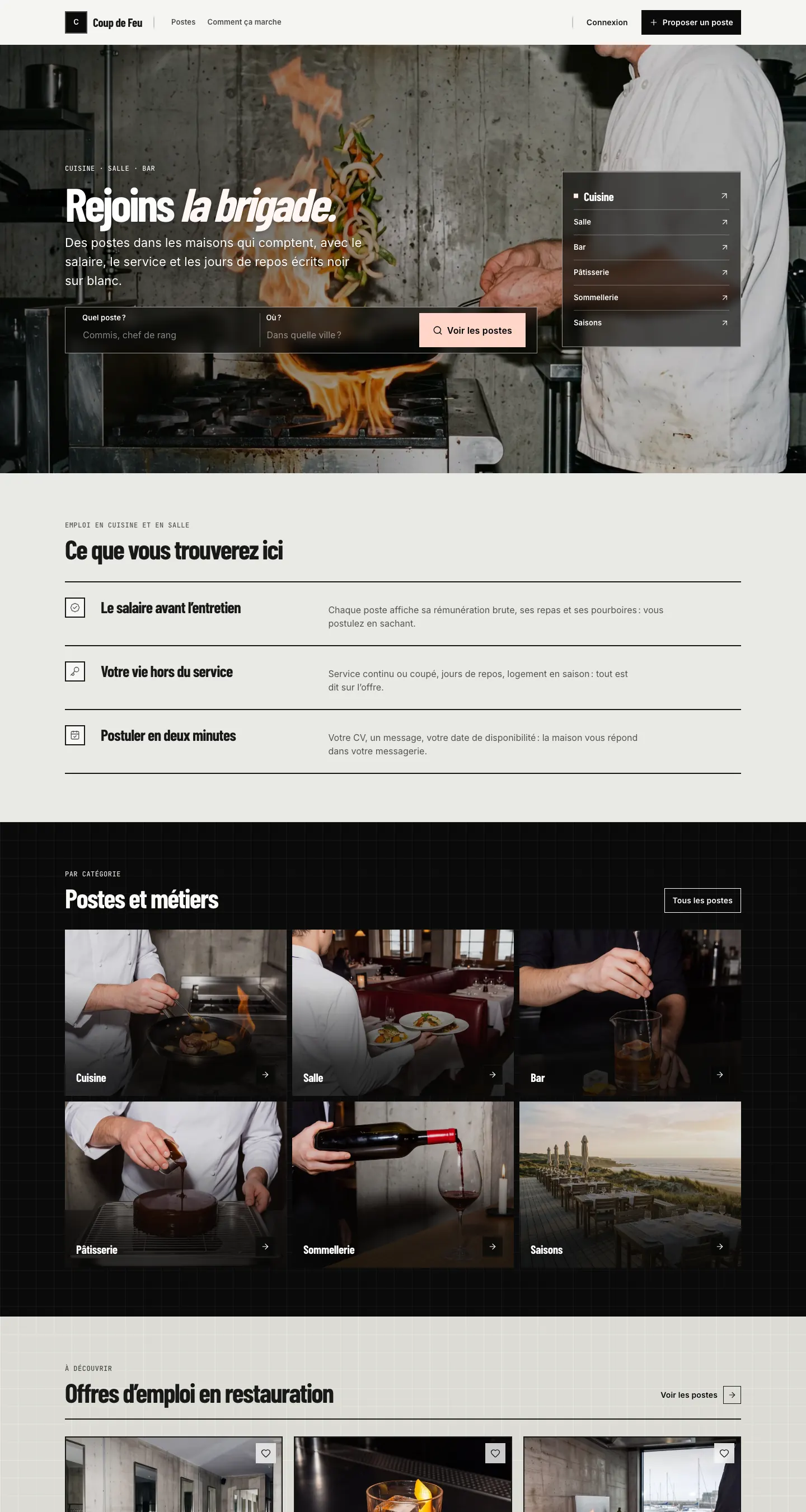
Coup de Feu (“the rush”, in kitchen slang) is one of the twenty examples in our gallery, created by the studio from a single sentence: “Job offers from restaurants and hotels, in the kitchen and the dining room, brutalist style”. It is a demo, not a customer’s site. It shows what a niche makes possible: trades arranged the way candidates look for them (kitchen, dining room, bar, pastry, sommelier, seasonal work) and a promise displayed on the site: salary and service hours in black and white. The job post for a pastry chef for the winter season shows €2,700 to €3,100 gross a month, an application deadline, the establishment, seasonal housing, meals and the experience required.
What a job board costs depends on the route. Sharetribe puts building a marketplace from scratch at “typically north of $50,000” in its guide to marketplace costs, and dedicated job board software is often sold by quote: SmartJobBoard, for instance, offers on its pricing page either a share of revenue or a flat annual fee, with the price given by its sales team.
With Marketplace Factory, the complete job board is delivered, hosted and maintained for you. The studio is free to try, with 2 ideas and 10 edits free when you sign up, no card needed. To open, here is what you pay per month, excluding VAT and Stripe fees:
| Paid online by your recruiters, per month | €0 | €1,000 | €5,000 |
|---|---|---|---|
| Marketplace Factory Launch, €79 + 2% | €79 | €99 | €179 |
| Marketplace Factory Pro, €199 + 1.5% | €199 | €214 | €274 |
As long as your job posts are free, Launch costs you €79 excl. VAT a month, nothing more. Pro adds up to three domain names, your emails sent from your domain, ten administrators instead of two, and up to 1,000 jobs imported and kept up to date from recruiting software. During the beta, you try everything without paying a thing: payments run in test mode. Plans are on the pricing page.
Launching in four weeks
- Week one: write your sentence, choose among six proposals in contrasting styles, refine with a word by asking the AI, or by hand in the editor. Switch on applications without an account, and job review.
- Week two: gather twenty recruiters and their first jobs, published for free, salary included.
- Week three: open on Launch, at your .marketplacefactory.app address, and share the jobs where your candidates are: schools, associations, trade groups.
- Week four: track three numbers, applications per job, recruiters’ response time and hires reported. When applications come in every week, open paid featured placement. The numbers worth watching are in our guide to marketplace metrics.
A niche job board is a service to a whole trade. With Marketplace Factory, yours arrives complete from one sentence, without a line of code: applications with CVs, stage tracking, an answer for every candidate, jobs that expire, Google for Jobs, discriminatory wording caught before sending and CVs deleted on time. Your energy goes to recruiters and candidates.
Frequently asked questions
How much does a job board cost?
Sharetribe puts building a marketplace from scratch at typically north of $50,000, and dedicated job board software is usually sold by quote, as a subscription or a share of revenue. With Marketplace Factory, Launch costs €79 excl. VAT a month, hosting included, plus 2% of what your recruiters pay online, which is nothing as long as your job posts stay free.
How do I get my job posts into Google for Jobs?
Each job page must carry structured data Google can read: the title, the description, the date posted, the hiring organisation and the location, and preferably the salary and the expiry date. A filled job must disappear or carry a past expiry date. On a Marketplace Factory job board, every published job is marked up this way; Google then decides whether to show it.
How long should I keep candidates’ CVs?
No longer than you need them. Under the GDPR, personal data is kept only as long as its purpose requires; the UK regulator says that, in general, you should not keep information beyond the period in which a legal claim can be brought, and CVs kept for future vacancies call for telling candidates first. On a Marketplace Factory job board, CVs are deleted two years after the candidate’s last activity.
Can I charge candidates?
Do not. In the UK, employment agencies may not charge work-seekers a fee for finding them work, apart from narrow exceptions such as entertainment and modelling, and job seekers everywhere expect applying to be free. Recruiters pay: per published job, by subscription or for featured placement. On a Marketplace Factory job board, applying stays free.
Do candidates have to create an account to apply?
Not necessarily. On a Marketplace Factory job board, if you turn it on, a code sent by email is enough to apply with a CV, as a PDF, an image or a Word file up to 5 MB, and the candidate’s consent is dated. Fewer steps before applying: a useful setting for trades where people apply from their phone.
Sources10
The pages cited in this article, checked on the date given in the text.
- law.cornell.edu/uscode/text/42/2000e-3
- law.cornell.edu/uscode/text/29/623
- legislation.gov.uk/ukpga/2010/15/section/39
- legislation.gov.uk/ukpga/1973/35/section/6
- legislation.gov.uk/uksi/2003/3319/regulation/26
- eur-lex.europa.eu/legal-content/EN/TXT/?uri=CELEX:32016R0679
- ico.org.uk/for-organisations/uk-gdpr-guidance-and-resources/employment/recruitment-and-selection/keeping-recruitment-records
- developers.google.com/search/docs/appearance/structured-data/job-posting
- sharetribe.com/academy/how-much-does-it-cost-to-start-a-marketplace-business
- smartjobboard.com/pricing
These articles are written by the Marketplace Factory team, who build the studio and the marketplaces it generates. How we write