By industry
How to build a service marketplace: bookings and quotes
Profiles, time slots, requests, quotes: how to build a service marketplace connecting clients and providers, from tutoring and coaching to home services.
Contents
A service marketplace sells time: a practitioner’s, a coach’s, a tutor’s, a consultant’s, a cleaner’s. To build a service marketplace that lasts, two decisions matter more than any other: choosing the right booking flow, then stopping clients and providers from dealing directly after the first appointment. This guide takes them in order, with the rules specific to tutoring and home services, and six examples created with Marketplace Factory, which creates the complete marketplace for your trade from a single sentence.
Four possible flows
Services are not all bought the same way. A treatment is booked, a wedding is quoted, an assignment is discussed, a job is applied for.
| Flow | The client… | The provider… | Typical trades | Example from the gallery |
|---|---|---|---|---|
| Slot request | picks a service and a preferred time | confirms or suggests another time | care, coaching, cleaning, lessons | Bien chez soi, Coach Book, Maison nette |
| Quote | describes the project: date, place, budget | replies with a priced quote | events, concierge, home improvement | Grand Soir, Clés d’or |
| Brief | sets out the need and duration | proposes an approach and a fee | consulting, freelancers | Les Associés |
| Application | applies, CV attached | shortlists or declines | odd jobs, internships | Job en poche |
The rule: pick the flow that looks like what your providers already do by phone or email. If a practitioner takes appointments by the slot, do not force a quote on her; if a caterer prices every event, do not display a fixed price.
At launch, a request confirmed by the provider is enough: it works for all four flows and teaches you what clients really ask for. A live calendar or a quote accepted online can come once volume justifies it.
Profiles that reassure
In services, the listing is a person. A good profile answers, before any exchange, the questions clients do not dare ask:
- a clear photo and a short first-person introduction;
- the services, each with its duration and price;
- the area covered, or “online”, or “at my practice”;
- usual availability and response time;
- qualifications, where the trade requires them;
- reviews, dated.
On “Bien chez soi” (“at home”), home care and wellbeing practitioners in Lyon, Marketplace Factory created filters that say what matters to that audience in France: where the session takes place (at home, at the practice, by video), the hourly rate, invoices for top-up health insurance, the French CESU service vouchers, “verified practitioner”, and timing (today, tomorrow, this weekend). The trade and the country shape the filters.
What to check, trade by trade
- Work with children or in people’s homes. Ask for a criminal record check. In England and Wales, DBS checks come in basic, standard and enhanced versions, and someone hiring a self-employed person for their family cannot request one on their behalf. The provider can request a basic check themselves: £21.50, usually processed within three days. Other countries have their own equivalent: find out which document applies where you operate.
- Regulated trades. Some activities require a qualification to be paid for them. In France, for instance, only holders of a recognised diploma or certificate may, for payment, teach, lead or supervise a sport (French sports code, L. 212-1). Ask for proof at sign-up.
- Consultants and freelancers. Check the business registration, and ask for professional liability insurance where it is customary.
A “verified” badge commits your word: only show it after a real check, and say on a help page what it covers.
Tutoring and home services
Tutoring has its own habits: subject and level as the first filter, a trial lesson, packages of several sessions, and a buyer (the parent) who is not the student. Home services live on repetition: same day, same time, same person.
Both can have a price argument clients grasp immediately where tax relief exists. In France, for example, tutoring at home, cleaning, small gardening jobs and small DIY jobs qualify for a tax credit of 50% of the cost, within an annual cap, when the service is provided by a declared organisation or by an employee of the household (service-public.fr, in French, checked on 15 April 2026). If your country has a similar scheme, distinguish on each profile the providers whose services qualify, and make it a filter.
For care, a design precaution: do not ask for medical information in the request form. The reason for the session is enough; the rest is between patient and practitioner.
Business model and disintermediation
Disintermediation is the number one risk in services. Take a cleaner booked two hours a week at €25 an hour: €50 a session, about €200 a month. With a 15% commission, she gives up €30 a month, €360 a year, for a client she already knows. After three weeks, both have understood the point of doing without you.
Three answers, often combined:
- Change what you charge for: a commission on the first booking only, a monthly provider subscription, or a service fee on the client’s side. The reasoning is in our article on the marketplace business model.
- Make the platform more useful than the phone: calendar, reminders, online payment, automatic invoices, reviews that stay on the profile, a replacement if the provider is ill. That is the thesis of Sharetribe’s guide on discouraging people from going around your payment system, updated on 3 March 2026: equip providers, reassure clients, remove friction.
- Protect without locking in: hiding contact details before the first booking limits leaks but prevents nothing afterwards. Only the value you provide keeps people.
On the payment side, Stripe charges 1.5% + €0.25 per standard European card from a euro-area account (Stripe, read on 27 September 2026), so €1 on a €50 session; from a US account, 2.9% + 30¢ (Stripe US), so $1.75 on a $50 session.
Providers' status and tax reporting
Your providers are usually independent: they set their prices, hours and conditions. Keep it that way, because the line is being drawn more tightly. In the EU, the Platform Work Directive (EU) 2024/2831, to be transposed by 2 December 2026, presumes an employment relationship where facts indicate “direction and control” by a digital labour platform; the platform must then prove otherwise. Its recitals exclude platforms that merely advertise offers or display available providers in an area “without any further involvement”. In the UK, being self-employed shows in facts such as giving quotes to get work, not being directly supervised and invoicing for work done (GOV.UK); in the US, the IRS looks at behavioural control, financial control and the type of relationship (IRS). If your model has you setting prices, schedules or how the work is done, have it checked by a lawyer before opening.
On tax, DAC7 covers “personal services”: time- or task-based work performed by individuals at a user’s request, online or offline, “after having been facilitated via a Platform”. The only threshold, fewer than 30 transactions for no more than €2,000, applies to sales of goods: a tutor who gives three lessons through you is reported. The operator reports by 31 January and informs each provider. The UK’s platform reporting rules work the same way for services; in the US, Form 1099-K kicks in above $20,000 and 200 transactions (IRS). The rest of the framework is in marketplace legal requirements in the EU.
Six examples from the gallery
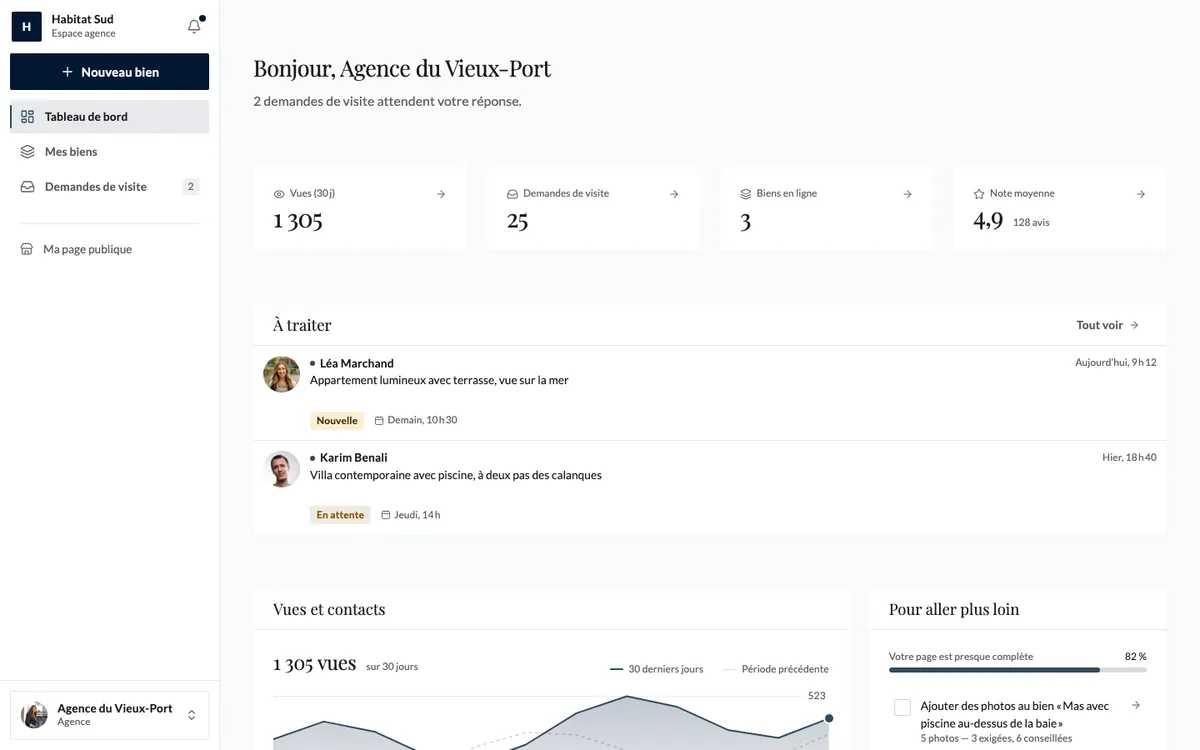
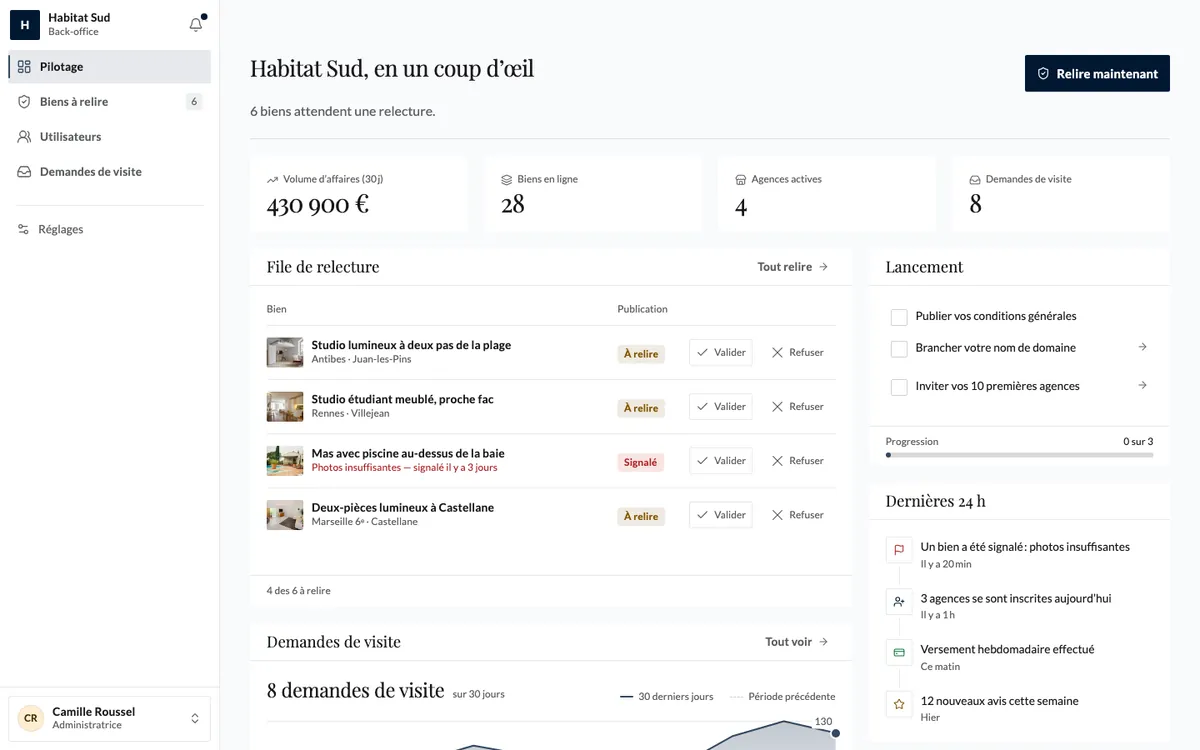
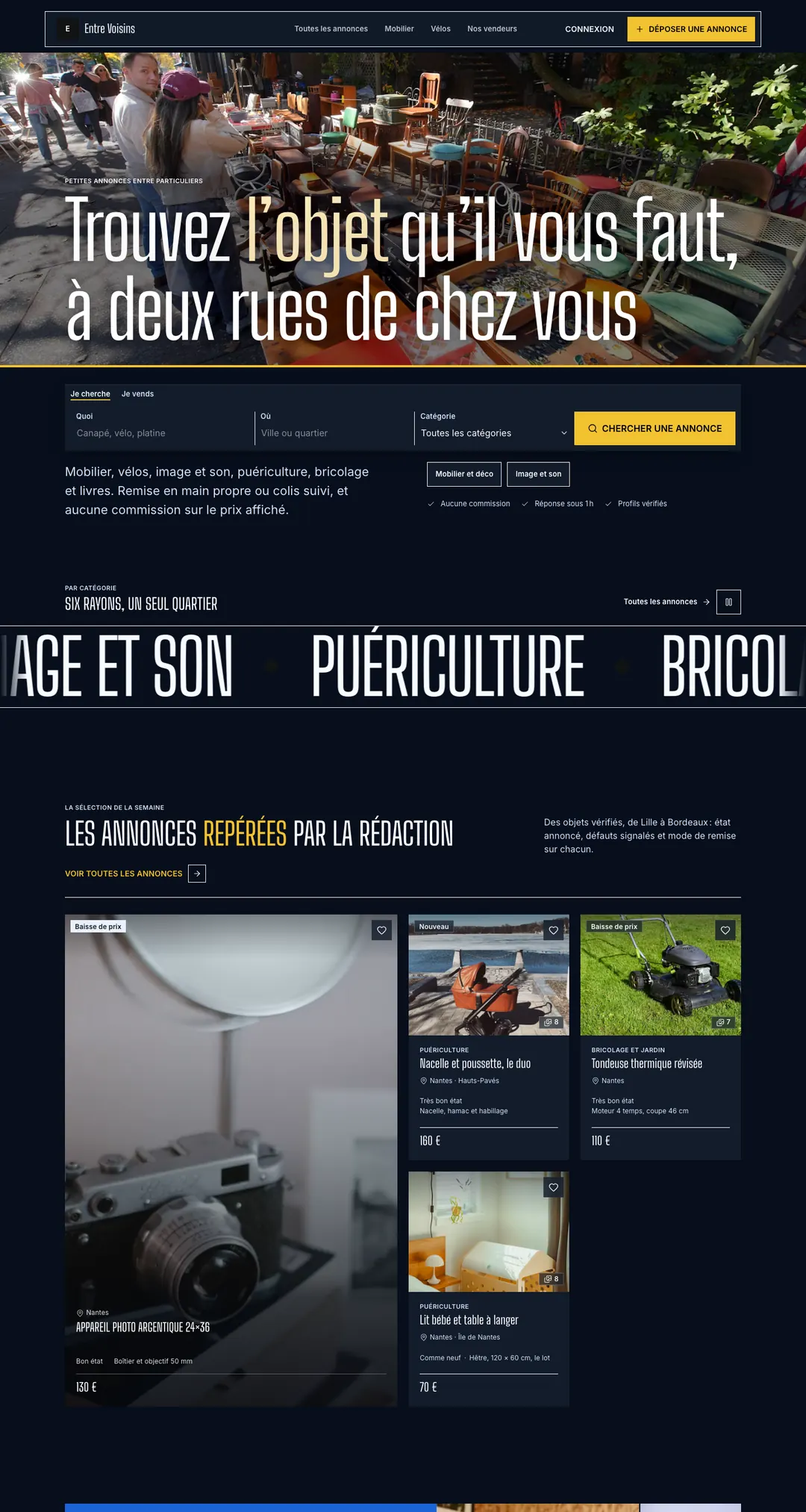
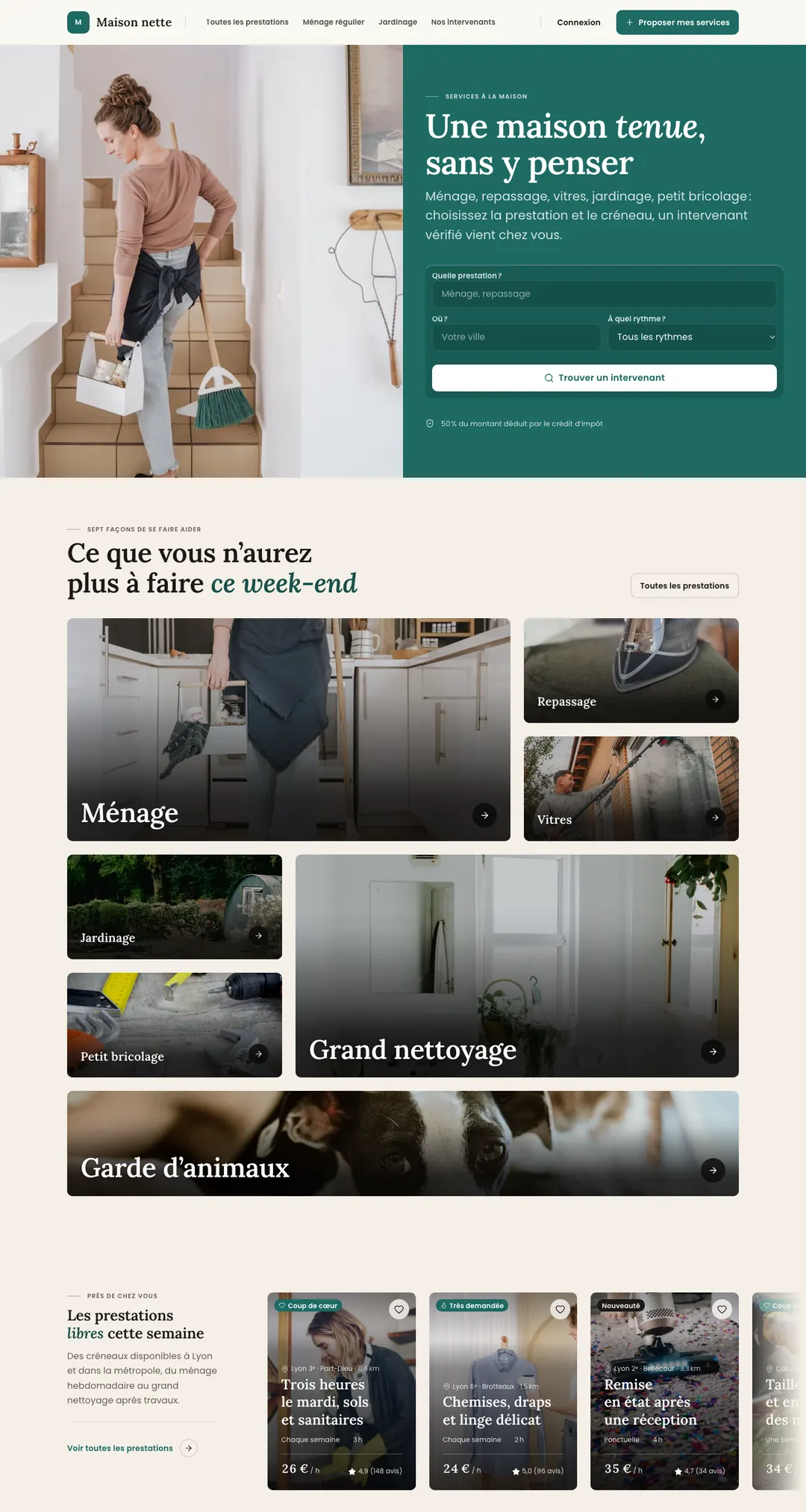
Six service marketplaces created with Marketplace Factory, each from one sentence. They are demos in French, not customer sites:
- Savoir-Faire (“know-how”): “Online classes taught by craftspeople and enthusiasts”. Editorial style; sessions and sign-ups.
- Bien chez soi: “Home care and wellbeing practitioners who come to you, in Lyon”. Warm style; time slots and verified profiles.
- Coach Book: “Personal trainers at home, night-time mood”. Nocturnal style; a booking flow, as for care.
- Maison nette (“clean house”): “Cleaners and home services, bookable by the hour”. Editorial style; repetition front and centre.
- Les Associés (“the partners”): “Independent consultants for small businesses”. Editorial style; briefs rather than slots.
- Job en poche (“a job in your pocket”): “Odd jobs for students, near campus”. Functional style; applications.
Same engine, four different flows: the trade decides. All can be browsed in the examples gallery.
Budget and launch
| Step | Marketplace Factory plan, excl. VAT | What you get |
|---|---|---|
| Try | Studio, €0 | complete proposals in a few minutes, edits, private preview |
| Open and take payments | Launch, €79 a month plus 2% of sales paid online | live site on name.marketplacefactory.app, the trade’s real flow (time slots, quotes or applications), online payment on your Stripe account with your commission, messaging, reviews, moderation, alerts, statistics |
| Become a brand | Pro, €199 a month plus 1.5% | everything in Launch, plus up to three domain names, your emails sent from your domain, connectors, several administrators |
Our share only applies to what clients pay online: on a €50 session, €1 on Launch, €0.75 on Pro; nothing on requests or on what is settled offline. In total, excluding VAT and Stripe fees, Launch comes to €179 a month for €5,000 of online sales and €279 for €10,000. During the beta, you try everything without paying a thing: payments run in test mode. Plans are detailed on the pricing page.
The launch itself costs little in software and a lot in presence. One trade, one city or neighbourhood, fifteen providers recruited one by one, and the first requests brought in by you: the method is in the marketplace chicken and egg problem, and the overview in our guide on how to build a marketplace.
With Marketplace Factory, your trade’s flow (time slots, quotes, briefs or applications), your providers’ profiles and online payments are there from the first sentence: your time goes to providers and to the first requests.
Frequently asked questions
Commission or subscription for a service marketplace?
A commission suits one-off services, such as an event quote or a first session. When the same client sees the same provider every week, it pushes both to deal directly: a provider subscription, or a commission on the first booking only, holds up better. Many platforms combine the two, then adjust after three months of data.
How should a service marketplace vet its providers?
Check what the trade requires: a qualification for regulated work, a business registration for freelancers, a criminal record check for anyone working with children or in people’s homes. In England and Wales, a basic DBS check costs £21.50 and the person requests it themselves. Only show a “verified” badge after a real check, and explain what it covers.
Can clients book time slots online from launch?
You can start more simply: the client picks a service and a preferred time, the provider confirms or suggests another. That confirmed request is enough for the first months and measures real demand. The live calendar, with availability and payment, comes next; at Marketplace Factory it is included from the Launch plan.
Is providers' income reported to the tax authorities?
Yes, once your platform facilitates the service. In the EU and the UK, platform reporting covers personal services, meaning time- or task-based work done by individuals at a user’s request. No threshold applies to services: the operator reports each provider’s income by 31 January and gives them a copy. In the US, Form 1099-K applies above $20,000 and 200 transactions.
Sources13
The pages cited in this article, checked on the date given in the text.
- eur-lex.europa.eu/legal-content/EN/TXT/?uri=CELEX:32021L0514
- gov.uk/guidance/reporting-rules-for-digital-platforms
- irs.gov/businesses/understanding-your-form-1099-k
- eur-lex.europa.eu/legal-content/EN/TXT/?uri=CELEX:32024L2831
- gov.uk/employment-status/selfemployed-contractor
- irs.gov/businesses/small-businesses-self-employed/independent-contractor-self-employed-or-employee
- gov.uk/dbs-check-applicant-criminal-record
- gov.uk/request-copy-criminal-record
- legifrance.gouv.fr/codes/article_lc/LEGIARTI000037388193
- service-public.gouv.fr/particuliers/vosdroits/F12
- sharetribe.com/academy/how-to-discourage-people-from-going-around-your-payment-system
- stripe.com/ie/pricing
- stripe.com/pricing
These articles are written by the Marketplace Factory team, who build the studio and the marketplaces it generates. How we write