By industry
Real estate listing website: how to build a property portal
Map search, alerts, agencies and private landlords: how to build a real estate listing website or flatshare portal, what listings must show, licences, budget.
Contents
A network of agencies that wants a shared shop window, a flatshare manager, a city or university looking for student housing, a specialist in land or holiday homes: they all want to build a real estate listing website, and they all run into the same questions. Who publishes? What must a listing show? Do you need a licence? How do you make a living without charging people who search? This guide answers, texts in hand, for the EU, the UK and the US, with three examples Marketplace Factory created, each from a single sentence.
Agency website or listing portal
| Agency website | Listing portal | |
|---|---|---|
| Advertisers | one agency, its own instructions | several agencies, owners, managers |
| Your role | selling or letting your clients' properties | publishing others' listings and connecting people |
| What matters | the quality of instructions | the quantity and freshness of listings, search |
| Revenue | fees on transactions | subscriptions and options paid by advertisers |
A portal is a marketplace: advertiser accounts, listing review, search, enquiries that reach the right advertiser, and a back office to run it all.
Who publishes, and how
Three families of advertisers, three sign-up paths:
- Agencies: several agents under one account, a reference per listing, high volume. Plan fields in their profile for the registration details and memberships their country requires them to show. On Marketplace Factory, importing their listings from their own software is coming soon.
- Private landlords and sellers: one or two listings, no fees, often less at ease with compulsory information. Guide them field by field.
- Managers (flatshares, student residences): rooms rather than whole homes, availability that turns over fast.
Mixing them is allowed, as long as it is clear. In the EU, since the Omnibus Directive (EU) 2019/2161, marketplaces must tell consumers whether each advertiser is a trader or not. In marketplaces made with Marketplace Factory, each advertiser declares that status before publishing, and it shows on their page.
Features people expect
Home seekers have been trained by the big portals. They expect:
- map search, list and map side by side, with pinned prices;
- filters: buy or rent, property type, price, floor area, bedrooms, energy rating, outdoor space, furnished;
- rich listings: at least five photos, a full-screen gallery, the floor plan, running costs, the energy certificate;
- alerts: save a search and receive new listings;
- viewing or information requests, delivered to the advertiser;
- favourites, to compare.
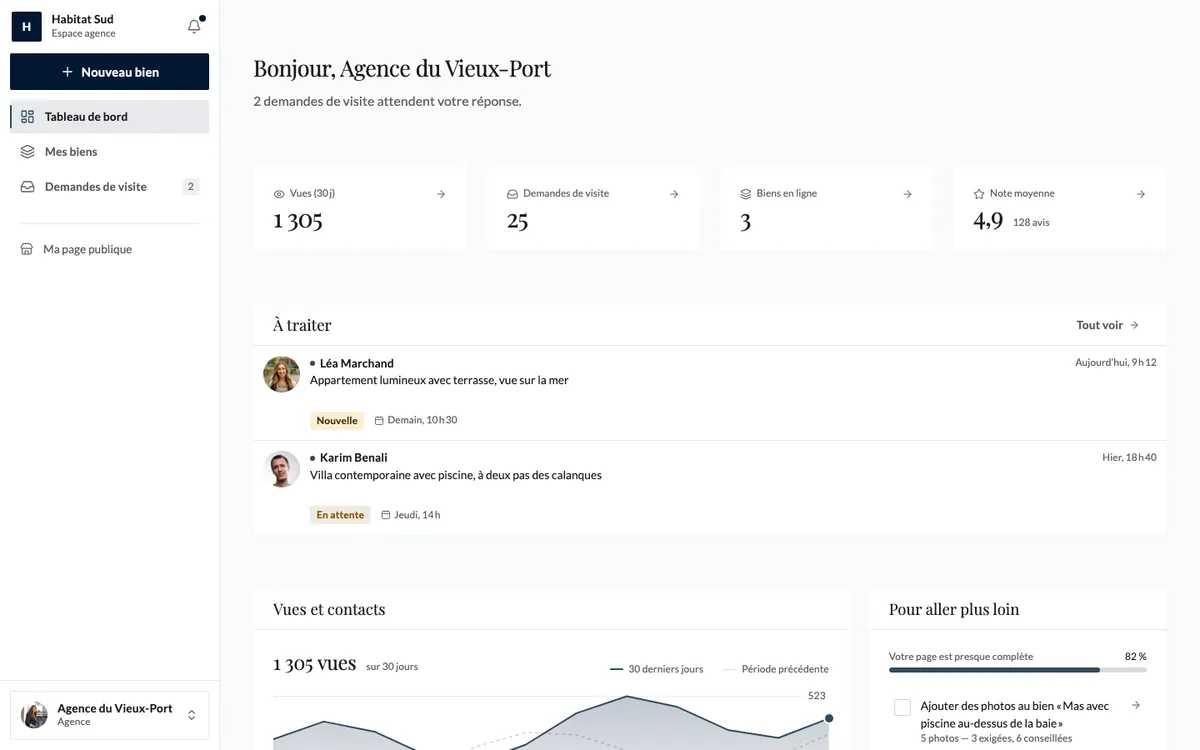
For advertisers: a space to submit, edit and mark as “sold” or “let”, requests to handle and statistics. For the operator: listing review before publication and activity tracking. Those are the four spaces Marketplace Factory’s home page shows on “Habitat Sud”, a demo property marketplace: public site, buyer account, seller space and back office.
What listings must show
This is what most projects discover too late.
- In the EU, the recast Energy Performance of Buildings Directive, Directive (EU) 2024/1275, requires in Article 20(4) that the energy performance class and indicator be stated “in online and offline advertisements, including in property search portal websites”, for buildings offered for sale or rent. Member States had to transpose it by 29 May 2026. France, for example, already requires the energy and climate classes in colour, a warning for F- and G-rated homes, and estimated annual energy costs (service-public.fr, in French), and has banned renting out G-rated homes since 1 January 2025.
- In the UK, “you must order an EPC for potential buyers and tenants before you market your property to sell or rent” (GOV.UK). In England, the Renters' Rights Act requires landlords and letting agents to publish an asking rent and prohibits them from accepting bids above it, and makes it illegal to discriminate against prospective tenants with children or on benefits. Check the government’s guide for the date each measure applies.
- In the US, the Fair Housing Act forbids publishing any advertisement for the sale or rental of a dwelling “that indicates any preference, limitation, or discrimination based on race, color, religion, sex, handicap, familial status, or national origin” (42 U.S.C. 3604(c)). Your review process should catch phrases like “no children”.
Marketplace Factory’s property listings already include the matching fields: energy class, emissions, running costs, agency fees and who pays them, rent excluding charges, deposit. Advertisers fill them in; you, as operator, remain responsible for what your portal publishes.
When do you need a licence?
The answer depends on the country, and on what you actually do.
- You publish other people’s listings, who pay to be seen; searchers contact the advertiser. You negotiate nothing and manage nothing. In the UK, section 1(4) of the Estate Agents Act 1979 does not count publishing advertisements, disseminating information or providing a means of communication between parties as estate agency work, when that is all you do. Elsewhere, this is the portals' usual position; confirm it for your exact model.
- You sell searchers access to lists of available properties. In France, that is a regulated activity: the Hoguet Act covers “the sale of lists or files” (our translation; Article 1), which requires a professional card and cannot be combined with any other property activity; practising without one is punishable by six months' imprisonment and a €7,500 fine (Service public Entreprendre, in French).
- You take part in the transaction: viewings, negotiation, fees on the sale or letting. You are an estate agent, with that trade’s licences and duties. In the US, ask a real estate lawyer or your state’s regulator before touching commissions.
The business model
The consequence is direct: a portal charges its advertisers, not its visitors. Common formulas:
- agency subscriptions, tiered by number of listings;
- featured placement: bump to the top, highlighted listing, badge;
- paid listings for private owners, one at a time;
- services: virtual tours, photo shoots, valuations.
An assumption to fix ideas, to adapt to your market: 25 agencies at €99 a month and 40 private listings at €29 bring in €3,635 a month. At launch, a monthly invoice to agencies is enough. Settled outside the site, it carries no share of sales: Marketplace Factory then costs you the subscription alone, €79 a month excluding VAT on the Launch plan. To choose and price your model, read our article on the marketplace business model.
On tax reporting, rental of immovable property is one of the activities covered by DAC7, but the directive excludes software that only lets users “list or advertise” without any further intervention: a pure listing portal is not covered, a platform that collects rents is.
Flatshares and furnished lets
Flatshares have their own rules, which vary by country. The listing should always say the type of tenancy (one joint tenancy for everyone, or one per tenant), the rent and bills for each room, and the deposit. Two kinds of listings live side by side: the room to let and the profile of the flatmate who is looking.
Protect applicants too. In France, for example, a landlord may only ask for documents from a fixed list, on pain of a fine of up to €3,000 (€15,000 for a company), and no money may be requested before the lease is signed (service-public.fr, in French). A portal that collects applications should limit the documents it asks for to what the law allows, and never charge a “reservation fee”.
Three examples made with Marketplace Factory
Each came from a single sentence, in a few minutes; they are demos in French, not customer sites:
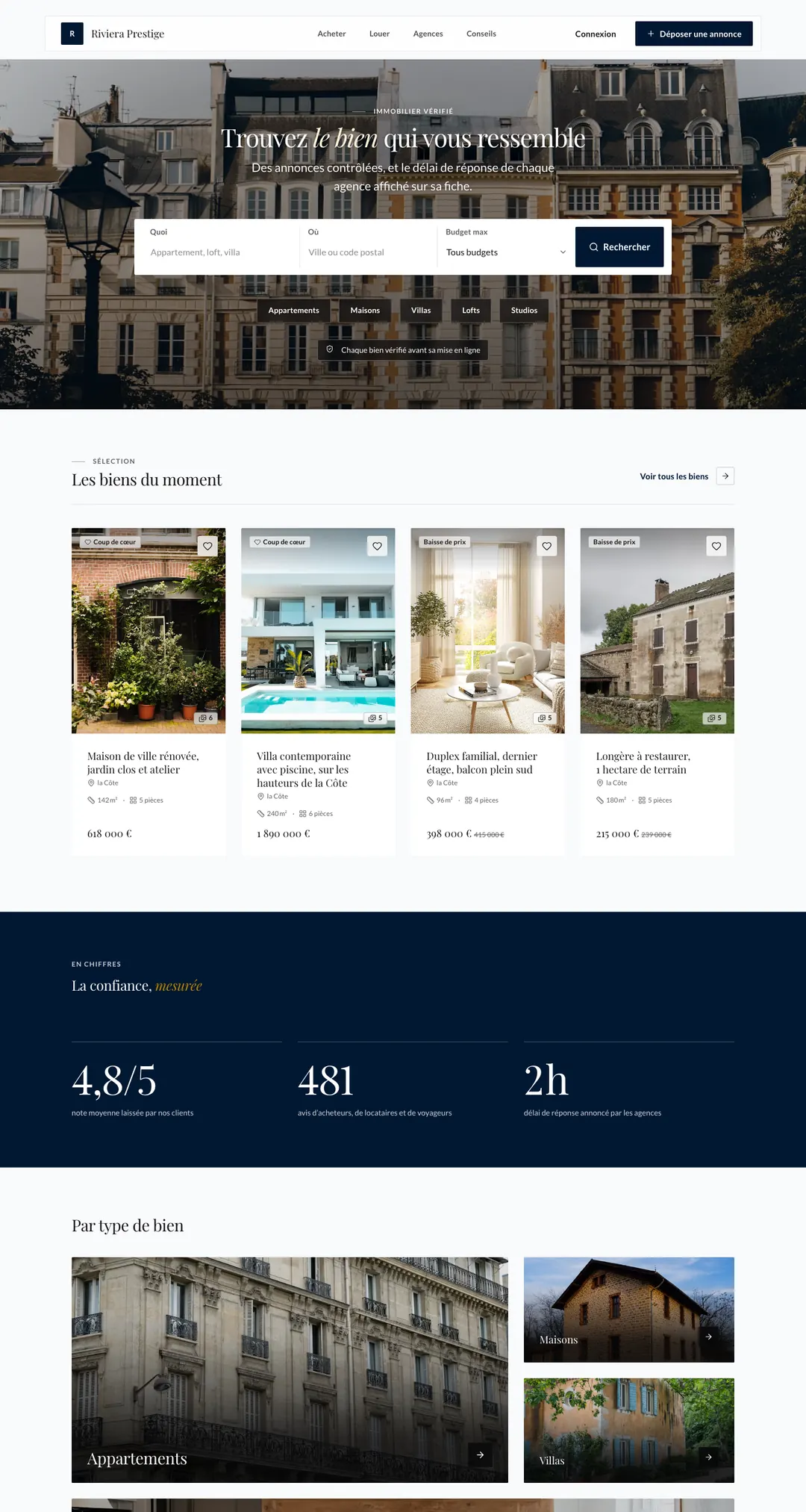
- Riviera Prestige: “A network of high-end estate agencies on the French Riviera”. Premium, understated style; map search and large photos carry the sale.
- Habitat Sud: the property marketplace whose four spaces the home page shows, from public site to back office.
- Toit & Moi (a play on “you and me” and “roof”): “Furnished flatshares for students, simple and efficient”. Functional style; each room states its tenancy type, individual or joint, and its deposit.
Riviera Prestige and Toit & Moi can be browsed in the examples gallery; Habitat Sud on the home page.
Budget
| Step | Marketplace Factory plan, excl. VAT | For a listing website |
|---|---|---|
| Try | Studio, €0 | complete proposals in a few minutes, edits, private preview |
| Open | Launch, €79 a month + 2% of online payments | name.marketplacefactory.app address, map search, alerts, listing review, statistics, online payment included: enough to open a flatshare site or a first portal |
| Become a brand | Pro, €199 a month + 1.5% | everything in Launch, plus up to 3 domain names, your emails sent from your domain, connectors, several admins: the plan for a regional portal |
| Large network | Dedicated, from €990 a month + 1% | dedicated installation, 7-day support, custom volumes |
Our share applies only to payments collected online on the site, refunds deducted: what you invoice advertisers offline carries none. When payments do go through the site, here is what you pay in total per month, excluding VAT and Stripe fees:
| Online payments per month | €1,000 | €5,000 | €10,000 |
|---|---|---|---|
| Launch, €79 + 2% | €99 | €179 | €279 |
| Pro, €199 + 1.5% | €214 | €274 | €349 |
| Dedicated, from €990 + 1% | €1,000 | €1,040 | €1,090 |
Above about €24,000 a month, Pro costs less than Launch; on Dedicated, the rate is renegotiated for large volumes.
Add a lawyer for your terms and the licence question, and a budget to make the site known to agencies. The full cost of a marketplace is in the cost to build a marketplace, plans on the pricing page, and the whole project in our guide on how to build a marketplace.
With Marketplace Factory, your portal arrives complete from one sentence: map search, listings ready for energy ratings and agency fees, an advertiser space, review before publication and a back office, without a line of code.
Frequently asked questions
Do I need an estate agent licence to run a property listing portal?
It depends on the country and on what you do. In the UK, the Estate Agents Act 1979 does not treat merely publishing advertisements or providing a means of communication as estate agency work. In France, selling lists of available properties to searchers requires a professional card. As a rule of thumb, publishing others' listings is one thing; negotiating or taking a fee on the deal is another. Confirm with a local lawyer.
What must an online property listing show?
In the EU, the recast Energy Performance of Buildings Directive requires the energy performance class and indicator in all advertisements, online and offline, including property portals. In the UK, an Energy Performance Certificate must be ordered before a property is marketed for sale or rent. National rules add more, such as agency fees in France or asking rents in England.
How do property portals make money?
The usual model charges advertisers, not searchers: a monthly subscription by number of listings, paid featured placement, services such as virtual tours. At launch, a simple monthly invoice is enough; with Marketplace Factory, an invoice settled outside the site carries no share of sales. Charging searchers to access listings brings you closer to regulated activities in some countries, such as selling property lists in France.
Can agencies and private landlords share the same site?
Yes, as long as each advertiser’s status is clearly shown, as EU consumer law requires of marketplaces: a private landlord charges no agency fees, while an agency must show its fees and legal details. Give each type of advertiser its own sign-up path and documents, and a filter to tell them apart.
Sources11
The pages cited in this article, checked on the date given in the text.
- eur-lex.europa.eu/legal-content/EN/TXT/?uri=CELEX:32024L1275
- gov.uk/buy-sell-your-home/energy-performance-certificates
- gov.uk/government/publications/guide-to-the-renters-rights-act/guide-to-the-renters-rights-act
- law.cornell.edu/uscode/text/42/3604
- legislation.gov.uk/ukpga/1979/38/section/1
- legifrance.gouv.fr/loda/article_lc/LEGIARTI000028806892
- entreprendre.service-public.gouv.fr/vosdroits/F38657
- service-public.gouv.fr/particuliers/vosdroits/F16096
- service-public.gouv.fr/particuliers/vosdroits/F1169
- eur-lex.europa.eu/legal-content/EN/TXT/?uri=CELEX:32019L2161
- eur-lex.europa.eu/legal-content/EN/TXT/?uri=CELEX:32021L0514
These articles are written by the Marketplace Factory team, who build the studio and the marketplaces it generates. How we write