By industry
How to start a handmade marketplace without relying on Etsy
How to start a handmade marketplace for a makers' collective: shops, basket, commission, budget, Etsy fees compared, and what your makers gain from it.
Contents
A makers' collective, a guild of craftspeople from one valley, a shop that sells one-off pieces on consignment: sooner or later they all ask the same question. Should everyone keep selling on Etsy, or should we start a handmade marketplace of our own? The answer comes down to two figures and a method: what Etsy costs your makers, what your own marketplace costs, and how to bring in your buyers. This guide gives all three, with the prices of Marketplace Factory, which creates complete marketplaces from a single sentence, and details what a makers' marketplace must plan for: shops, basket, shipping, returns and seller status.
Why a collective opens its own marketplace
The reasons that come up:
- Identity: a region, a craft, a curated selection. On Etsy, a shop gets lost among all the others; with you, it belongs to a collection.
- Chosen rules: who can sell, what really counts as handmade, how pieces are photographed, lead times.
- The relationship with buyers: your customers, your newsletter, your events.
- Money that stays in the collective, to pay for photos, fairs, advertising.
There is a constraint too. Etsy’s policy says that “any action to move a transaction off the Etsy platform is strictly prohibited”, including “directing buyers to another venue via a QR code” (Etsy’s Fees & Payments Policy, version of 13 February 2026). Customers found on Etsy stay on Etsy.
What it takes to succeed: about ten makers at least, a first audience (a market, a venue, followers) and one person who runs the site every week.
What Etsy costs a maker on 1,000 of sales
Assumptions: 25 orders at 40, shipping included, 25 listings, paid through Etsy Payments. Etsy’s fees as read on 27 September 2026 in the Internet Archive copies of 19 September and 27 August 2026 (Etsy blocks automated readers), for a seller in the US and a seller in the euro area (France or Spain).
| Etsy fee | Calculation | US seller, $1,000 | Euro-area seller, €1,000 |
|---|---|---|---|
| Listing | 25 listings × $0.20 | $5 | $5, about €4.40 |
| Transaction | 6.5% of the displayed price plus shipping | $65 | €65 |
| Payment processing | US: 3% + $0.25 per order; France and Spain: 4% + €0.30 | $36.25 | €47.50 |
| Total before advertising | about $106, 10.6% | about €117, 11.7% | |
| Offsite Ads, if 5 orders come from them | 15% of 200 | $30 | €30 |
| Total with offsite ads | about $136, 13.6% | about €147, 14.7% |
A UK seller pays 4% + £0.20 per order in processing, so about £110 on £1,000 before ads, plus $5 of listing fees. Sources: Etsy’s fees policy for listing, transaction and Offsite Ads (15% under $10,000 of yearly sales, with an opt-out; 12%, compulsory, above), and the Etsy Payments policy, updated on 31 July 2026, for processing fees by country. Etsy’s site refuses automated readers, so we read both policies in Internet Archive copies of 19 September and 27 August 2026: check them in your own browser before deciding. Etsy may also add a shop set-up fee or country-specific regulatory fees.
And on a collective’s marketplace
Same assumption, ten makers at 1,000 each: 10,000 in sales, 250 orders, a 10% commission. Costs from a euro-area Stripe account:
| Item, per month | Amount |
|---|---|
| Marketplace Factory, Launch plan: subscription (excl. VAT) | €79 |
| Marketplace Factory, 2% share of sales paid online | €200 |
| Stripe: 250 standard European card payments, 1.5% + €0.25 | €212.50 |
| Stripe Connect, platform-set pricing: 10 active makers at €2, then 40 weekly payouts, 0.25% of €9,000 paid out + €0.10 each | €46.50 |
| Total cost for the collective | €538, or 5.4% of sales |
| Commission collected, 10% | €1,000 |
| Left to run the collective | €462 |
Fees read on Stripe’s price list and Connect pricing; a premium card costs more (2.8% + €0.25). On Pro, with your own domain name, the subscription and our share come to €349 instead of €279. With US Stripe pricing (cards at 2.9% + 30¢, Connect at $2 and 0.25% + 25¢), the same volume in dollars costs about $365 in card fees and $53 in Connect.
On the maker’s side: 10% commission, against about 10.6% to 14.7% on Etsy depending on country and ads. The gap is small in the US, clearer in Europe.
The other difference cannot be priced: every buyer the collective brings in stays with the collective, with their address, their next order and their visit to the next market. The full twelve-month cost of a marketplace is in the cost to build a marketplace.
What you need: shops, basket, shipping, returns
- A shop per maker: their story, their workshop, their photos, their lead times.
- Listings that say everything: dimensions, materials, care, making time for made-to-order pieces, stock (often a single item).
- An order flow: at first, a request confirmed by the maker is enough; the basket with online payment comes later. If a basket mixes several makers, each ships and invoices their own part: plan shipping costs per shop.
- Delivery or collection: tracked shipping, hand-over at the workshop, collection at a market.
- Common return rules, written and shown before purchase.
With Marketplace Factory, these pieces come together: finished proposals from one sentence, in a few minutes, then the collective’s complete marketplace (public site, buyer account, maker space, back office), online payment from the Launch plan, without a line of code.
When the seller is a trader, the consumer’s right to cancel lasts fourteen days. Two exceptions matter a lot for makers, both under Article 16 of the EU Consumer Rights Directive and regulation 28 of the UK Consumer Contracts Regulations: goods “made to the consumer’s specifications or clearly personalised”, and goods liable to deteriorate rapidly. Mind the nuance the French administration spells out (service-public.fr, in French): choosing a colour or finish from the maker’s usual options does not make a piece clearly personalised. A bowl engraved with a name is; a bowl chosen in blue rather than green is not.
In the EU, since 19 June 2026, withdrawal must also be possible online, through a function labelled “withdraw from contract here” or an unambiguous equivalent (Directive (EU) 2023/2673, Article 11a). The duty falls on the trader, but the marketplace’s interface carries it: if your makers are traders selling at a distance, it must be there. Details are in marketplace legal requirements in the EU.
Traders or hobbyists: what to display
A collective often mixes established craftspeople and weekend makers. That is allowed, as long as you say so. EU consumer law, since the Omnibus Directive (EU) 2019/2161, requires marketplaces to tell buyers whether each seller is a trader and, if not, that EU consumer rights do not apply. In marketplaces made with Marketplace Factory, each seller declares their status before publishing their shop, and it shows on their page.
Three points specific to makers:
- Define your words. “Handmade”, “artisan”, “upcycled” or “refurbished” are promises. Write in your rules what each means on your marketplace, and check local rules: some terms are regulated in some countries.
- Tax reporting has a threshold for goods. In the EU (DAC7) and the UK (HMRC), a seller with fewer than thirty sales for no more than €2,000 (about £1,700) in the year is not reported; above that, the platform reports their income by 31 January.
- In the US, high-volume sellers must be verified. Under the INFORM Consumers Act, marketplaces selling new or unused consumer products collect and verify details from sellers with 200 or more sales and $5,000 or more over twelve months, and display contact details for those above $20,000.
The model: commission, shop subscription or membership fee
Three formulas, often combined:
- Commission: makers only pay when they sell. The easiest to accept at launch.
- Shop subscription: a fixed monthly amount, which suits makers who sell a lot and regularly.
- Membership fee: for a collective run as an association, a yearly fee can replace all or part of the commission.
The calculation above shows the threshold: with ten makers in Europe, the collective covers its costs once the commission passes about 5.4% of sales. Everything else funds the collective’s work. The full reasoning is in our article on the marketplace business model.
Bringing in buyers without Etsy’s audience
This is the work that decides success. What works for a collective:
- Markets and fairs, with a QR code to each maker’s shop on your site: what Etsy’s policy forbids, your marketplace allows.
- Each maker’s own networks, pointing to their shop in the collective rather than to an isolated shop.
- Pages by town and craft: “ceramics in Bristol”, “handmade gifts in Brittany”.
- Curated collections: Mother’s Day, back to school, Christmas, prepared two months ahead.
- Local partners: tourist office, bookshop, café, showing a few pieces and pointing to the site.
- A newsletter, sent to buyers who agreed to receive it.
To recruit the first makers, then the first buyers, the step-by-step method is in the marketplace chicken and egg problem.
Three examples from the gallery
Created by Marketplace Factory, each from one sentence; they are demos in French, not customer sites:
- Seconde Nature (“second nature”): “An online thrift shop for designers and second-hand clothes”. Raw style. Designers and second-hand side by side, so traders and private sellers mixed: each shop’s status becomes the key information.
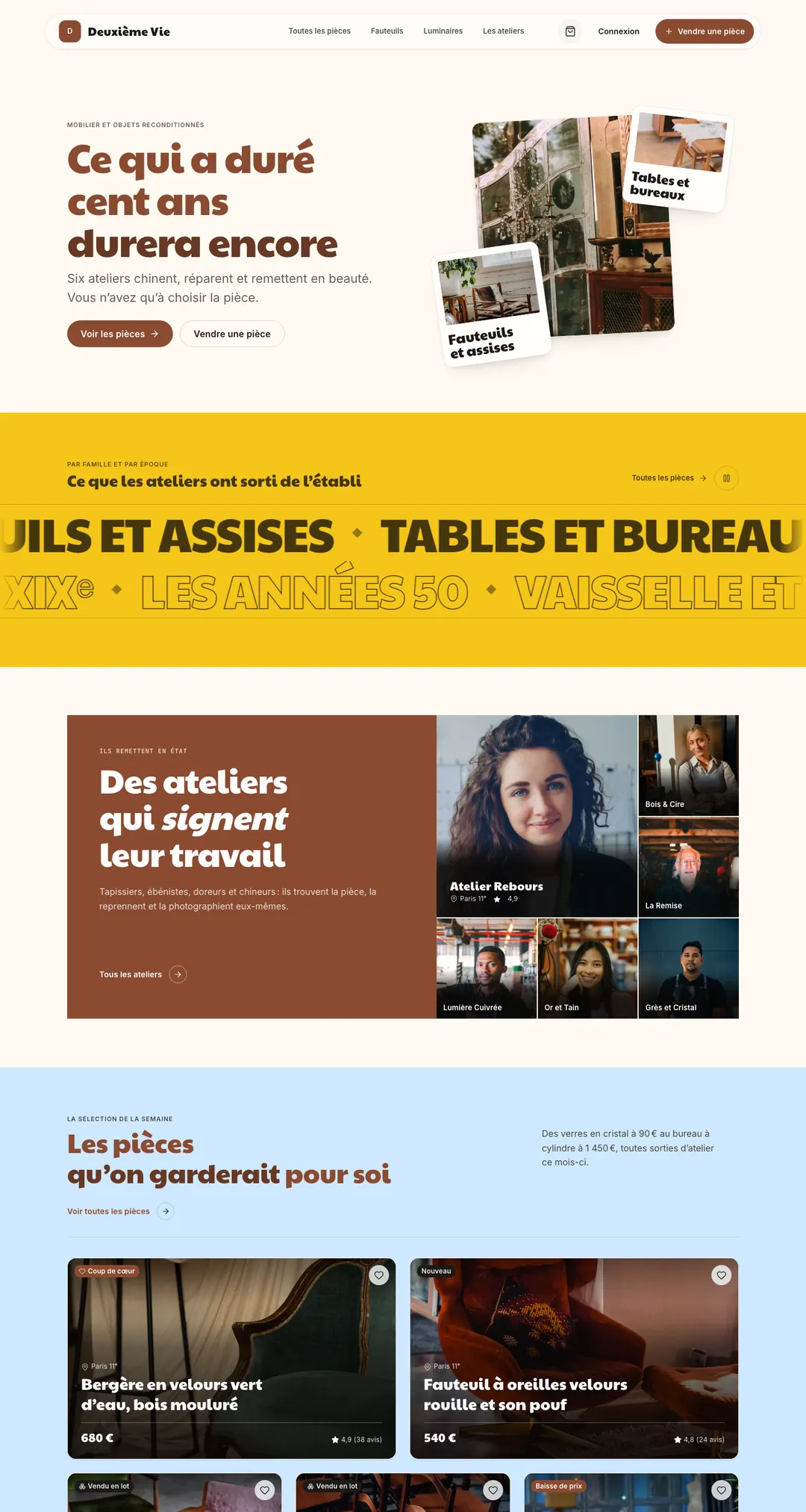
- Deuxième Vie (“second life”): “Furniture and objects refurbished by craftspeople”. Warm style. One-off pieces, precise dimensions, collection at the workshop for furniture, and the word “refurbished” used with care.
- À table (“dinner’s ready”): “Caterers and home cooks for family meals”. Raw style. Perishable food, so no right to cancel, and allergens to flag: the EU list is in Annex II of Regulation (EU) No 1169/2011, whose Article 14 requires mandatory information on prepacked food to be available before a distance purchase.
All can be browsed in the examples gallery.
Budget
| Step | Marketplace Factory plan, excl. VAT | For a collective |
|---|---|---|
| Try | Studio, €0 | complete proposals in a few minutes, edits, private preview |
| Open | Launch, €79 a month + 2% of online sales | name.marketplacefactory.app address, maker shops, basket and online payment on your Stripe account, your commission, makers paid out |
| Become a brand | Pro, €199 a month + 1.5% | everything in Launch, plus up to 3 domain names, your emails sent from your domain, connectors, several admins |
Our share applies to sales paid online, excluding shipping and after refunds; nothing on orders settled directly. What you pay in total per month, excluding VAT and Stripe fees:
| Online sales per month | €1,000 | €5,000 | €10,000 |
|---|---|---|---|
| Launch, €79 + 2% | €99 | €179 | €279 |
| Pro, €199 + 1.5% | €214 | €274 | €349 |
| Dedicated, from €990 + 1% | €1,000 | €1,040 | €1,090 |
Above about €24,000 of sales a month, Pro costs less than Launch. During the beta, you try everything without paying a thing: payments run in test mode. Plans are detailed on the pricing page, and the whole project in our guide on how to build a marketplace.
For a collective, Marketplace Factory changes the starting point: your makers’ complete marketplace, with their shops, online payment and a back office, comes from one sentence, and your buyers stay yours.
Frequently asked questions
Is your own marketplace cheaper than Etsy for makers?
Yes, in both of our examples. On $1,000 of sales, Etsy takes about $106 from a US seller before advertising, and about €117 on €1,000 from a seller in France or Spain, against $100 or €100 with a 10% commission on a collective’s marketplace. For the collective, the Marketplace Factory subscription, its share of sales and payment fees cost about 5.4% of sales in Europe; the rest of the commission funds the collective. And the buyers you bring in stay yours.
Who handles returns on a makers' marketplace?
In the EU and the UK, each maker who is a trader owes consumers a 14-day right to cancel for their own sales, except for items made to the buyer’s specifications or clearly personalised, and perishable goods. The marketplace sets common rules and shows them before purchase; in the EU, since 19 June 2026, its interface must also let trader-makers offer an online withdrawal function. Between private individuals the right does not apply, and buyers must be told.
Can hobby makers sell on a handmade marketplace?
Yes, as long as each shop clearly shows its status, private individual or trader, as EU consumer law requires of marketplaces. Buyers must know that a private seller owes them no right of withdrawal. On tax, platforms in the EU and the UK report sellers who reach thirty sales or exceed €2,000 in the year.
Do I need a multi-maker basket at launch?
No. At first, an order confirmed by the maker is enough: the buyer requests the piece, the maker confirms, and the two agree on payment and shipping. It validates demand cheaply. The basket with online payment comes once orders are regular; at Marketplace Factory, online payment is included from the Launch plan, and our 2% share applies only to sales paid online.
Sources15
The pages cited in this article, checked on the date given in the text.
- etsy.com/legal/fees
- etsy.com/legal/etsy-payments
- stripe.com/ie/pricing
- stripe.com/ie/connect/pricing
- stripe.com/pricing
- stripe.com/connect/pricing
- eur-lex.europa.eu/legal-content/EN/TXT/?uri=CELEX:32011L0083
- legislation.gov.uk/uksi/2013/3134/regulation/28
- service-public.gouv.fr/particuliers/vosdroits/F10485
- eur-lex.europa.eu/legal-content/EN/TXT/?uri=CELEX:32023L2673
- eur-lex.europa.eu/legal-content/EN/TXT/?uri=CELEX:32019L2161
- eur-lex.europa.eu/legal-content/EN/TXT/?uri=CELEX:32021L0514
- gov.uk/guidance/reporting-rules-for-digital-platforms
- ftc.gov/business-guidance/resources/informing-businesses-about-inform-consumers-act
- eur-lex.europa.eu/legal-content/EN/TXT/?uri=CELEX:32011R1169
These articles are written by the Marketplace Factory team, who build the studio and the marketplaces it generates. How we write