By industry
Build a website like Vinted: a second-hand marketplace
Build a website like Vinted for your community: resale, consignment or designers. Features, the law, shipping and the real budget, without a line of code.
Contents
Building a website like Vinted means giving a second life to what a community you know no longer uses: collectible sneakers, vintage fashion, children’s clothes from one school, gear for a sport. This guide explains how to go about it at your own scale: why a niche wins where a generalist struggles, the three possible models, the features you cannot do without, the law to respect, shipping and the real budget. Marketplace Factory creates your complete second-hand marketplace from one sentence: six finished proposals arrive in about a minute, then the site, sample listings included, within a few minutes.
Why a niche: a community, a style, a city
Second-hand keeps gaining ground. ThredUp’s 14th annual Resale Report, published on 2 April 2026 with research by GlobalData, found that “in 2025, the U.S. secondhand market grew nearly 4X faster than the broader retail clothing market”. The same report projects the global secondhand market to reach $393 billion by 2030, and the U.S. market alone $78.8 billion.
Those figures say two things. Demand is there. And the market rewards those who make buying second-hand easy and safe: a second-hand marketplace earns its living from trust, selection and the cart, not from pieces sold one by one at the lowest price. That is exactly what a niche makes possible:
- A community: sneaker collectors, riders, vinyl lovers, parents from the same school.
- A style: 70s vintage, designer fashion, streetwear, workwear.
- A city: the wardrobes of a neighbourhood, with collection in person and shipping for the rest.
In a niche, buyers find pieces described by people who know them, with the criteria that matter to them: size and “never worn” condition for a collectible pair, flat measurements for a vintage jacket. They come back, and gladly buy several pieces at once.
Three models: peer-to-peer, consignment, designers’ thrift shop
| Model | Who sells | What changes | What to watch |
|---|---|---|---|
| Peer-to-peer | private individuals clearing out their wardrobes | many pieces, low prices, a sale agreed by message or paid online | showing status, organising trust |
| Online consignment | one or more shops selling pieces left with them | checked pieces, higher prices, tracked stock | shop rules on second-hand goods, the right to cancel |
| Designers’ thrift shop | designers and workshops that rework or restore | one-off pieces, a story to tell | the words “handmade” or “upcycled”, made-to-order pieces |
Nothing forces you to choose a single model. Mixing private and professional sellers is allowed, as long as each seller’s status is shown: we come back to it in the section on the law. For designers, our guide on how to start a handmade marketplace goes further; for everyday items sold close to home, read the one on building a website like Craigslist.
The features of a second-hand marketplace
A second-hand marketplace looks like an online shop, with three differences: every piece is unique, every seller is different, and condition matters as much as price. Here is what it must do, and what a Marketplace Factory marketplace from the Selling goods family does:
- One-of-a-kind items: once paid, a piece leaves the site at once, never sold twice, even if two buyers make up their minds in the same second.
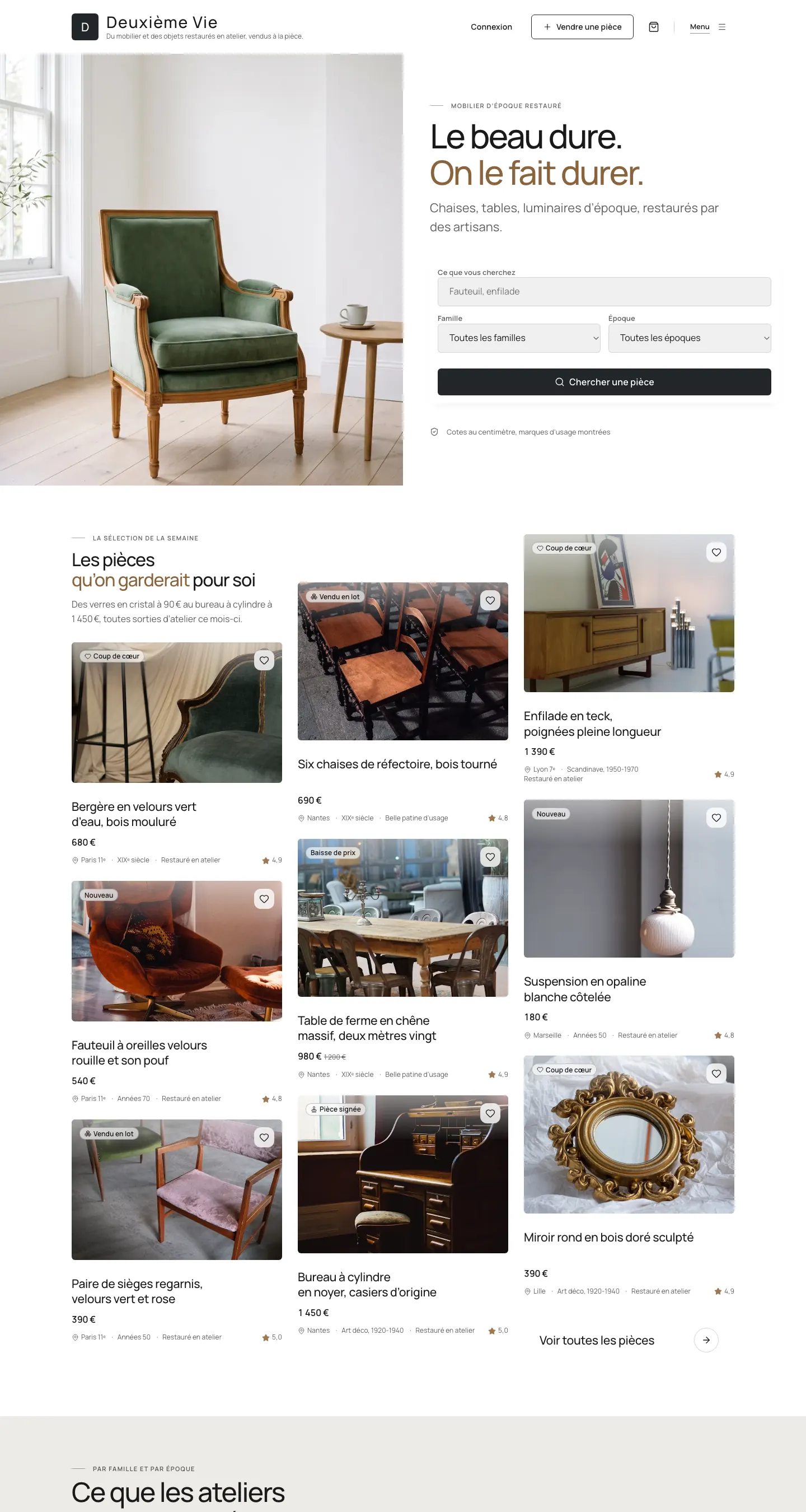
- Sizes and condition: guided listing creation asks your trade’s questions, with the photos, and saves the draft at every step. On the Seconde Nature (“second nature”) example, a jacket’s listing gives its condition, its size, its material and its era.
- One cart, several sellers: the buyer fills a single cart, from several sellers, and pays once; each seller receives their share of the same cart, minus your commission.
- Verified reviews: only a customer who bought can rate, and the rating shows on the listing and on the seller’s page.
- Search and alerts: your trade’s filters, and an email as soon as a new piece matches a saved search.
- Messaging: every request has its own conversation, with photos attached, for the question that decides a purchase, about the size or a flaw.
- Google Shopping, Facebook and Instagram: your catalogue goes out to their storefronts, up to 5,000 products.
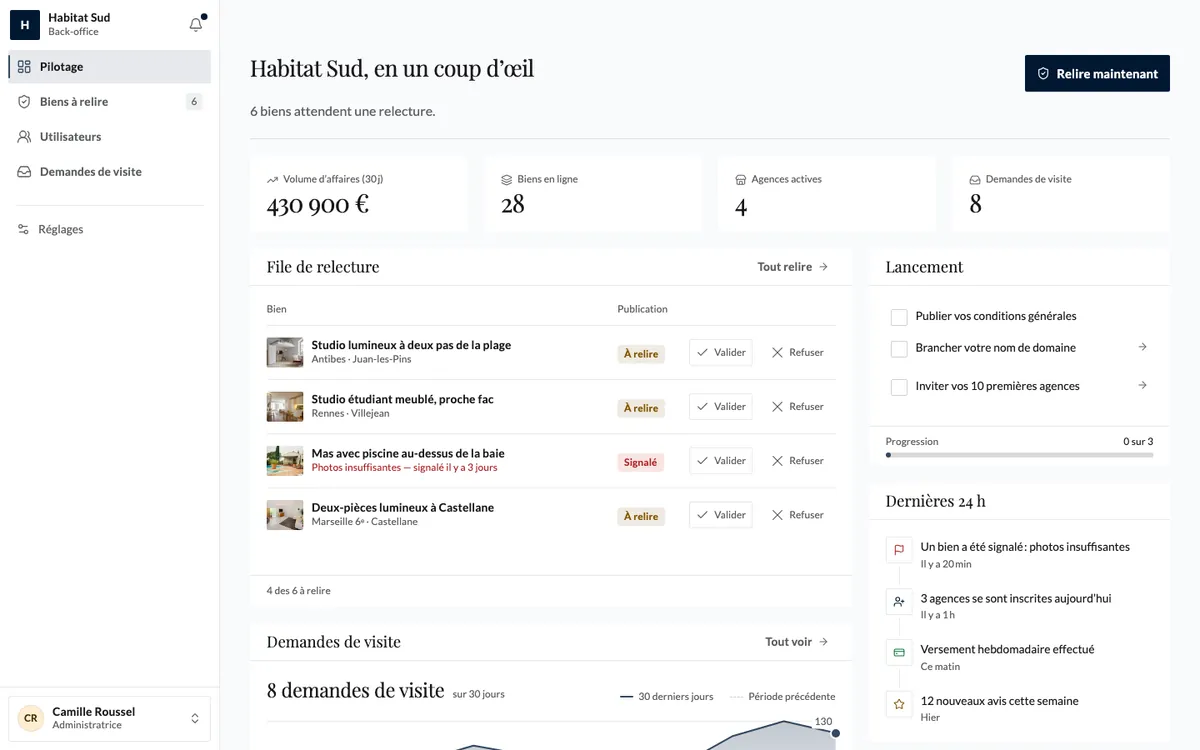
All of this comes with the marketplace’s four spaces (the public site, the buyers’ area, the sellers’ area and the back office) and its online payments on your own Stripe account, from the Launch plan. The details are on the Solutions page for selling goods.
The law: private or trader, reporting, high-volume sellers
Saying who sells. In the EU, since the Omnibus Directive (EU) 2019/2161, an online marketplace must tell consumers whether the third party offering an item is a trader or not and, if not, that consumer rights do not apply to the contract. The difference is concrete: a trader selling at a distance owes the buyer fourteen days to change their mind under the Consumer Rights Directive, and so does a UK trader under the Consumer Contracts Regulations 2013; a private individual selling their own belongings does not. In a Marketplace Factory marketplace, every professional declares their identity, and their company registration is checked.
Private sellers and tax. Selling your own used belongings is generally not a business; buying items in order to resell them, regularly, is. Someone who resells as a habit should sell on your site as a trader. In the US, the IRS treats payments for personal items such as clothing or furniture as reportable when they are sold at a gain, as its Form 1099-K page explains.
Reporting sellers’ income. Under the EU’s DAC7 directive, the platform reports its sellers’ income every year, by 31 January, except for sellers of goods with fewer than thirty sales and no more than €2,000 in the year; the UK’s platform reporting rules apply the same exclusion. In the US, payment platforms file Form 1099-K when a seller exceeds $20,000 in more than 200 transactions. Being reported does not mean being taxed, but plan to collect your sellers’ addresses and tax numbers before they cross those thresholds.
High-volume sellers in the US. The INFORM Consumers Act requires marketplaces selling new or unused consumer products to collect and verify the details of high-volume sellers, 200 or more sales and $5,000 or more over twelve months. On a sneaker marketplace, “deadstock” pairs are unused: the rule may apply to your biggest sellers.
Shops that resell. In some countries and states, businesses that buy used goods to resell them must keep a register or hold a dealer licence. If your sellers are shops, remind them of it in your terms.
The rest of the framework (digital services, personal data, terms and conditions) is in our guide to marketplace legal requirements in the EU.
Shipping, seller by seller
On a second-hand marketplace, there is no warehouse: each seller ships what they sell. Your role is to make the experience consistent, without taking on stock yourself.
- Clear options on every listing: tracked parcel, pickup point, hand-over in person for nearby buyers.
- A common shipping time, for example within 48 business hours, shown before purchase, as on a Seconde Nature jacket listing.
- Shipping costs per seller: a cart that brings together two sellers makes two parcels.
- Packaging and proof rules: photos before shipping, tracking number sent by message.
- A written return rule: fourteen days for traders, as the law requires; for private sellers, at least the return of a piece that does not match its description.
Shipping costs are added to the price of the items. At Marketplace Factory, our share never counts them: it applies to what your customers pay online, refunds deducted and delivery excluded.
The Seconde Nature and Semelle rare examples, and the budget
Two examples from our gallery, each created by the studio from a single sentence. They are demos, not customer sites.
- Seconde Nature: “An online thrift shop of designers and second-hand, collage spirit”. Second-hand pieces and designer pieces sit side by side, each described by its condition, its size and its material. When private individuals and shops sell together, each seller’s status becomes the key piece of information.
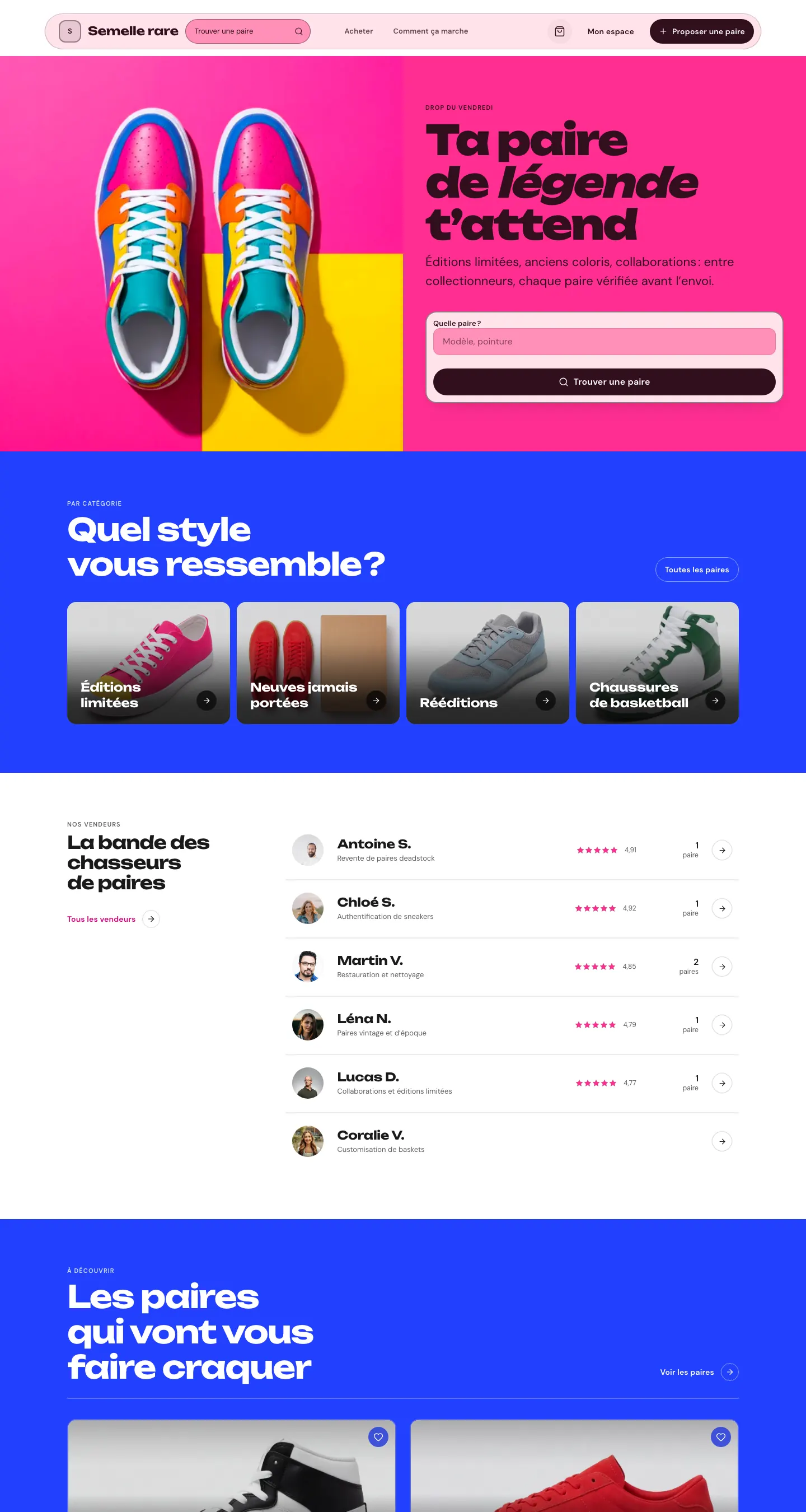
- Semelle rare (“rare sole”): “Buying and reselling collectible sneakers between enthusiasts, pop and colourful”. A niche of collectors, who search by model, brand or size: condition (“deadstock”, never worn) and the original box make the price. One piece of advice if you launch this kind of site: only promise that pairs are authentic once you have organised a real check. It is a promise that commits you.
The weight of small prices. On a €10 piece, each card payment carries €0.25 of fixed fees on top of 1.5%, according to Stripe’s price list for a euro-area account. The cart changes the sum:
| With a 12% commission | One €10 piece | A cart of three pieces, €30 |
|---|---|---|
| Platform commission | €1.20 | €3.60 |
| Stripe fee, standard European card | €0.40 | €0.70 |
| Marketplace Factory’s share, 2% on Launch | €0.20 | €0.60 |
| Kept by the platform, before Connect fees | €0.60 | €2.30 |
Per piece, the platform keeps €0.77 instead of €0.60. From a US account, where a domestic card costs 2.9% + 30¢ (Stripe US), the gap is wider: $0.41 kept on a single $10 piece, $0.61 per piece in a cart of three. To pay sellers their share, depending on the option chosen, Stripe Connect adds up to €2 per active seller per month and 0.25% + €0.10 per payout (Stripe Connect pricing). The cart, well-chosen pieces and a fair commission make a marketplace that lives.
What the site costs. Sharetribe’s guide to building a website like Vinted, updated on 18 June 2025, puts building one from scratch with a development team at “$50,000 to $200,000 or more”. Software to configure costs less but stays generic: at Sharetribe, going live takes the Live plan, at $199 a month billed yearly, read on 10 October 2026.
With Marketplace Factory, the complete marketplace is delivered, hosted and maintained for you. The studio is free to try, with 2 ideas and 10 edits free when you sign up, no card needed. To open, here is what you pay per month, excluding VAT and Stripe fees:
| Sales paid online per month | €1,000 | €5,000 | €10,000 |
|---|---|---|---|
| Marketplace Factory Launch, €79 + 2% | €99 | €179 | €279 |
| Marketplace Factory Pro, €199 + 1.5% | €214 | €274 | €349 |
| Marketplace Factory Dedicated, from €990 + 1% | €1,000 | €1,040 | €1,090 |
Above about €24,000 of online sales a month, Pro costs less than Launch, with up to three domain names and your emails sent from your domain. During the beta, you try everything without paying a thing: payments run in test mode. How the money travels, from the buyer to the sellers, is explained in our guide to marketplace payments with Stripe Connect.
Second-hand is won close to a community. With Marketplace Factory, yours gets its complete marketplace from one sentence: one-of-a-kind items, a cart for several sellers, verified reviews, online payments on your Stripe, without a line of code. Yours is the best part of the work: gathering the first sellers, and making people want to come back.
Vinted is a trademark of its owner; Marketplace Factory is not affiliated with it.
Frequently asked questions
Can private individuals sell on my second-hand marketplace?
Yes, as long as buyers know who is selling: a trader owes consumers the 14-day right to cancel a distance purchase in the EU and the UK, a private individual does not. For the seller, reselling their own belongings is generally not a business; buying to resell is. At Marketplace Factory, every professional declares their identity and their company registration is checked.
Who handles shipping on a second-hand marketplace?
Each seller ships what they sell, and the marketplace sets the common rules: shipping time, tracked parcel or pickup point, packaging, returns. Shipping costs are added to the price of the items. At Marketplace Factory, our 2% share on Launch never applies to delivery fees, only to the items paid online.
Do I need a cart for several sellers?
For second-hand, it is almost essential. Pieces are cheap: paid one by one, each one carries the fixed part of the payment fee. With a single cart, the buyer gathers pieces from several sellers, pays once, and each seller receives their share. Marketplace Factory includes it in the Selling goods family.
Are my sellers’ sales reported to the tax authorities?
Above a threshold, yes. In the EU and the UK, the platform reports sellers who reach thirty sales or exceed €2,000 in the year, by 31 January of the following year. In the US, payment platforms file Form 1099-K above $20,000 and 200 transactions. Being reported does not mean being taxed: selling your own used belongings for less than you paid is generally not income.
How much does a website like Vinted cost?
Sharetribe puts building one from scratch with a development team at $50,000 to $200,000 or more. Software to configure costs $199 a month billed yearly at Sharetribe Live. With Marketplace Factory, Launch costs €79 excl. VAT a month, plus 2% of sales paid online, with online payments, hosting and maintenance included, without a line of code.
Sources13
The pages cited in this article, checked on the date given in the text.
- newsroom.thredup.com/news/thredup-14th-resale-report
- eur-lex.europa.eu/legal-content/EN/TXT/?uri=CELEX:32019L2161
- eur-lex.europa.eu/legal-content/EN/TXT/?uri=CELEX:32011L0083
- legislation.gov.uk/uksi/2013/3134/regulation/29
- eur-lex.europa.eu/legal-content/EN/TXT/?uri=CELEX:32021L0514
- gov.uk/guidance/reporting-rules-for-digital-platforms
- irs.gov/businesses/understanding-your-form-1099-k
- ftc.gov/business-guidance/resources/informing-businesses-about-inform-consumers-act
- sharetribe.com/how-to-build/website-like-vinted
- sharetribe.com/pricing
- stripe.com/ie/pricing
- stripe.com/ie/connect/pricing
- stripe.com/pricing
These articles are written by the Marketplace Factory team, who build the studio and the marketplaces it generates. How we write