Guides
How long does it take to build a marketplace?
How long does it take to build a marketplace? Months custom, weeks to configure, a few minutes with Marketplace Factory: the full timeline, step by step.
Contents
How long does it take to build a marketplace? Vendors and agencies answer in months, sometimes in weeks. With Marketplace Factory, the answer is on another scale entirely: six finished proposals arrive in about a minute, and the complete marketplace, sample listings included, within a few minutes. What still takes time is no longer the technology: it is your sellers, your terms, your payments. The good news is that all of it can be prepared in parallel, and you can launch much sooner than you think.
This article gives the time each approach takes, with sources, what happens second by second after you write your sentence, what is still yours to do, and a four-week calendar to open.
How long it takes: the short answer
| Approach | Time announced or measured | According to | What you end up with |
|---|---|---|---|
| Custom development | 12 to 18 months of planning and coding to reach a first product | Marketplacer, May 2025 | your own software, to maintain |
| Custom rental marketplace | “6+ months to launch, even longer to refine and scale” | Sharetribe, March 2026 | an MVP, typically from $50,000 |
| Vendor platform, ready to configure | “as little as 6–12 weeks” | Marketplacer, May 2025 | the vendor’s platform, configured |
| Marketplace Factory | six proposals in about a minute; the complete marketplace within a few minutes | the promise on our home page; proposals measured in production on 6 October 2026 | the marketplace of your trade, ready to refine |
In every case, the opening date also depends on you: you need sellers, reviewed terms, payments ready. These are the jobs that make up most of the calendar today.
Why custom work is counted in months
Building a marketplace from scratch means writing four pieces of software that talk to each other: the public site, with its search and listing pages; the customer area; the seller area; the operator’s back office. On top come roles and permissions, so that no seller ever reads another seller’s requests, payments split between sellers, dozens of emails, moderation and legal pages. Each block is designed, coded, then tested with all the others.
Hence the months. Marketplacer, which sells marketplace software to retailers, recalls in an article of 24 May 2025 that “teams spent 12 to 18 months planning and coding to get to an MVP”, and promises for its own platform a launch “in as little as 6–12 weeks”. Sharetribe’s guide to building a website like Airbnb (updated 20 March 2026) gives the same order of magnitude for a rental marketplace developed to measure: “6+ months to launch”, with custom development that “typically starts around $50,000 for an MVP”.
That time is not wasted: it goes into writing what others have already written. A platform ready to configure shortens the road, since the code exists; its setup, its copy, its branding and the connection of your tools remain. Our checklist for a turnkey marketplace says what those blocks must contain on the day you open.
What happens after your sentence, step by step
With Marketplace Factory, there is no specification and no configuration: you write one sentence, for example “Personal trainers who come to your home, in Manchester”, and the work starts. Here is what happens, timed to the second. The times come from a measurement made in production on 6 October 2026 on three real creations, a florist, indoor plants and craftspeople, written in French; they are counted from the moment the sentence reaches our servers.
| After the sentence arrives | What Marketplace Factory does |
|---|---|
| about ten seconds | the sentence is read: the trade, the city, the audience, the style |
| 19 to 22 seconds | the cover photos of the six proposals are ready |
| 28 to 32 seconds | the marketplace’s name and categories are written |
| 33 to 37 seconds | the taglines of the six proposals are written |
Then the six proposals appear, finished, copy and photos included: the Marketplace Factory home page promises six finished proposals in about a minute. They do not look alike: each one comes from a different style, from chic to graphic, from young to calm, and each already carries your project’s name and its four spaces. What the AI does during that minute, and what it never touches, is detailed in build a marketplace with AI.
Last come the sample listings. For a trade read in your sentence, Marketplace Factory prepares a photo gallery for each one, checked photo by photo before it is kept: that is the longest part of the creation, the part that takes you from one minute to a few minutes. You do not have to wait for it to look around: the proposals appear as soon as they are finished, and the listings join them as they are prepared.
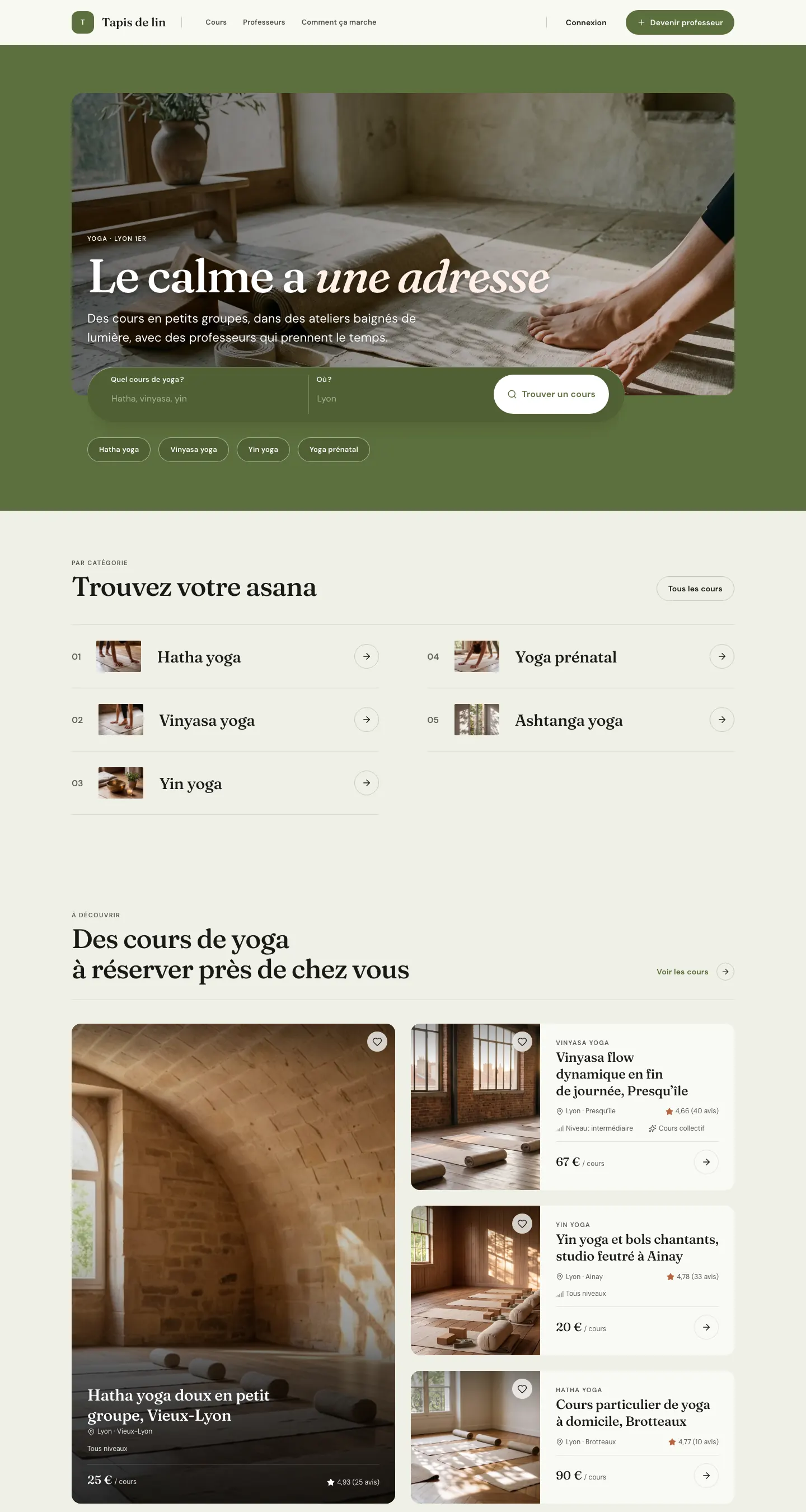
To see what the result looks like, the examples gallery shows twenty marketplaces, each born from one sentence.
Your first hour
Since the technology is ready within minutes, your very first hour can already serve your project. Here is how to spend it, without paying anything:
- Write your sentence, then a variant. Two ideas are free when you sign up: try for example “Personal trainers who come to your home, in Manchester”, then “Running and strength coaches who come to your home, in Manchester, understated style”. Comparing two readings of your idea helps you sharpen it.
- Open two or three proposals. Walk through the customer area, the seller area and the back office the way your customers, your sellers and your team would. In ten minutes, you know whether the flow fits your trade.
- Keep the one that feels like you, and refine it. The title, the tagline, a colour: the ten free edits are enough to make it yours.
- Write down what belongs only to you: your cancellation rules, your guarantees, your prices, what sets you apart.
- Start the list of your first fifty sellers, with their names and a way to reach them. That list is what will set your opening date.
What still takes time
Four jobs remain yours, whatever the solution. None needs a developer; all of them need your attention.
Your first sellers
This is the real critical path. A visitor who finds three listings leaves; one who finds twenty, in their city and their trade, comes back. The first sellers are convinced one by one: a list of fifty names, calls, meetings, then the first listings created with them, with good photos. Count most of your first weeks here. Methods and numbers to track are in our article on the marketplace chicken and egg problem.
Your terms and your business
Marketplace Factory provides each site’s legal pages, written for the country where you are established: legal notice, privacy, terms of use, and terms of sale as soon as the site takes payments. They are binding on you: have them reviewed. And register your business before you take money, since you become a platform operator. What your terms must say is in our guide to marketplace terms and conditions.
Live payments
Online payments go through your own Stripe account. In test mode, the account is ready at once; Stripe will ask for your documents before the first real payment. Not ready to take money yet? Open in request mode: the customer asks, the seller confirms, payment happens offline, and you connect Stripe later, without rebuilding anything.
Your domain name
On Launch, your marketplace is live at a .marketplacefactory.app address, with nothing to set up. On Pro, it moves to your own domain name, up to three of them, with your emails sent from yours: allow time to buy the name and connect it.
Three trades, three critical paths
The longest job changes from one trade to another. Three examples:
- Personal trainers who come to your home. The longest part is gathering enough coaches, available at the hours your customers look for them, and writing cancellation rules everyone accepts.
- Camper vans rented between individuals. You have to convince owners, get good photos of every van and settle insurance before the first rental. Our guide on how to build a rental marketplace covers these points.
- An online thrift shop. Every piece is unique: photographing it, describing it and setting shipping and return rules takes longer than finding people who sell.
In all three cases, the marketplace itself is ready from day one: the time goes to the trade, not to the software.
A four-week calendar
For a local marketplace, one trade and one city, here is a pace that holds: it leaves time to meet every seller, which remains the best way to begin.
| When | What you do | What it costs |
|---|---|---|
| Day 1 | write your sentence, compare the six proposals, choose yours; list fifty possible sellers | nothing: 2 ideas and 10 edits free when you sign up, no card needed |
| Week 1 | refine the copy, photos and colours; set your rules: commission, cancellation, listing review; read the terms | AI credits beyond the free edits |
| Week 2 | meet the first sellers and create ten to twenty complete listings with them; open your Stripe account, connect it, set your commission | your time |
| Week 3 | test every flow end to end with people you know: request, payment in test mode, cancellation, emails | your time |
| Week 4 | open, in request mode or with online payments; bring in the first requests and measure every week | Marketplace Factory Launch: €79 excl. VAT a month, plus 2% of sales paid online |
During the beta, you try everything without paying a thing: payments run in test mode. On Pro, at €199 excl. VAT a month plus 1.5%, your marketplace moves to your own domain name, with ten administrators.
Four weeks is not a rule: you can open sooner, with five founding sellers and request mode, or take the time to gather fifty listings. Our guide on how to build a marketplace extends this calendar to twelve weeks, up to the first sales, online payments and your commission.
What saves time, whatever the solution
- A narrow market. One trade, one city, one audience: you know whom to call from day one.
- Request mode first. No payments to connect to prove there is a market.
- Founding sellers. Five committed sellers beat fifty silent sign-ups.
- No mobile app at the start. The public site of every marketplace Marketplace Factory creates is built for computers and phones alike.
- Measuring every week. Requests received, seller response rate, returning customers: fix what gets stuck, one thing at a time. The numbers worth tracking are in our guide to marketplace metrics.
With Marketplace Factory, the time it takes to build a marketplace is counted in minutes: what is left is to fill it with sellers and customers, and that is the best part of the work.
Frequently asked questions
Can you build a marketplace in a day?
Build it, yes: with Marketplace Factory, six finished proposals arrive in about a minute, and the complete marketplace, sample listings included, within a few minutes. Opening to the public the same day is rarer: you need sellers, reviewed terms and, to take payments, a verified Stripe account. Request mode lets you open before you switch on online payments.
Why do agencies talk about months?
Because they build: four spaces, roles and permissions, split payments, dozens of emails, moderation, then testing. Marketplacer recalls that teams spent 12 to 18 months planning and coding to reach a first product built from scratch. Marketplace Factory starts from building blocks already written and tested: only your trade, your copy and your sellers remain.
What takes the longest?
Sellers. A marketplace opens when there is something to choose from: ten to twenty complete listings with good photos beat an empty catalogue, and they are won one by one, on the phone or in person. With Marketplace Factory, the technology is ready within minutes: all your time goes to that supply.
Do I have to wait for all my sellers before opening?
No, but do not open empty. Start with a few founding sellers, one city and one trade, then add the others week by week. At Marketplace Factory, you can open in request mode, without online payments, then connect your Stripe account once confirmed requests come in.
Sources2
The pages cited in this article, checked on the date given in the text.
These articles are written by the Marketplace Factory team, who build the studio and the marketplaces it generates. How we write