Tools
Build a marketplace with AI: one sentence is enough
Build a marketplace with AI: one sentence, six finished proposals in about a minute, edits on request, and what AI must never touch. A plain-English guide.
Contents
Building a marketplace with AI, in 2026, can mean two very different things. Asking an app builder to write, screen by screen, a site that looks like a marketplace. Or describing your project in one sentence and receiving a marketplace that already works. Marketplace Factory does the second: six finished proposals arrive in about a minute, each with its four spaces, your trade’s flow and online payments, without a line of code.
This article shows what the AI does at each step, from reading your sentence to the edits, what it must never invent, and what it costs. It ends with a point-by-point comparison of an AI app builder and Marketplace Factory.
What AI does well, and what it must never invent
AI shines at what you can see: understanding an intention, writing copy, composing a page, creating photos, offering variations, fixing something in seconds. Days of work for a designer and a copywriter now fit into a minute.
It is less at home where a mistake stays invisible until it costs money:
- Payments: the right amount, the commission, the seller’s share, the refund. One approximate rule, and money goes to the wrong place.
- Access rights: who sees which requests, who can edit which listing. One forgotten rule, and a seller reads a competitor’s messages.
- Data: who receives it, where it is kept, how it leaves.
If the AI rewrites those rules on every request, every new version can break them. Marketplace Factory takes the opposite stance: these blocks are written once, tested, the same for every marketplace, and the AI only works on what you see.
| Marketplace Factory’s AI handles | What never depends on it |
|---|---|
| reading your sentence: the trade, the city, the audience, the style | accounts, roles and access rights |
| writing the name, categories, taglines and copy | payments on your Stripe account, the commission, refunds |
| preparing photos for your trade | the emails of every step, already written |
| composing six proposals in contrasting styles | moderation, reports, legal pages |
| editing a text, a colour, a section, at your request | hosting, backups, the export of your data |
And your data? Marketplace Factory’s AI runs through Anthropic and Google, which only receive what the task requires, never your account or payment data. Your data stays hosted in the European Union, on AWS in Stockholm, and is backed up every day.
Your sentence, read
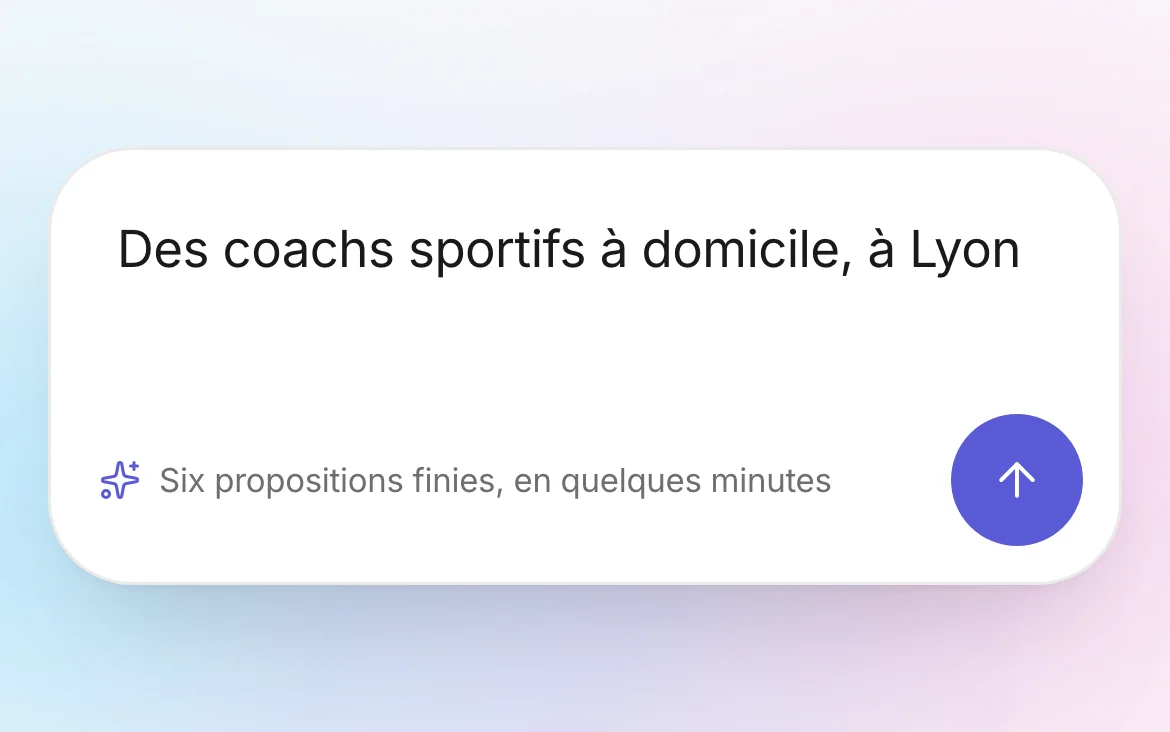
Everything starts with one sentence, in the bar on the home page. No specification: your trade, your customers, your city and, if you have one, the style you want. Three sentences from our gallery show what one sentence can say:
- “Exceptional villas to rent in Marrakech, chic black and gold”: a rental, a place, a style;
- “Small-group yoga classes in Lyon, natural and bright”: classes, a city, a mood;
- “Exceptional craftspeople to renovate your home, on quote, natural and terracotta”: work on quote, private customers, a material.
Marketplace Factory deduces the trade and its flow. Nineteen trades are in the catalogue: real estate, home care, boat rental, fashion and second-hand, personal trainers, cleaning, car rental, house shares, student jobs, meals and caterers, events, private concierge, leisure, consulting and freelancers, classifieds, outdoor gear, refurbished objects, online courses, and a general model for services.
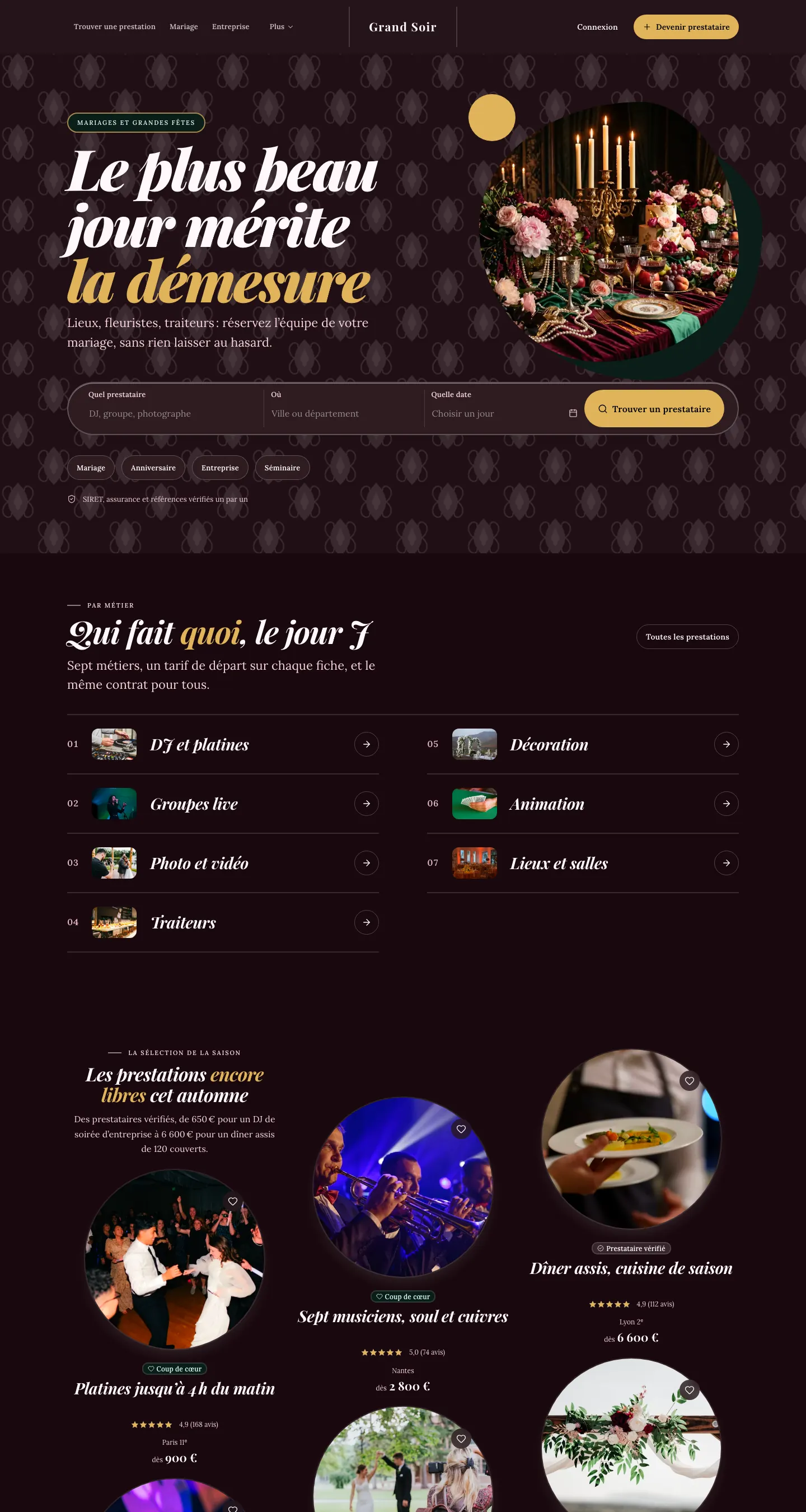
Your trade is not there? Describe it. Marketplace Factory reads it in your sentence and gives it one of ten families of flows, from nightly stays to job applications, by way of appointments, carts and quotes. The sneakers, the villas and the yoga of the gallery were born that way.
Writing a good sentence: five tips
A good sentence fits on one line and answers five questions. No need to say more: the rest is refined afterwards.
- Who sells? Private individuals, craftspeople, agencies, certified coaches: the flow and the rules depend on it.
- What, exactly? “Converted vans” rather than “vehicles”, “treatments and massages at home” rather than “wellness”.
- For whom, and where? A city, a neighbourhood, an audience: “for students and young professionals”, “in Lyon”, “on the Riviera”.
- How is the deal closed? By the night, by the day, on quote, through a cart, by application: one word is enough to pick the right flow.
- In what style? “Chic black and gold”, “70s retro”, “natural and bright”; with no style stated, the six proposals explore contrasting directions.
Compare: “a services marketplace” leaves everything to guess; “Exceptional craftspeople to renovate your home, on quote” states the trade, the audience, the flow and the tone. Other sentences from the gallery make good models: “Furnished flatshares for students and young professionals, Y2K spirit”, or “Characterful motorbikes to rent between riders, urban poster style”.
Six proposals, sixteen styles
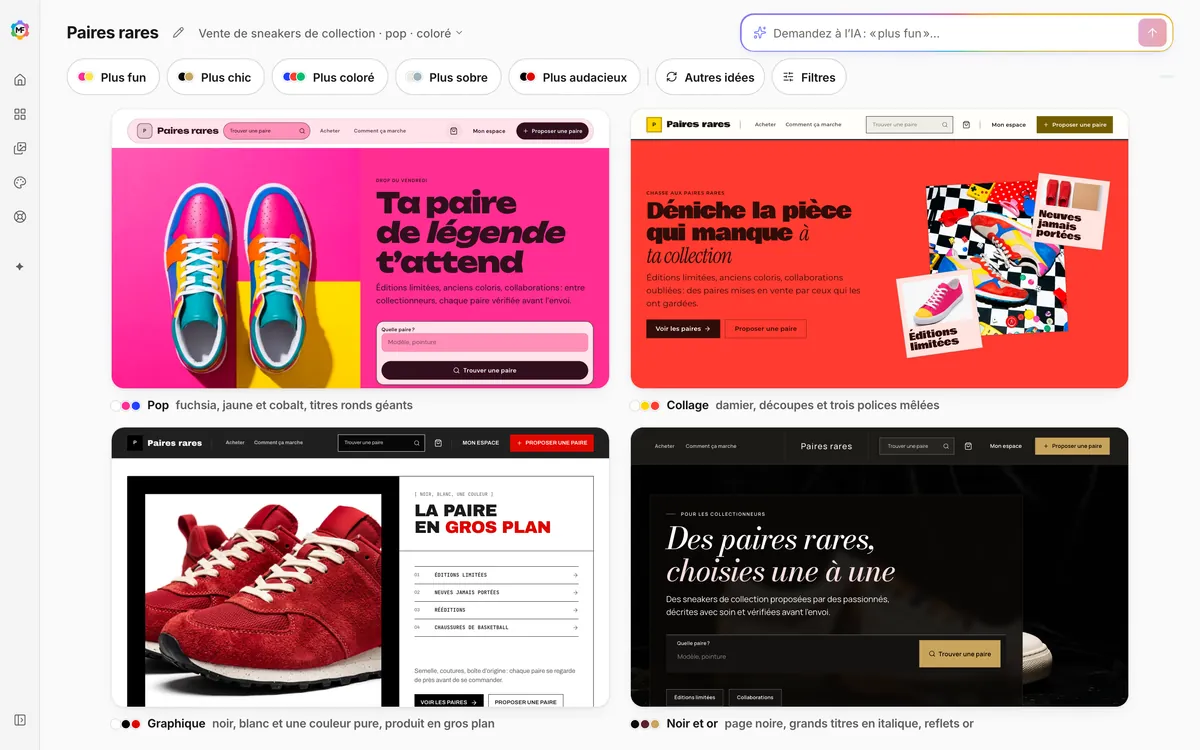
Once the sentence is read, Marketplace Factory composes six finished proposals, in about a minute. Not six colours of one template: six directions, drawn from sixteen complete styles in four families, from chic (black and gold, Art Deco, baroque…) to young (pop, chrome Y2K, collage…), from graphic (black and white, brutalist, neon…) to calm (magazine, Nordic minimal, 70s retro…). The proposals contrast on purpose: you quickly recognise the one that feels like you.
Each proposal carries your project’s name, its categories, its copy, and photos created for your trade, then kept in your media library. Above all, each one is a real site: open one, and try the customer area, the seller area or the back office. You like none of them? Six other proposals cost 10 credits.
An example: collectible sneakers
Take the sentence that gave Semelle rare (“rare sole”) in our gallery: “Buying and reselling collectible sneakers between enthusiasts, pop and colourful”. The reading finds a trade that is not in the catalogue, sneaker resale, an audience of enthusiasts and a style, pop. Semelle rare kept the Pop style: fuchsia, yellow and cobalt, giant rounded titles. On its board, the same idea also exists in Collage (checkerboard, cut-outs and three mixed typefaces), in black-and-white Graphic (one pure colour, the product in close-up) and in Black and gold (a black page, large italic titles, gold highlights): one sentence, brands that look nothing alike.
Once you have chosen, editing takes over. Ask for “rewrite the title, warmer”: the title changes in that direction, for 2 credits, and you judge the result for yourself.
The sixteen styles, and the twenty gallery examples that show them, are presented in our article on the marketplace template; the examples gallery shows them full size.
Editing: the AI, the editor, the design
“Ask AI”
One sentence is enough to edit too. “Make the home page warmer”, “shorten the title”, “make the buttons green”: “Ask AI” changes a text, a colour, a section. Every edit is made by Claude Opus 5.5, from Anthropic, and costs 2 credits. Every action shows its price before it runs, and an action that fails, or changes nothing on your site, costs you nothing.
The editor, by hand
For what you would rather set yourself: sections, a drag-and-drop outline, texts, colours and fonts. Nothing to code, nothing to install.
Changing the design without losing anything
You like a proposal for its content, less for its style? Move it to another style: the design changes, the content stays. That is the advantage of a marketplace built on shared building blocks: style is a layer, not a foundation.
For everything that can be done without a line of code, and the other tools that allow it, see no-code marketplace builders.
What the AI costs
When you sign up, 2 ideas and 10 edits are free, no card needed. Beyond that, AI is paid in credits, which you can buy as soon as your account exists, with no subscription; every plan also includes credits each month.
| Action, at Marketplace Factory | Credits |
|---|---|
| A new idea: six proposals | 20 |
| Six other proposals (“More fun”, “Other ideas”…) | 10 |
| An edit by the AI, made by Claude Opus 5.5 | 2 |
| A photo | 5 |
| An article or an SEO page | 10 |
| Rewrite all the site’s copy | 17 |
| A logo, in three versions to choose from | 20 |
| A set of about a dozen photos for your trade | 60 |
| A welcome video | 60 |
Credits included: 200 a month on Launch, 1,000 on Pro, 5,000 on Dedicated; a month’s credits carry over to the next month. Top-ups: 100 credits for €10, 500 for €45, 2,000 for €160 excl. VAT. Launch’s 200 credits are, for example, a hundred edits a month.
And the marketplace itself: €79 excl. VAT a month plus 2% of sales paid online on Launch, online payments included; €199 excl. VAT plus 1.5% on Pro, with your own domain name. The pricing page details everything. During the beta, you try everything without paying a thing: payments run in test mode.
AI app builder or AI marketplace builder
AI app builders, such as Lovable, write the code of the application you describe, prompt after prompt. They suit a prototype, or a product that looks like nothing known, and you own your code. For a marketplace, what does the work still has to be requested, then checked: seller accounts and permissions, moderation, split payments. The built-in payments described in Lovable’s documentation let you monetise your app with subscriptions and one-time payments, with only one provider active per project, Stripe or Paddle; splitting a payment between several sellers is not part of it and needs a separate integration.
| AI app builder | Marketplace Factory | |
|---|---|---|
| What you describe | every screen, every rule, prompt after prompt | your marketplace, in one sentence |
| What you receive | an application to complete | six finished marketplaces, with their four spaces |
| Accounts, roles, permissions | to request, then to check | written and tested, the same for every marketplace |
| Payments between sellers | a separate integration | included from Launch, on your Stripe account |
| Moderation, emails, legal pages | to build | included |
| Hosting and backups | depends on the tool | included, daily backups, data in the European Union |
| The code | yours, to maintain | hosted and maintained for you, can be bought separately |
You are a developer and want to write the code yourself? An app builder is made for that. If you want a complete marketplace, without a line of code, that is Marketplace Factory’s job.
Another family also presents itself as “AI”: online store generators. They quickly create a shop for a single brand, which sells its own products. A marketplace makes other people sell: it needs seller accounts, payments split between them, moderation, platform rules. Before choosing, ask what the tool really creates: a shop window for you, or a marketplace for your sellers. Split payments, their fees and their rules are explained in our guide to marketplace payments with Stripe Connect.
What AI does not replace
A successful marketplace depends less on its code than on what only you bring. AI does not replace:
- your knowledge of the trade: what your customers fear, what reassures your sellers, the detail that makes someone pick one listing over another;
- your sellers: they are convinced one by one, on the phone or in person, and no proposal, however beautiful, replaces ten real listings;
- your rules: the commission, cancellation, what is accepted or refused, which only you can set;
- your voice: the copy arrives written for your trade, but it becomes yours when you reread it and put your own words in.
That is the right split of roles: Marketplace Factory’s AI saves you the months of building, and all your time goes to what decides success. You stay in control at every step: every action shows its price before it runs, and nothing goes live without you.
For the full calendar, from sentence to opening, see how long it takes to build a marketplace; for what a marketplace must contain on launch day, our turnkey marketplace checklist.
Building a marketplace with AI, at Marketplace Factory, means letting AI do what it does best, fast and well: understanding your idea and giving it six faces. The rest, what protects your money and your data, is already there, solid, the same for every marketplace.
Frequently asked questions
Does the AI write my marketplace’s code?
No. At Marketplace Factory, what protects money and data (accounts, permissions, flows, payments, emails, back office) is written and tested once, the same for every marketplace. The AI reads your sentence, writes the copy, prepares the photos and composes the proposals, then edits what you ask it to. It never rewrites those rules.
Does my payment data go through the AI?
No. Payments go through Stripe, on your own account. Marketplace Factory’s AI runs through Anthropic and Google, which only receive what the task requires, never your account or payment data. Your data is hosted in the European Union, on AWS in Stockholm, and can be exported on every plan.
How much does the AI cost?
2 ideas and 10 edits are free when you sign up, no card needed. After that, every action shows its price in credits before it runs: 20 for a new idea, 2 for an edit by Claude Opus 5.5, 5 for a photo. Plans include 200, 1,000 or 5,000 credits a month, and a top-up of 100 credits costs €10 excl. VAT.
What if I like none of the proposals?
Ask for six other proposals, for 10 credits, or refine the one that comes closest: a text, a colour, a section, in one sentence to the AI or by hand in the editor. You can also switch to another style and keep the content. An action that fails, or changes nothing on your site, costs you nothing.
My trade is not on the list: can I still do it?
Yes. Nineteen trades are in the Marketplace Factory catalogue, and the others are read from your sentence: collectible sneakers, villas, yoga, craftspeople on quote… Each trade of your own rests on one of ten families of flows, from nightly stays to job applications, with its four spaces and its online payments.
Sources2
The pages cited in this article, checked on the date given in the text.
These articles are written by the Marketplace Factory team, who build the studio and the marketplaces it generates. How we write