By industry
Build a website like Airbnb: your vacation rental platform
Build a website like Airbnb for a niche of stays: nights, seasonal prices, payments, short-term rental rules and the real budget, without a line of code.
Contents
Building a website like Airbnb does not mean taking on a global giant. The stays platforms that succeed at their scale choose a niche (a region, a type of place or a clientele) and do better there than the generalists: homes chosen one by one, accurate listings, a welcome with a face. This guide reviews the features a home-booking site cannot do without, the short-term rental rules that changed in 2026, how to make money and the real budget. Marketplace Factory creates your complete stays platform from one sentence: six finished proposals arrive in about a minute, then the site, sample listings included, within a few minutes.
A niche rather than a generalist
The big platforms have everything, everywhere. That is their strength, and the room they leave: selection. A traveller looking for a treehouse for a weekend for two, a staffed villa for a large family or a cottage where their horse will have a stable does not want to sort through a thousand listings. They want an address they can trust.
A few niches that work:
- A region: the cottages of a national park, the houses of an island, the villas of a city.
- A type of place: treehouses, yurts and bubbles, architect-designed houses, houseboats.
- A clientele: families with young children, wheelchair users, riders, surfers.
- A use: team retreats in the countryside, remote-work stays, weddings with rooms for the guests.
A niche launches faster. Twenty hosts recruited one by one are enough to open, where a generalist needs thousands. Your listings can say what matters to your clientele: the distance to the waves, the width of the doors, the horse’s stable. And your communication speaks to an audience you know how to find. If your project is about renting things rather than stays (cars, boats, equipment), read our guide on how to build a rental marketplace.
The features of a stays platform
A stays platform is a marketplace in which every listing has a calendar, and a price that changes with it. Here is what it must do, and what a Marketplace Factory marketplace from the Stays family does:
| Feature | What the guest, or the host, sees |
|---|---|
| Arrival, departure, nights counted | the total shows at once, cleaning fee included if any, in the local currency |
| Calendar-based pricing | high season, weekends, specific dates: the right price applies automatically |
| The home’s amenities | everything the place offers, at a glance, with its map and an approximate address |
| The registration number | required when each home is listed, and shown on the listing |
| Verified reviews | only a guest who booked can rate; the rating shows on the listing and on the host’s profile |
| Cancellation rules, applied | flexible, moderate, strict or non-refundable: the refund follows the rule automatically |
| Payments on your Stripe | by card, into your own account; the host is paid 24 hours after the guest arrives, minus your commission |
| The host’s space | their calendar and closed dates, their extras (per night or per person), requests to accept or decline with a reason |
On top comes the base of every marketplace: an account in seconds or “Continue with Google”, messaging with attachments, favourites, search alerts, the “Report” button, ready legal pages, and a back office with its statistics, from sales to occupancy rate. Would you rather take payments later? Without Stripe, the site switches to request mode: the guest requests their dates, the host confirms, payment is settled between them. Everything, line by line, is on the Solutions page for stays.
Short-term rental rules in 2026
Short-term rentals are regulated almost everywhere, and the platform has its share of the work. Here is the state of the main texts on 10 October 2026.
In the European Union. Regulation (EU) 2024/1028 on short-term accommodation rental data has applied since 20 May 2026. It harmonises registration schemes across the Union. Where a registration procedure applies, the platform must let each host enter the home’s registration number before it is offered, display that number on the listing and check hosts’ declarations at random on a regular basis. It also transmits activity data to the authorities: every month, with a lighter schedule for the smallest platforms. National and local rules come on top: many cities cap the number of nights a main residence can be let, or require a change of use for a second home. Check them for every city you open in.
In the United Kingdom. In Greater London, homes can be used as short-term accommodation without planning permission only for up to ninety nights in a calendar year, under the rules inserted by section 44 of the Deregulation Act 2015; beyond that, a host needs permission. Other parts of the UK have their own schemes, such as the short-term let licence in Scotland, which a host must hold before taking bookings: check the rules of each area you cover.
In the United States. Rules are set city by city. New York is the best-known case: Local Law 18 requires short-term rental hosts to register with the Mayor’s Office of Special Enforcement, and prohibits booking platforms “from processing transactions for unregistered short-term rentals”, with enforcement starting on 5 September 2023. If you list homes in such a city, check each host’s registration before you take a booking.
Tourist and occupancy taxes. In many places, a tax is due per night. Where the platform collects payment on behalf of hosts, the local rules may make it responsible for collecting and remitting that tax: check them before you take your first payment.
Reporting hosts’ income. Rental of immovable property is one of the four activities whose income the operator reports under the EU’s DAC7 directive, by 31 January of the following year, informing each host. The threshold of thirty sales and €2,000 only applies to sales of goods: for homes, there is none, and the only exclusions are public entities, listed companies and entities for which the platform facilitated more than two thousand rentals of the same property. The UK’s platform reporting rules work the same way, and in the US, payment platforms file Form 1099-K above $20,000 and 200 transactions (IRS).
The rest of the framework, common to all marketplaces (digital services, personal data, terms and conditions), is in our guide to marketplace legal requirements in the EU.
The money: commission, payout, a worked example
A stays platform usually earns a commission on each booking. In a Marketplace Factory marketplace, you set it from 0% to 50%, to two decimal places, and it is taken automatically on every stay paid online. The guest pays by card into your own Stripe account. The host receives their share 24 hours after the guest arrives, minus your commission; if the guest reports a problem, the payout is held and your team decides. How the money travels and how hosts are verified is detailed in our guide to marketplace payments with Stripe Connect.
A three-night stay at €150 a night, with a €60 cleaning fee, and a 15% commission:
| Line | Amount |
|---|---|
| Paid by the guest: 3 nights × €150 + €60 cleaning | €510.00 |
| Platform commission, 15% | €76.50 |
| Stripe fee, standard European card: 1.5% + €0.25 | €7.90 |
| Marketplace Factory’s share, 2% on Launch | €10.20 |
| Received by the host, 24 hours after arrival | €433.50 |
| Kept by the platform, before Connect fees | €58.40 |
On Pro, our share drops to 1.5%, or €7.65, and the platform keeps €60.95. Fees read on Stripe’s price list for a euro-area account; depending on the Connect option chosen, add up to €2 per active host per month and 0.25% + €0.10 per payout (Stripe Connect pricing). From a US account, the card fee on $510 would be $15.09 (2.9% + 30¢, Stripe US), leaving $51.21 before Connect fees. A tourist tax, when you collect it, is added to the price and passed on to the authority.
Other revenue comes from hosts themselves: a subscription for managers of several homes, a paid featured listing labelled as such. They are switched on in the back office, and the reasoning for choosing is in our article on the marketplace business model.
Bringing in hosts and guests
Order matters: hosts first, then guests. A guest does not come back to a site with three homes; a host, on the other hand, is convinced one by one.
- Recruit twenty hosts by hand, in your region or your niche: visit, photograph, help them write their listing. Offer the first ones a reduced commission for the first season.
- Take care of the listings: real photos of each home, complete amenities, clear rules. For the rest of the site, the home page and the sections, the studio creates photos made for your trade and keeps them in your media library.
- Get found: every marketplace arrives with its sitemap, its structured data and a share image on every page. The pages that bring people are precise: “treehouse with a hot tub in the Landes”, rather than “holiday rentals”. Our guide to marketplace SEO shows how to build them.
- Work with partners: tourist offices, event organisers, clubs in your niche.
- Bring people back: search alerts and more than a hundred emails already written, from confirmations to reminders, keep the link without effort.
The Villa Minuit example, and the budget
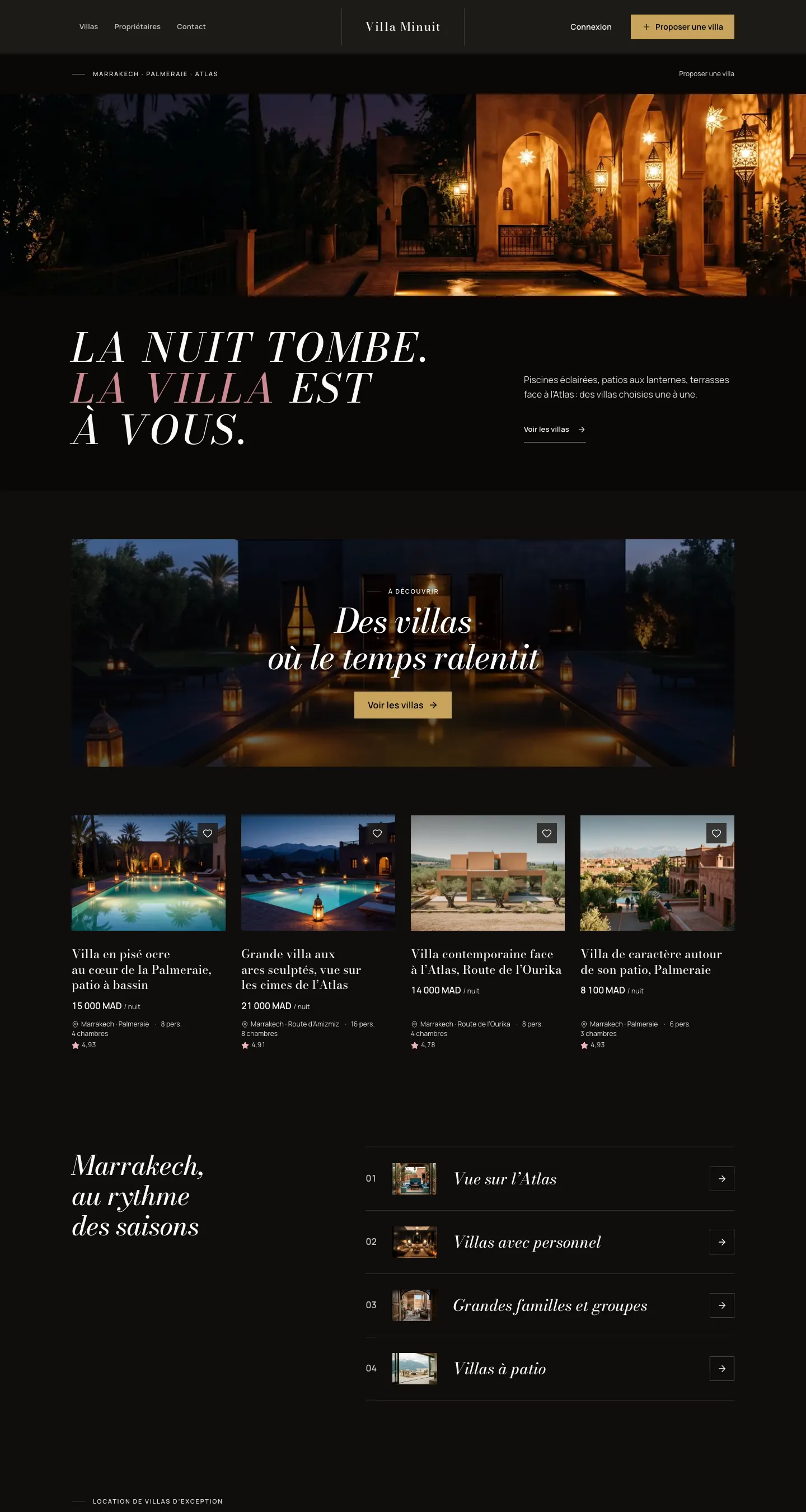
Villa Minuit (“midnight villa”) is one of the twenty examples in our gallery, created by the studio from a single sentence: “Exceptional villas to rent in Marrakech, chic black and gold”. It is a demo, not a customer’s site. It shows what a niche makes possible: a territory (the Palmeraie, villas with views of the Atlas), villas presented one by one with their capacity, their number of bedrooms and their nightly price in dirhams, sections that speak to its clientele (villas with staff, large families and groups, patio villas), and the amenities that decide a booking, from the patio pool to the house staff. On every listing, the total is calculated for the chosen dates and confirmed before any payment.
What such a platform costs depends on the route. Sharetribe’s guide to building a website like Airbnb, updated on 20 March 2026, says custom development of a rental marketplace “typically starts around $50,000 for an MVP”, with “6+ months to launch, even longer to refine and scale”. Software to configure costs less, but stays generic: at Sharetribe, going live takes the Live plan, at $199 a month billed yearly, read on 10 October 2026.
With Marketplace Factory, the complete platform is already there. The studio is free to try, with 2 ideas and 10 edits free when you sign up, no card needed. To open, here is what you pay per month, excluding VAT and Stripe fees:
| Stays paid online per month | €1,000 | €5,000 | €10,000 |
|---|---|---|---|
| Marketplace Factory Launch, €79 + 2% | €99 | €179 | €279 |
| Marketplace Factory Pro, €199 + 1.5% | €214 | €274 | €349 |
| Marketplace Factory Dedicated, from €990 + 1% | €1,000 | €1,040 | €1,090 |
Our share only applies to what your guests pay online, refunds deducted: nothing on requests, nothing on what is settled offline. Above about €24,000 a month, Pro costs less than Launch, with up to three domain names and your emails sent from your domain. During the beta, you try everything without paying a thing: payments run in test mode.
A stays platform at your scale is now one sentence, a few minutes and twenty well-chosen hosts. With Marketplace Factory, counted nights, seasons, cancellation, the registration number and payments on your Stripe are there from the start, hosted and maintained for you, without a line of code. Your talent goes to what brings guests back: the choice of places.
Airbnb is a trademark of its owner; Marketplace Factory is not affiliated with it.
Frequently asked questions
Which rules apply to a short-term rental platform?
It depends on where the homes are. In the EU, Regulation (EU) 2024/1028 has applied since 20 May 2026: where a registration scheme exists, the platform must let hosts enter their registration number, display it, check declarations at random and share activity data with the authorities. Cities add their own rules, such as London’s 90-night limit or New York’s host registration. Platforms also report hosts’ income under DAC7 in the EU and the UK.
How do I avoid double bookings?
Give each home its own calendar, and ask hosts to close a date as soon as it is taken elsewhere. Guests pick their dates on that calendar, see the total before paying, and hosts accept or decline requests with a reason. With Marketplace Factory, each home’s calendar and closed dates are managed in the host’s space.
Commission or service fee: which should I choose?
The commission, taken from what the host receives, is the simplest: guests see a clear total and hosts know what they will get. At Marketplace Factory, you set it from 0% to 50%, taken automatically on every stay paid online. Our share, 2% on Launch, is never added to the price your guests pay.
Is hosts’ income reported to the tax authorities?
In the EU and the UK, yes. Rental of immovable property is one of the activities covered by DAC7 and by the UK’s platform reporting rules, without the threshold of 30 sales and €2,000 reserved for sales of goods. The operator reports hosts’ income by 31 January of the following year and informs them. In the US, payment platforms file Form 1099-K above $20,000 and 200 transactions.
How much does a stays platform cost?
Sharetribe puts custom development of a rental marketplace at typically $50,000 and more for an MVP, with six months or more to launch. Software to configure starts at $199 a month billed yearly at Sharetribe Live. With Marketplace Factory: €79 excl. VAT a month on Launch, plus 2% of stays paid online, online payments included.
Sources12
The pages cited in this article, checked on the date given in the text.
- eur-lex.europa.eu/legal-content/EN/TXT/?uri=CELEX:32024R1028
- legislation.gov.uk/ukpga/2015/20/section/44
- mygov.scot/short-term-let-licences
- nyc.gov/site/specialenforcement/registration-law/registration.page
- eur-lex.europa.eu/legal-content/EN/TXT/?uri=CELEX:32021L0514
- gov.uk/guidance/reporting-rules-for-digital-platforms
- irs.gov/businesses/understanding-your-form-1099-k
- sharetribe.com/how-to-build-website-like-airbnb
- sharetribe.com/pricing
- stripe.com/ie/pricing
- stripe.com/ie/connect/pricing
- stripe.com/pricing
These articles are written by the Marketplace Factory team, who build the studio and the marketplaces it generates. How we write