Tools
Marketplace template: six finished sites, not a theme
Marketplace template: what it must cover, the design that sells, and why six finished sites in sixteen styles beat a theme you still have to configure.
Contents
Looking for a marketplace template means looking for a shortcut: a design that is already beautiful, which you would only have to fill. The shortcut is real for the pages; much less so for everything a marketplace does behind them, from seller accounts to split payments. Marketplace Factory offers something other than a theme: from one sentence, six finished marketplaces, each in its own style, with its four spaces and your trade’s flow, in about a minute.
This article compares the three ways to start from a model, says what a marketplace template must cover and what makes a page sell, then presents Marketplace Factory’s sixteen styles and its gallery of twenty examples.
Template, theme, finished proposal: the table
Three words, three different objects. Prices read on official pages on 10 October 2026.
| No-code template | WordPress theme and plugin | Marketplace Factory | |
|---|---|---|---|
| What you receive | an app model to complete inside the tool | a design, and multi-vendor features to install | six finished marketplaces, in your name |
| Example price | a free marketplace template on Bubble’s marketplace; up to $500 for others | from $149 a year for the Dokan plugin, theme extra | free to create; €79 excl. VAT a month + 2% of sales paid online to open |
| Hosting and updates | the tool’s subscription | yours to handle | included |
| Payments between sellers | to assemble | through a plugin | included from Launch |
| What is left to do | flows, emails, moderation | hosting, security, plugin compatibility | your content and your sellers |
On the no-code side, Bubble’s template marketplace offers for example a free marketplace template, with a landing page, sign-up as a buyer or a seller, a search page and a dashboard; other templates there are free or sold for $3 to $500 with an individual licence. On the WordPress side, the multi-vendor plugin Dokan offers a free core, then licences from $149 a year for one site, hosting not included.
A template saves time on the drawing. It saves none on the rest: that is the whole difference between a theme and a finished marketplace. To compare the software itself, prices and cuts included, see our comparison of Sharetribe alternatives.
What a marketplace template must cover
A template’s home page is judged at a glance; the rest needs a full demo. Before choosing, open one and check four things.
The four spaces
A template often shows the home page, the search and the listing page. A marketplace needs four spaces: the public site, the customer area (requests, favourites, messages), the seller area (listings, requests to handle, statistics) and the back office. At Marketplace Factory, every proposal arrives with all four, connected and ready to use.
The flow
A shop has a cart, a rental has dates, a coach has time slots, a craftsperson has quotes, a recruiter has applications. A generic template draws one flow; the others are added, screen by screen. Marketplace Factory composes the flow of your trade: nineteen trades in the catalogue, and trades of your own, built on ten families of flows.
The emails
Every step of a flow sends an email: request received, payment, reminder, refund, payout. With a template, they are often yours to write and wire up; Marketplace Factory delivers more than a hundred, already written and sent at the right moment.
The phone
Your visitors will also search from their phones: the search, the map, the listing pages and the profiles must work there effortlessly. The public site of every marketplace Marketplace Factory creates is built for computers and phones alike, whatever its style.
The design that sells
A beautiful site is not enough. A marketplace sells when visitors find quickly, understand what they are buying and trust someone they do not know. Four elements do that work.
Search up front
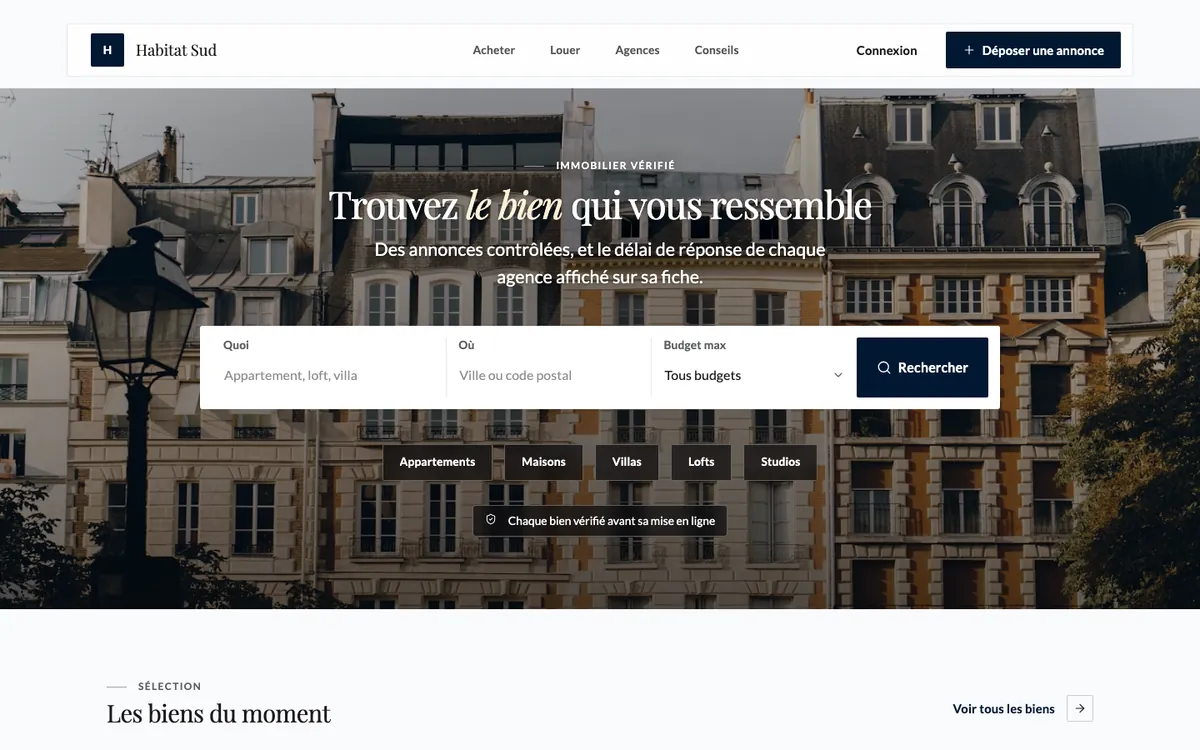
A visitor’s first move is to search. The home page must let them do it straight away, with your trade’s filters: dates for a rental, a neighbourhood for housing, a discipline for a coach. The home pages Marketplace Factory creates are composed for your trade, search first, then categories and featured listings; and the number of results updates live, with every filter.
Complete listing pages
The listing page decides the request: a photo gallery, the key facts, the description, the rules, and similar listings to bounce to. On the map, an approximate address protects the exact location.
Photos of your trade
Photos carry the design. A template arrives with demo images, to be replaced; Marketplace Factory creates photos of your trade for your site, and keeps them in your media library. Your sellers then add their own, listing by listing.
Trust
Booking or buying from a stranger takes proof: a public page for each seller, with their listings and reviews; verified reviews, which only a customer who bought or booked can leave; professionals’ identity declared and their company registration checked; a “Report” button on every page. All of that is included in every marketplace Marketplace Factory creates, whatever its style.
Five design mistakes that cost sales
They come up from one site to the next, and show within seconds in a demo:
- A home page with no visible search. Visitors have to guess where to click; they leave. The search bar, with the trade’s filters, goes at the top.
- Vague or too many categories. “Miscellaneous”, “Other”, twenty sections on one line: visitors do not know where to look. A few clear categories, each with a photo, work better.
- Listings without the right photos. A stock image, or no image at all, and the listing loses its request. Every listing must show what is being booked or bought.
- A style that changes from page to page. Buttons in three shapes, colours added along the way: the site looks home-made. A complete style keeps the same logic from one page to the next, from home page to listing.
- Invisible trust. No reviews, no seller page, no way to report a problem: visitors do not dare pay a stranger.
A well-chosen template avoids the first two; the other three depend on what is built behind the pages. In a marketplace Marketplace Factory creates, all five are handled from the start: search comes first, your trade’s categories arrive with their photos, the images are made for your trade, the style holds from page to page, and the proof of trust is included.
Sixteen styles in four families, and twenty examples
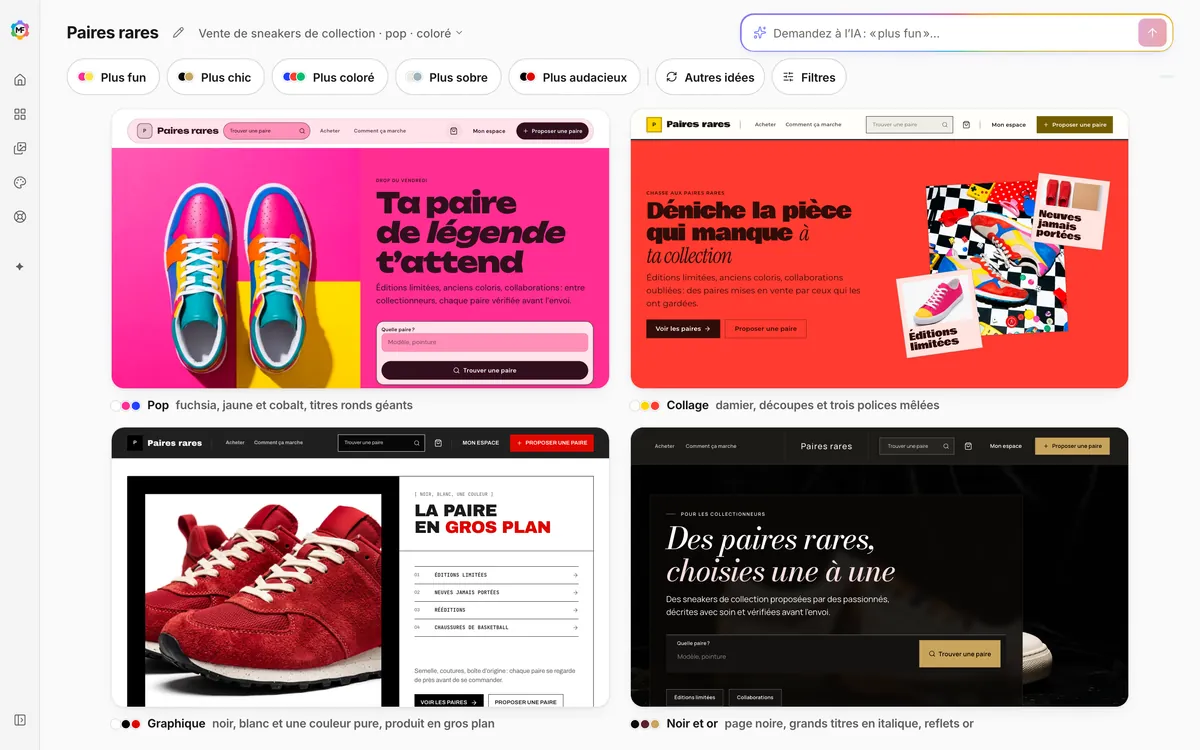
A template imposes one style, then comes in a few colours. Marketplace Factory starts from sixteen complete styles, each with its colours, fonts and layout, grouped in four families. For each sentence, six proposals draw their style from them, in contrasting directions.
| Family | Marketplace Factory styles | An example from the gallery |
|---|---|---|
| Chic | Black and gold, White couture, Art Deco, Baroque | Villa Minuit: exceptional villas in Marrakech, in black and gold |
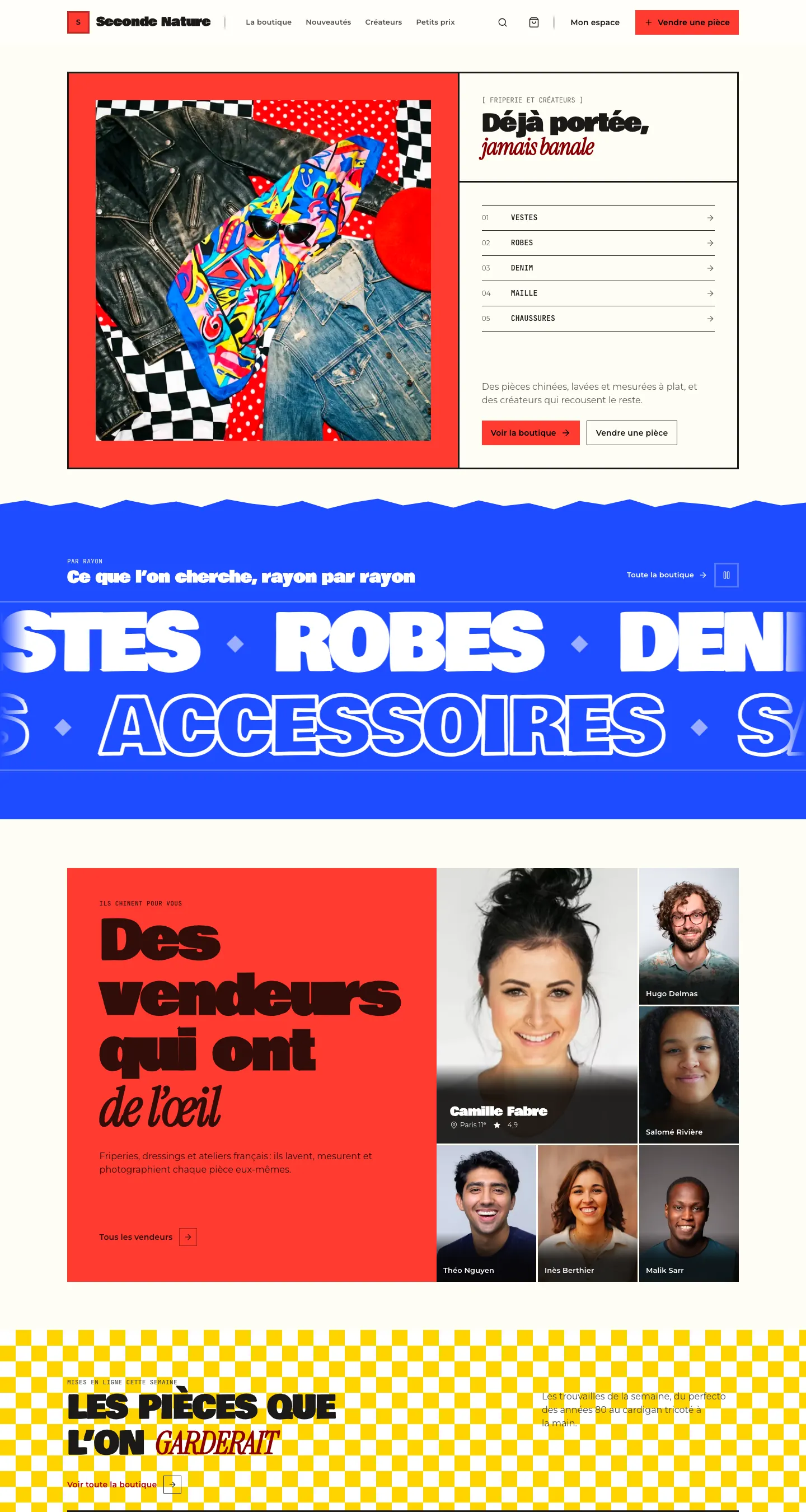
| Young | Pop, Chrome Y2K, Collage, Tropical | Semelle rare: collectible sneakers between enthusiasts, in pop |
| Graphic | black-and-white Graphic, Brutalist, Neon night, Urban poster | Noctambules: parties, concerts and clubs, in neon |
| Calm | Magazine, Nordic minimal, Natural earth, 70s retro | Tapis de lin: yoga classes in Lyon, in natural earth |
Which style for which trade?
There is no rule, only affinities, which the gallery illustrates:
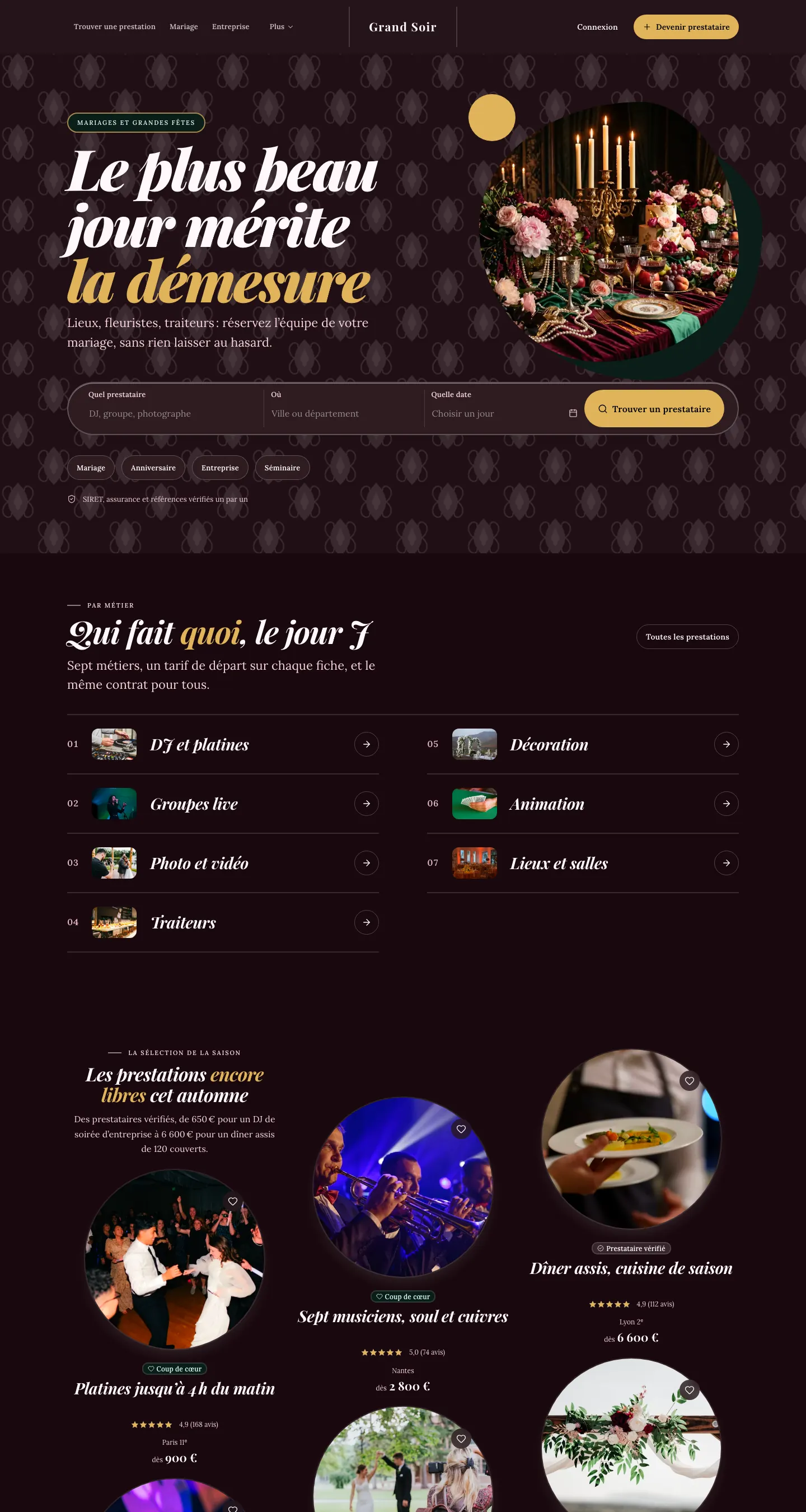
- Chic for what sells on trust and price: villas in black and gold, home treatments in white couture, sailboats on the Riviera in Art Deco, sumptuous weddings in baroque, collector cars in white couture.
- Young for an audience that scrolls fast: sneakers in pop, flatshares in chrome Y2K, a thrift shop in collage, cooks who come to your home in tropical.
- Graphic to stand out in a crowded market: make-up in black and white, mountain gear in brutalist, nights out in neon, motorbikes in urban poster, job offers in brutalist.
- Calm for what calls for serenity or time: yoga in natural earth, restored furniture in Nordic minimal, a concierge service and architect-designed houses in magazine, craftspeople on quote in natural earth, surfers’ vans in 70s retro.
These affinities are only a starting point: the same trade works very well in two opposite families, and that is precisely why Marketplace Factory shows you six.
The examples gallery shows twenty, each born from one sentence: Grand Soir for sumptuous weddings, in baroque; Poudre & Paillettes for make-up, in black and white; Van & Vagues for surfers’ vans, in 70s retro; Coup de Feu for restaurant and hotel jobs, in brutalist. They are examples created by Marketplace Factory, not customer sites: open one to see its board, then write your own sentence. The solutions by industry show, family by family, what each marketplace gets on top.
Changing style while keeping your content
A theme is chosen once; changing it often means redoing your pages one by one. At Marketplace Factory, the design changes without losing anything: another style, the same content. You can also ask for six other proposals, for 10 credits; edit a text, a colour or a section by asking the AI; or use the editor, for sections, the drag-and-drop outline, texts, colours and fonts. How the AI goes about it is explained in build a marketplace with AI.
Creating and comparing costs nothing: 2 ideas and 10 edits are free when you sign up. To open, Launch costs €79 excl. VAT a month plus 2% of sales paid online, online payments included; Pro, at €199 excl. VAT plus 1.5%, adds up to three domain names of your own. During the beta, you try everything without paying a thing: payments run in test mode.
Before choosing, whatever the solution, go back to our checklist for a turnkey marketplace: ten points that tell you whether a model really opens without a developer. And to place templates among the other no-code routes, see no-code marketplace builders.
With Marketplace Factory, you no longer fill a theme: you choose among six finished marketplaces, in the style that feels like you, and move straight on to what matters, your sellers and your customers.
Frequently asked questions
Are there free marketplace templates?
Yes: Bubble’s template marketplace offers, for example, a free marketplace template, and Dokan a free core for WordPress. The template is free; hosting, plugins and the time to assemble everything are not. At Marketplace Factory, creating and comparing six finished marketplaces costs nothing: 2 ideas and 10 edits are free when you sign up, no card needed.
Is a WordPress theme enough for a marketplace?
A theme gives you the design. You still need a multi-vendor plugin (Dokan starts at $149 a year for one site, price read on 10 October 2026), hosting, updates and security. It makes sense if you already run a WordPress site and have someone to look after it. If you want a complete marketplace, hosted and maintained, without a line of code, that is Marketplace Factory’s job.
Can I change the design later?
Yes. At Marketplace Factory, you switch styles without losing anything: another design, the same content. You can also ask for six other proposals for 10 credits, edit a text, a colour or a section in one sentence to the AI, or use the editor: sections, a drag-and-drop outline, texts, colours, fonts.
Is the design ready for phones?
Yes. The public site of every marketplace Marketplace Factory creates, with its search, map, listing pages and profiles, is built for computers and phones alike, whatever the style chosen. The simplest way is to check for yourself: open an example from the gallery on your phone.
Sources3
The pages cited in this article, checked on the date given in the text.
These articles are written by the Marketplace Factory team, who build the studio and the marketplaces it generates. How we write